3 months ago
110
3 months ago
110
Good afternoon to everyone, apart from the organisers of Afcon.
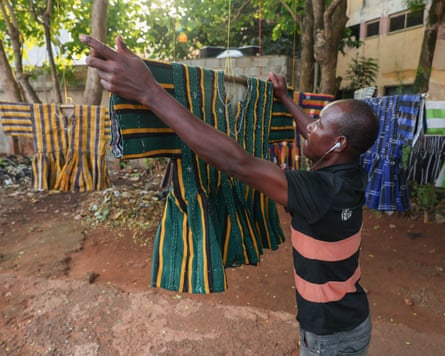
Several weeks ago, the Ghanaian president, John Dramani Mahama, wore the traditional fugu, a patterned smock, on a state visit to Zambia. He came in for mockery from Zambians (some of it lighthearted) on social media, with some calling it a “blouse”.
The result was that the Ghanaian government mandated every Wednesday as “Fugu Day”. Many in Ghana heeded the call. It prompted weeks of conversation among The Long Wave team, who have origins in Nigeria, Ghana, Sudan, and Trinidad and Tobago, about the politics of wearing traditional clothes. A thread was pulled, as it were. Why is wearing our traditional clothing sometimes so fraught?
Where traditional dress matters
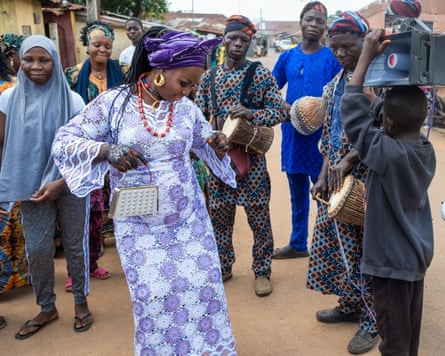
I cannot claim to have embarked on the level of travel that can enable me to draw a pan-African conclusion, but from the exposures I have had on the continent, it is noticeable how dramatically the wearing of traditional dress varies. In Sudan, the male galabeya and female thobe are worn by everyone, depending on the context. Both are staples - on weekends, at events and on casual errands. Nigerians in Nigeria wear their traditional clothes just as regularly, Long Wave editor Dipo, who enjoys wearing a kaftan when in Lagos, tells me. In Morocco, I saw kaftans everywhere, worn by men and women.
But in Nairobi, I was struck by how traditional clothing is rarely seen outside ceremonial events. The same goes for Johannesburg and Cape Town. Generic basic western dress is so the norm that if you closed your eyes, you could be anywhere. Some of that is probably down to the fact that in some countries, such as Kenya, there are so many tribes with their own micro-dress climates that nothing totemic of the entire nation has emerged. But perhaps empire also plays a role, with nations that endured longer periods of settler-colonialism more likely to have had traditional dress effaced from the public sphere and bureaucracy. In 2023, Kenya’s parliament decreed that the Kaunda suit, named after the late Zambian president Kenneth Kaunda, as well as other African attire, was not welcome in parliament. The speaker stated that the proper dress code was “a coat, a collar, a tie, long-sleeved shirt, long trousers, socks, shoes, or service uniform” for men, and below-knee skirts and dresses for women, with no sleeveless blouses. Contrast this to Nigeria’s politics, which is rich in traditional fashion. Both countries became independent within only three years of each other, but only one was a settler colony.
But there is another factor that is less political. There is a distinction, as far as I can see, between rural and urban areas in terms of the uptake of traditional dress (Egypt is a strong example of this) – with smaller towns and villages more likely to default to sartorial custom. Western dress has become associated with cosmopolitanism and even class.
Diaspora dress code switching
I think that the bundling up of clothing with notions of modernity can be traced in the mockery of Mahama’s “blouse”. The sense that what is traditional is primitive, even a bit silly. This is also potentially a factor in how traditional dress is worn by those in the diaspora. Of course, all dress is contextual; we are social beings who conform to convention. I’m not going to wear a kaftan to the office in London. It’s too cold most of the time for a start. But also, there are norms when I am in African countries that fall away in the west, and which wouldn’t massively stick out. Turbans and head scarves, big prints, maxidresses that are practical, crucially made of materials that don’t need ironing, and could easily be incorporated into western wardrobes. The same goes for wearing collarless jackets and dashikis for men (which I think are the most elegant choice a man could ever make; Michael B Jordan got the memo at the Oscars). Why are we mostly in much more muted and miserable colour palettes, and even in synthetic clothes, far inferior to the cottons and linens that most traditional clothes are made of?
The slightly uncomfortable truth is that sometimes you don’t want to be that guy. A person who is trying to make a point through their clothing that they are exotic and different. At home, traditional dress is a comfortable staple; out of context it can feel performative – it can become political or statement-like by default.
Authenticity snobbery
There is an observable variation in attitudes to traditional dress based on where one sits in the diaspora. We occupy, broadly, three categories: Those who live in Africa, those who were born and bred in Africa but now live abroad, and those born abroad. Since we’re in the territory of the uncomfortable, in our Long Wave conversations, someone said something that sent a chill of self-recognition down my spine. There is sometimes a perception that outside Africa, traditional dress is either for older generations who grew up back home, or for the younger who are severed from their backgrounds, and so make more of an effort to sharpen their identities through dress that sets them apart. For those who grew up in their home countries and then became part of the diaspora, this prejudice adds another layer of self-consciousness. Not wearing signifiers of origin is a way to say (mostly to yourself?) that you are, in fact, so comfortable in your identity that you don’t need to wear mementoes out of context.
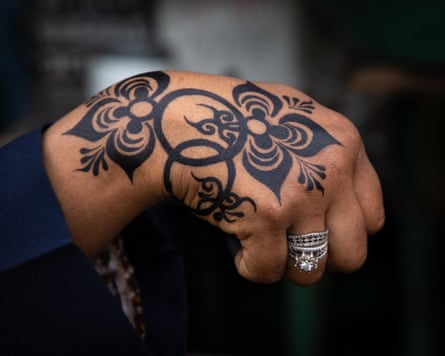
This extends to all sorts of things. I have noticed this, for example, in the fact that younger Sudanese women born in the diaspora sometimes casually get a temporary henna tattoo. I saw a henna lady at a Sudanese-themed restaurant event recently in Nairobi and immediately turned into a grandmother, scandalised at the thought of henna being drawn anywhere outside wedding or event prep. Couldn’t be me! Mortifying.
Relaxing into multiple identities

Clearly, there is a lot at play here, from national political histories and practices to the way that, all over the diaspora, people – and not just Africans – navigate multiple identities. But it probably shouldn’t be that deep. Traditional dress, in addition to being a stylistic treasure trove in the age of sad, neutral “quiet luxury”, is a birthright. Relinquishing it for no good reason seems like a colossal waste.
Perhaps a way to cut through the self-consciousness is to take a leaf out of Mahama’s book and unofficially mandate a personal weekly traditional dress day, in all modifications and variations and innovations, wherever we are.