2 months ago
91
2 months ago
91
Key events Show key events only Please turn on JavaScript to use this feature
Donovan Carrillo is indeed skating to Elvis music, but the arrangement emphasizes the piano over Presley’s voice through most of it. Toward the end, the big voice boomed through the arena, followed by the upbeat A Little Less Conversation that featured in some legendary soccer ads with Eric Cantona many years ago.
He runs into some issues. His first two quads get negative grades of execution. A triple axel is deemed underrotated, as is the second triple in a triple-triple combo. A complex triple-double axel-double axel is solid, but he pops out of a triple lutz and only lands a single.
Still, it’s a season best 143.50 for a total of 219.06, and he kisses the ice after he’s done.
As I feared, that was a cover version of Eleanor Rigby. No McCartney tonight.
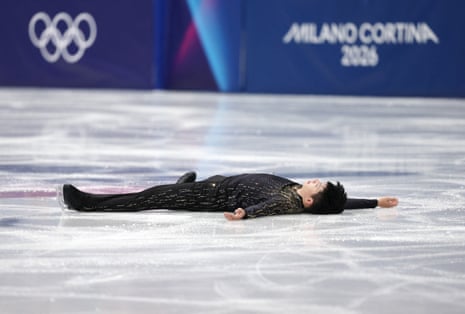
It’s a clean program for Li Yu-Hsiang, but the jumps certainly aren’t at the level of the other skaters’ routines. The most dazzling part of his routine is a closing spin in which he changes position several times and seems to hang on forever. He finishes with a smile, then lies down on the ice as if making a snow angel.
But it’s nearly five points off his season best – 141.92, for a total of 214.33. Malinin will be hoping to score somewhere in that vicinity in his free skate alone.
Li is due to start at 19:08 local time, which … would be now.
Malinin is due to start at 22:48.
Get comfortable.
Li’s on the ice now …
Group 1 start list
The 24 skaters in this competition will go in groups of six and in reverse order from where they were ranked after the short program.
So who will you see, what will they attempt, and what will you hear musically? (Please, no more from the Interstellar soundtrack. I’m trying to be in a happy place today.)
The first group, ranked 24th through 19th after the short program …
Li Yu-Hsiang (Chinese Taipei): Already improved from 30th in last year’s world championships, he’s only attempting one quad and a couple of combinations. Music is Eleanor Rigby – the start list says it’ll be from The Beatles, but we so often hear such music reimagined for these competitions because we can’t have nice things.
Donovan Carrillo (Mexico): His best finish in the world championships is 15th in 2024. He’ll come out swinging with two quads, a combo starting with a triple axel and another triple axel. Two more combos in the back half: triple-triple and triple flip-double axel-double axel. Music is given as “Elvis Presley selection.” That narrows it down.
Kao Miura (Japan): The winner of last month’s Four Continents Championship will be disappointed to be in this position today, but he plans to rally by starting with a quad loop, quad salchow, and a quad-triple combo. He’ll add have two triple axels, one leading into a combo. Music is Les Parapluies de Cherbourg. That’s probably not a Ramones track.
Vladimir Samoilov (Poland): After going 10th in the team event short program, he’ll do his first Olympic free skate with a quad lutz, quad-triple and a triple axel. He’s got two triple-triples. The music is something called Lay My Body Down, Really Slow Motion Human. That surely can’t be translated correctly.
Adam Hagara (Slovakia): One quad, two triple axels (one leading into a triple-double combo), a triple-triple, and a triple-double axel-double axel. Music is called “James Bond 007.” Sounds like fun.
Lukas Britschgi (Switzerland): The 2025 European champion will open with a quad-triple, then a quad, then a triple axel-double axel-double axel. A triple-triple comes up later. Music is “Journey Through the Orient.”
Risk and reward
Malinin can surely win with a solid program that doesn’t include the quadruple axel.
If you were Malinin, would you attempt it?
Me, no – I can’t even skate backwards. But it’s not just a function of physical ability here. It’s a question of what you can handle mentally or emotionally, and it’s a question of what you want to accomplish.
If we’re all guessing, we’d have to say Malinin will go for it because he doesn’t just want gold. He wants to make history. He wants to skate over to the kiss and cry this evening knowing that he has just done things no one has seen in the Olympics.
Years of training that come down a moment. But would he want to walk away wondering “What if?”
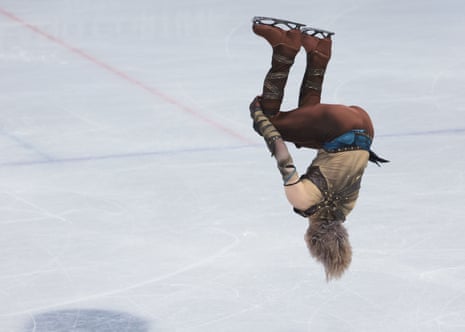
And he might even throw a backflip for good measure – legal but not something isn’t even graded as a technical element.
So you want to be a heavily favored Olympian ...
I have to start today by confessing two biases …
First, Ilia Malinin isn’t just from my home country (USA). Not just my home region (metro area: Washington, DC). He’s from my hometown (Vienna, Va.). You could run a 5k road race from my home to his high school. I know people who’ve taught him. I know people who’ve skated with him. I could easily bump into him on a fast-food run this summer if his dietary choices are as bad as mine.
Second, I’ve long thought that one of the saddest things that can happen in the Olympics is to see someone who has dominated for three years somehow lose it on the sport’s biggest stage – and in the case of far too many people, the only stage on which they’re seen at all.
The risk of such a loss in worse in some sports than in others. When Usain Bolt was at the starting line for a race, he knew that he was simply faster than everyone else there, and nothing could stop him getting gold aside from a catastrophic problem getting out of the starting blocks. Michael Phelps and Katie Ledecky were never going to leave the Olympics empty-handed, in part because they had several individual races to attempt.
And in a lot of sports, athletes can afford one or two errors. Rachel Homan’s Canadian curling team had an uncharacteristic bushel of inaccurate shots in a loss to the USA today, but that’s just one game in the round robin. The Soviet Union hockey team didn’t lose to the USA in 1980 because of one play; the USA had to generate offense through about three-fourths of the game and then hold on as the Soviets fired away at Jim Craig’s goal. (And the USA still almost handed back the advantage, trailing in their last game before rallying.)
Also, the outcome may sometimes be out of the athletes’ hands. No one will ever offer an air-tight defense of the decision to give Laurence Fournier Beaudry and Guillaume Cizeron the ice dancing gold medal, and all Madison Chock and Evan Bates can do is walk away knowing that they skated as well as they could possibly skate. (Yes, in case you don’t follow US media and have been wondering – people in this country are not very happy about that decision.)
But sometimes, injuries can strike at the wrong time, as they did to Lindsey Vonn multiple times. Or a skate edge can lose the millimeter of grip it has on the ice. Or a turn of the skis can be an inch away from where it needs to be. In the worst case, consider Mikaela Shiffrin, who overcompensated for her DNFs in Beijing by going out too slowly in the team event here, and all but the most hard-hearted people will be holding their breaths when the GOAT next races.
Malinin has done incomprehensible things in the sport. He’s the only person to land a quadruple axel in competition, and he’s done it more than a dozen times. But does he have that elusive mix of confidence and calmness to do it when the whole world is watching?
The conventional wisdom before the Olympics was that he could afford a couple of bobbles and still win because the jumps that he attempts are on a different plane from most skaters. But he was beaten in the team event short program, and his margin in the team event long program and the individual event’s short program has been considerably closer than most people figured. He’ll be under immense pressure today from Japan’s Yuma Kagiyama.
So join us as we watch 24 outstanding skaters trying to show their best when we’re all watching. And for the last of them, Malinin, hold your breath with everyone else.
Beau will be here shortly. In the meantime, here’s how the team event went:
The United States held off a late charge from Japan to retain the Olympic team figure skating title on Sunday, with Ilia Malinin delivering in the men’s free skate to secure gold after three days of competition. Japan finished with silver, while host nation Italy claimed bronze.
The United States survived a final-day surge from Japan to retain the Olympic team figure skating title on Sunday night, with Ilia Malinin delivering under intense pressure in the men’s free skate to secure gold at the Milano Cortina Games. Japan finished one point behind in silver, while host nation Italy claimed bronze after three days of tightly contested competition.
The final standings – 69 points for the United States, 68 for Japan and 60 for Italy – reflected just how narrow the margin was in one of the most dramatic Olympic team events since the format was introduced in 2014. What had begun as a comfortable American lead after two days turned into a head-to-head showdown in the final session, ultimately decided by the sport’s most technically ambitious skater.
American hopes had rested heavily on Malinin, the 21-year-old two-time world champion who has gone more than two years without losing a competition. But he entered the decisive free skate carrying unusual pressure after a below-par short program on Saturday left the defending champions vulnerable. When Japan erased the remaining US cushion earlier Sunday, the outcome effectively came down to Malinin versus Japan’s Shun Sato in the final discipline.
You can read the full report below: