3 months ago
144
3 months ago
144
MJ calls what happened to her in Zion national park “small ‘T’ trauma”. She knows women have experienced worse from their partners. But she still feels the anger of being left behind on a hike by her now ex. “It brings up stuff in my body that maybe I have not cleared out yet,” she said.
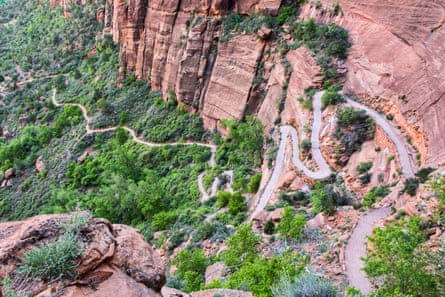
Five years ago, MJ and a new partner – he was not exactly her boyfriend, and the pair were not exclusive – traveled from Los Angeles to Utah for an adventure getaway. MJ, who is 38 and works in PR, was looking forward to exploring Zion’s striking scenery; its vast sandstone canyon and pristine wading trails were on the list. But on the morning of their big hike, MJ was not feeling well. She could not shake the feeling that something was “off”; indeed, MJ would learn on this trip that her partner was seeing other women.
As they made their way up Angel’s Landing, MJ’s partner started walking faster than her. “I could tell it was getting on his nerves that I was slow,” she said. “I was like, ‘Fuck it, just go ahead of me.’” He did without hesitation.
When she caught up at the top of the mountain, they took a picture together. Then her partner hiked down the mountain with a woman he had met on the way up, leaving MJ to finish by herself. They broke up shortly after that trip. (MJ asked to be referred to by her initials for the sake of speaking openly about a past relationship.)
Last month, MJ opened TikTok and heard the phrase “alpine divorce”, a label she now attaches to her experience in Zion.
On social media, women describe alpine divorce as going on a hike, climb or other outdoor adventure with a male partner, only to be abandoned or left behind – perhaps he went too fast and neglected to wait, or a fight on the trail resulted in him storming off. Breakups have quickly followed.
In a TikTok with more than 4.2m likes, a woman bawls as she takes shaky steps down a rock formation. “He left me by myself, I should have never come with him,” sobs the woman, who did not respond to a request for comment. Others flooded the comments section with stories about being served with an alpine divorce. One woman described a 12-hour journey out of the Grand Canyon after her boyfriend ditched her, during which she was assisted by a “very nice man from Norway” who carried her backpack. Another described getting lost in the woods after a man left her behind, and immediately blocking his number once she got home.
Many of the women described having some level of dependence on their partner in nature. They may not have been carrying the right supplies or enough water, or were not familiar with the terrain, making them feel vulnerable.
“It’s such a common thing,” said Julie Ellison, the first female editor-in-chief of Climbing magazine who now works as an outdoor lifestyle photographer. She has heard “so many stories” about men fumbling outdoor dates. “There’s that male ego element to it that’s not necessarily evil or ill-intentioned, but it usually has a negative effect on the partner who’s being left behind.”
A recent case study illustrates this point: last month, an amateur Austrian mountaineer was found guilty of gross negligence manslaughter for leaving his exhausted girlfriend behind on his country’s highest peak while he went in search of help. The man, a Salzburg chef identified only as Thomas P, said he was “endlessly sorry” for her death, and his lawyer called it a “tragic accident”. But Thomas P could not explain why he failed to wrap his freezing girlfriend in her emergency blanket before heading down the mountain without her. Earlier in their trek he had also told a police officer over the phone that they did not need any help, even though a rescue helicopter was made available to them.
A former girlfriend testified that Thomas P had left her behind on a trail during a hike in 2023 – “so that was the last mountain expedition we undertook together”, she said.
Outdoor culture romanticizes pushing your limits and flexing endurance. Folk heroes have been made out of rugged men such as Timothy Treadwell, the environmentalist who was mauled by the grizzly bears he lived alongside, or Christopher McCandless, who eschewed society to live alone in the wild and later died of starvation. “There’s this emphasis on strength, independence and stoicism that is really embedded in the way males are taught to prioritize character traits,” said Doriel Jacov, a New York-based therapist who specializes in relationship patterns. “Masculinity seems to play a role in how alpine divorce manifests in real life.”
A man walking 100ft ahead of his girlfriend because he cannot be bothered to wait for her is bad manners. But failing to properly care for someone in an environment they’re not prepared to handle alone can cause real harm. “I can’t see how leaving someone in a highly unsafe position wouldn’t qualify as an abusive dynamic, especially if [the man] is aware to some degree that that’s what they’re doing,” said Jacov.
Naomi, 46, an educator and member of the Wine Hiking Society, a community organization for women that promotes outdoor exploration and socialization, was not surprised when she saw discussion of alpine divorce on TikTok. “It feels like another version of a #MeToo story to me,” she said. “My response is like, well of course [this happens].”
About 20 years ago, Naomi hit Deseret Peak, an 11,036ft (3.4km) mountain close to her home in Salt Lake City, with two friends: another woman and a man who she had a “close” but not romantic relationship with. On the way up, Naomi started to feel disoriented, possibly from altitude sickness. But the man, who was chasing a goal of hiking the highest peak in every county in Utah, did not want to stop. (Naomi requested to use only her first name for the sake of privacy.)
The man and woman left Naomi on the way up. She knew that they would not come back for her because the trail was a loop, and she feared she would pass out. “I felt like I had to crawl on my hands and knees, and finally I made it to the top.”
Naomi eventually stopped hiking with the man. “I realized at some point that every bad thing that would happen to me outside, he was the common denominator,” she said. “I would find myself in sketchy situations that were way outside my comfort zone, which is often a theme in these stories of either being left behind or pushing yourself beyond your limit.”
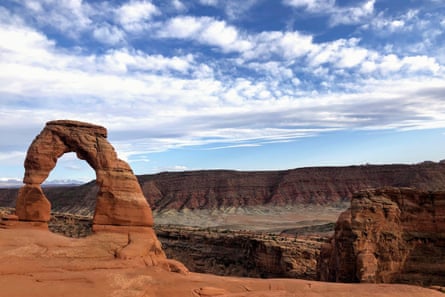
A few years ago, Naomi was hiking Arches national park in Utah when her group noticed a woman lying on the ground in distress.
The woman told them she suffered from severe vertigo – not ideal given the park’s topography – and her date had gone to retrieve his camera after she accidentally dropped it into the bowl near Delicate Arch. “There was no way she was going to get out by herself, and we hiked with her back down to the trailhead,” Naomi said. On the way, they learned that she was on a “second or third date” with the man. “We were asking her, like, ‘So … this might be the last date, huh?’”
TikTokers talking about alpine divorce might not know that the phrase comes from an 1893 short story by the Scottish Canadian writer Robert Barr about an unhappily married couple who spends a weekend away in the Alps. The husband had planned to push his wife off the summit during a hike, but in an O Henry-esque twist, the wife tells him she has framed him for murder before jumping off the ledge herself, right before the police she called show up.
That said, many alpine divorces do not happen because a man has ill intentions. Maybe, like the Austrian hiker claimed, he thought he was doing the right thing. Maybe he was impatient, or had a woefully uncritical view of the Hemingway-esque macho man archetype that he wanted to embody in nature. Or maybe he had a radically different goal for the hike than his partner, and they failed to touch base beforehand.
David Webb, editor-in-chief of Canada’s Explore magazine, would never leave anyone behind in the wilderness. “If you invite someone on a hike, you’re basically acting as their de facto guide,” he said. “Would a guide just storm off on their clients? Of course not. The guide moves at the pace of the slowest member, always.”
But Webb does remember a hike he took years ago with his wife. It wasn’t that great of a trail, and it became, in his words, “a trudge”. Webb forged on. He figured that since the hike was so bad, they might as well get to the viewpoint to make it worthwhile. “She was not loving it,” he said. “I did come to a realization that our expectations were totally different for the day. My goal was to go on a mission, and she just wanted to spend the day outside, getting fresh air and exercise, and wouldn’t have cared if we turned around. I was a little bit guilty of dragging her on a mission that I had not really communicated about.”
Avid backpacker, climber, surfer and skier Daniel Duane, 59, is a writer and marriage and family therapist in San Francisco. He and his wife, the writer Elizabeth Weil, hike together near their home. These days, Weil is faster than Duane – but he is more comfortable on “technical” terrain, such as very steep areas, due to his background in climbing.
“It’s just so awesome to share an outdoor adventure with good company, and yet, we often have these personal hungers and ambitions when we go into the mountains,” Duane said. “Sometimes that more selfish part of ourselves takes over.”
He believes most people realize this as an issue in hindsight. “I don’t think it’s very common to hear, ‘I blew off my romantic partner in the mountains so that I could run all the way up this peak, it devastated them and wrecked our relationship, but I’m so glad I did because I got to the top faster,’” Duane said. “I think it’s good to keep in mind that with the benefit of hindsight, the narrative is almost exclusively, ‘God, I was a jerk and I really wish I hadn’t done that.’”
Some women in the outdoors industry bridle at the gender stereotypes wrapped up in alpine divorce: chiefly, the assumption that a woman cannot take care of herself or has less experience outside than her male partner. “Believe it or not, we can do things that have nothing to do with men,” said Ellison, the Climbing editor. “I really struggle with saying ‘men do this,’ and ‘women do that,’ and those generalizations.”
Blair Braverman is a writer, adventurer and dogsled musher who has competed in the Iditarod and Kobuk 440. (She took 36th place in the 2019 Iditarod, becoming the first Jewish woman to finish the storied, 1,000-mile (1609km) race.) “Personally, if I were with a man and he wandered away from me on a mountain, I’d be more worried for him than me,” she said. “I think it’s interesting that [the term] assumes that the woman is the one with less capability.”
If there is a feminist spin on alpine divorce, it’s what comes after the women are left behind. When her ex ditched her in Zion, MJ hiked alongside a friendly female stranger and her young son. Naomi helped the woman with vertigo in Arches. “It happened to me many years ago,” one user wrote in the comment section of the viral TikTok clip. “I met 2 girls on the mountain and told them what happened, and we walked down together. They wouldn’t let me go alone.”
MJ did not hike for a year after her alpine divorce. She figured her inability to keep up with her ex meant that she wasn’t fit enough for the type of activities she grew up loving: “When I got home I was like, something is wrong with me that I wasn’t able to keep up with him.” It took two of what she calls her “Eat Pray Love trips” to the wilderness of Montana, alone, to find that spark again.
“The reason why I love hiking is because it doesn’t matter if you’re fast or not,” she said. “It doesn’t matter how long it takes. Hiking is something you don’t have to be good or bad at. It’s just there.”
MJ is in a loving, committed relationship with someone in North Carolina, where she lives. He’s not that outdoorsy. Sometimes he jokes: “Aren’t you glad I don’t like hiking?” After her Zion trip, MJ is content to have a personal relationship with the outdoors unencumbered by a man.