3 months ago
127
3 months ago
127
On the pavement outside the Netflix office, I stand in the rain, confused. Was that interview a little off? Louis Theroux seemed not to like my questions, which were typical interview questions, related to him and his big glossy Netflix debut, Inside the Manosphere. He seemed, I don’t know, prickly? A bit testy? I’m prone to rumination, so perhaps I am overthinking. Because Louis Theroux is a good guy, right? He skewers the bad guys. And yet here I am, baffled. The only thing to do is sit in a cafe and replay the tape.
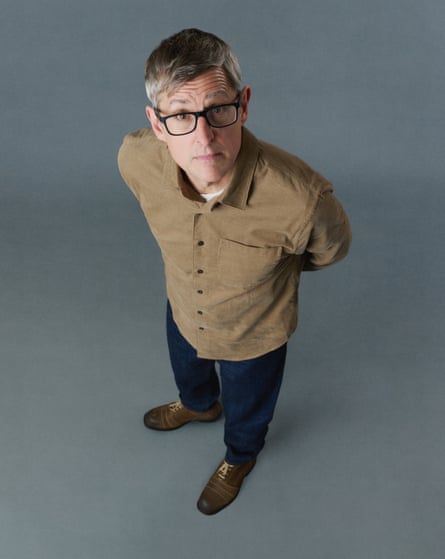
Theroux is solicitous, lightly ironic in tone. “Louis,” he says. “How do you do?” I am fine. Looking forward to our chat, as you may imagine. Theroux, 55, might be north London dad in appearance – specs, grey T-shirt, black jeans, sneakers – but he’s the grandmaster of both the immersive documentary and interview form. The son of American writer Paul Theroux (a nepo baby before they existed), he has built a 30‑year career in television, much of it at the BBC, making a virtue of being a socially awkward verbivore, hyper‑curious, super-funny.
His 90s stuff saw him embedded in American subcultures – Nazis, gun nuts, porn stars, apocalyptic cults – just to see what happened. It was TV of its era in that it was gonzo, shock-driven, perhaps a little ethically unsound in tone and the way that it poked fun at and portrayed its subjects. Later, came prisoners, opioid addicts and the Church of Scientology. Then there were the interviews. The most famous was with Jimmy Savile before the crimes of the children’s presenter became public, to whom he posed the tentative question, “People say that you are a paedophile?” (He replied, “Nobody knows whether I am or not.”)
More recently, Theroux joined the podcast universe with a show billed as “in-depth and freewheeling”. Then he became a viral sensation when Jiggle Jiggle, a rap he composed in 2000, resurfaced. Perhaps because there’s nothing gen Z likes more than nostalgia plus a curiosity plus a dance routine, clips on TikTok and YouTube were streamed hundreds of millions of times. Shakira performed it, as did Snoop Dogg and Megan Thee Stallion. Now the kids knew who he was (to the despair of his own – “Why is my dad, the most cringe guy in the universe, everywhere on TikTok?”). A-listers such as Barry Keoghan, Paul Mescal, Florence Pugh and Justin Theroux, his cousin, appeared on the show.
While Theroux is accustomed to praise – including for his recent BBC documentary on the violence of ultra‑Zionist settlers in the West Bank – his podcast interview with musician Bobby Vylan in October was so controversial that British Airways paused sponsorship of his show.
He asked Vylan (real name Pascal Robinson-Foster) what he’d meant by his “Death to the IDF” chant at Glastonbury last summer. Vylan said he wanted to end the IDF as an institution, but “end to the IDF” didn’t scan. Theroux said he didn’t agree with “death to” chants full-stop. But there were those, including Dave Rich, author of Everyday Hate, who were angry that Theroux didn’t press Vylan on earlier calls for “death to every single IDF soldier”. This, Rich argued, made the interview sound like a “soft-soaping” in contrast to his usual needling style; many listeners also balked at Theroux’s use of the phrase “post Holocaust Jewish exceptionalism” when discussing Israel and the war in Gaza. Theroux stood by the interview. While it was “painful” to lose a sponsor, he said last month, his is a “unique place in the British broadcasting landscape. I’m willing to have difficult conversations and long may it continue … I’m very proud of how we handled the interview and how we did it.”
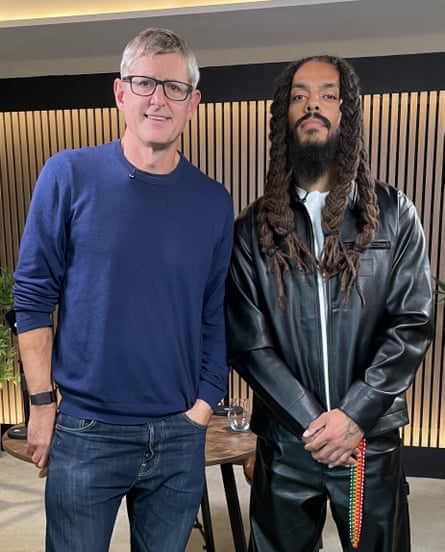
Now Theroux has a contract with global streamer Netflix, and this is where we are, in a windowless brown room on the fifth floor of their London headquarters. He pantomimes a juggle asking where I want him to sit and asks how long I want him. He can’t last much more than an hour before “the truth comes out. I have to watch myself.” The truth is good, I say, the truth is what we want. He shrinks from my recording devices as if they are two black scorpions. “That’s not off-putting at all to have two screens pointing at me. One of them showing literally what I’m saying as it comes out of my mouth.” He begins reading the transcription aloud in a sort of repetitive meta-loop that could go on for ever if I don’t interrupt him. “Louis was stalling,” he tells the tape.
We’re here to discuss Inside the Manosphere’s content creators, promoters of extreme misogynistic ultra-masculinity. The documentary is timely, coming after Adolescence (not an influence, he says) and the Epstein files. He calls it “the final boss subject in the video game of my career”, because it draws on themes he’s explored before – the adult film industry and cam girls, which is “adjacent to the OnlyFans” stuff here, plus the far right. Also, conspiracy theories.
And Savile, of course. “I’ll get in trouble for saying this, but there’s so much Savile overlap. Savile would always say” – he slips into Savile’s nasal delivery – “‘I can’t live with women. They’re brain-damaged. It doesn’t mean I don’t like them, but I can’t be around them too long.’ That’s kind of a manosphere concept,” he says, adding more, “‘I love women, but they’re not like men. They’re different, and they need men to show them what to do.’” He says Savile said off-camera that a psychologist had told him there was something in all women that wants to be a prostitute. “Another manospherism, right?”
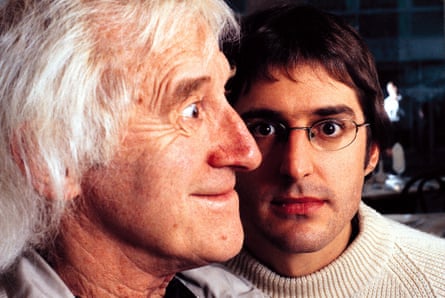
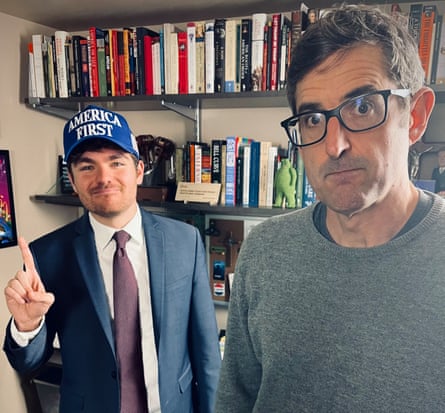
Theroux’s first encounter with the manosphere was via his three sons, now 20, 18 and 11. “Like everyone else, I realised they were on the phone consuming some of this content.” Nick Fuentes, the rightwing America First live-streamer, about whom Theroux made a film four years ago, has just got “bigger and bigger”, he says. “He’s now saying he likes Epstein. That’s his latest bit of diablerie.” He spells D, I, A, B, L, E, R, I, E into the tape recorder and I remember that years ago he entered a spelling bee in the US and did well.
Role models when he was young included John Noakes, Peter Purves, Peter Duncan, whereas kids now have characters such as HSTikkyTokky, Sneako, Clavicular – he of “looksmaxxing”, the trend, which originated in “incel” culture, for young men to boost their appearance. “On Blue Peter, they were teaching us to make a house out of sticky-back plastic. ‘Send in your old keys or stamps to raise money for Africa!’ Kids today are looking at streamers going, ‘Bro, look at that gyatt.’” He smirks like a schoolboy after using this slang for an impressive butt, and says, “Too much?”
I mention Jordan Peterson and he stops me. He wants me to understand that the term manosphere, like a lot of terms that have captured the zeitgeist, is inexact. “I’m going to sound super-pretentious, but it reminds me of studying history. People talk about the English civil war and puritans and you’re, like, who was a puritan? They always said, ‘Puritanism is in the eye of the beholder’”– as in, subjective and used sometimes in a derogatory way – “Manosphere, to some extent, is also in the eye of the beholder.” He says that at one end are men like, say, Peterson, who promote old-fashioned or traditional views, “saying, like, ‘Oh, men and women are different and, actually, why can’t a man be a man and a woman be a woman?’ And you’re, like, OK.”
At the other end are those in his programme who take their cue from the toxic creed of Andrew Tate, who with his brother Tristan is being investigated in connection with human trafficking. Theroux had wanted Tate to play a bigger role in the film, “because he’s kind of Exhibit A in the culture”. They had “extended back and forth” on text with Tate sending long voice notes. “I think part of him wanted to do it. He does do interviews,” Theroux says. He suspects Tate was ultimately nervous. “I suppose I should be flattered that he didn’t, in a weird way.”
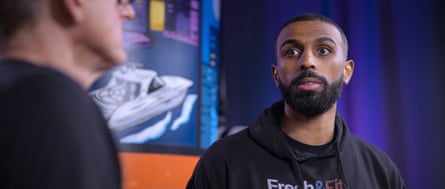
Instead, he tails HSTikkyTokky (real name Harrison Sullivan), Ed Matthews, Sneako (Nicolas Kenn De Balinthazy), as well as podcasters Myron Gaines and Justin Waller. They are proponents of “red pilling”, a term borrowed from The Matrix, claiming to “see the truth for what it is” (eg feminism is evil; a secret cabal runs the world, etc). There’s a segment in which Gaines tears apart young women on his Fresh and Fit show. “You’re huge, you’re not attractive and for you to behave in the way you do is a fucking embarrassment to society,” he tells one. “You fat fucking bitch, get the fuck out of my studio.”

Amazingly, these men gasp if you call them misogynistic. They “love women”, they say. “I actually understand them,” Gaines tells Theroux. “And since I understand them, I know what is best for them.” “Better than them?” asks Theroux. “In many ways, yes.” Waller thinks the world is fucked up because men are born with no value and have to strive to achieve it. There is a Sexual Market Value calculator popular on manosphere forums, where men can input their details – height, income, fitness, penis length. Women, supposedly, have more innate “value” and therefore more power. A young woman challenges Gaines, “How are we born with value?” “You literally have a vagina and titties,” he spits back. Gaines says everything about women is a lie because they wear makeup and you can’t tell when they are menstruating. He, like others, believes in “one-way monogamy” (the men can cheat). Waller boasts that his wife packs his condoms before he goes on trips. Meanwhile, the women just look pained.
It’s enraging to watch all this spew, I tell Theroux, and he says, “Good.” He wants it to be a challenging watch. At the same time, it’s a difficult landscape to navigate because the terrain has been “policed”. “I was very keen that it shouldn’t be, like, ‘Oh look, there’s some people being sexist on the internet. There’s some people on the internet who don’t read the Guardian, let’s make a documentary about them.’ It’s about something far darker and deeper.” I ask what the feedback from women has been on the film and he says he rates the opinion of his wife, Nancy Strang, although her favourite bits were when the women were speaking. Which wasn’t often.
As with all his work, Theroux walks the knife-edge between allowing subjects their invective while trying to get behind the facade. It’s no secret that there’s a deep vulnerability for which a lot of manosphere figures are overcompensating, he says. “We sort of pull the layers back.” While editing he was struck by a specific moment. They’d used an internet clip in which Tate says, “My dad beat the shit out of me. You grew up real quick, one good ass whipping.” “You realise how physically abused he was,” Theroux says. “You feel, ‘You absolutely are scarred by things that you lived through, aspects of that you’ve then internalised. You and your brother have created this trauma-bonded unit and projected these qualities of self-reliance.’ This brutal, almost apocalyptic thing that they’ve lived through has birthed an outlook that they then retail and sell.”
As well as the “lift yourself up by the bootstraps” narrative, manosphere influencers flog fitness and investment products; questionable crypto “that no one can really understand”; in fact, “anything that does well on the internet”, including access to OnlyFans girls. There’s a “strange incongruity”, Theroux says, of advocating traditional values, while surrounded by girls in bikinis. “It’s hard to separate the ideology from the grift. They will literally do or say anything that drives the algorithm.”
In January, a handful of these influencers “jumped the tracks”, in Theroux’s words. Sneako, Gaines, Waller, along with the Tate brothers, Fuentes and Clavicular filmed themselves driving around Miami singing along to Ye’s Heil Hitler. At the Vendôme club the same evening, the song was played while rightwing influencers raised the Nazi salute. It was, says Theroux, a big moment in the culture. “A new benchmark for outrageous and offensive behaviour.” He’s not proud of this, but in a purely journalistic sense he felt a twinge of relief. “I had the dark pleasure of seeing that our story was still relevant. You have this fear that your story will not be relevant. If anything, it’s the reverse.”
The problem with these screaming edgelords is where to draw the line between not taking them too seriously and taking them seriously enough, he says. The ideas are old. They are “repurposed” from places like the writer Iceberg Slim’s playbook, the language of the so-called pimp code. Lately, Tate, Sneako and Gaines converted to Islam in what looks like a race to find a more conservative ideology. But Theroux also argues that we shouldn’t underestimate the ability of children to read stuff against the grain: to deconstruct, to grasp irony. He gives his kids credit for being able to largely see it as ironic. “Which isn’t to try and excuse how horrible some of it is.” He makes the questionable case for exposing kids to it “in a way that allows them to sort of build an immune system” rather than “Oh, actually, this is genuinely distorting your worldview. I tend to think tiny amounts of horrific content are quite healthy to build your immune system, like being exposed to a pathogen.”
He shies away from the subject of Epstein when I raise it in the context of the male power structures that get rebuilt however much we tear them down. He agrees to the extent that there’s a danger of seeing Epstein as an outlier. It reminds him of Savile (again). “I take issue with the idea that this isn’t going on routinely,” he says. “So it feels a little bit tokenistic to me.”
“What do you think about Ghislaine Maxwell?” he asks suddenly. “Her level of complicity and what was going on with her psychologically?” I ask what he thinks. “I’m not sure. I’d like to know more.” He’s currently ploughing through the many documentaries on the couple. “These collapsing of categories of predator and victim, these qualities can infuse each other. Some of the victims were themselves recruiting other girls into the scheme, and at the top of that was Ghislaine.”
I wait for him to say more about child rape, grooming, internalised misogyny. Instead, he says he’s “more intrigued by how Epstein got so much money. That, to me, is the mysterious part. The fact that he was able to prey on vulnerable people is horrific, but not surprising. His ability to seemingly defraud and inveigle money from sophisticated financiers, bankers, business people – I find much more weird and interesting.”
This being a profile, I – like Theroux when he considers his subjects – am interested in what shaped him. He grew up in the 70s, in a house that shone with academic brilliance. He has mentioned that his working mother went to Oxford and that they had live-in au pairs, and also that he spent hours watching the TV. He has joked that he trailed his highly prized older brother (the writer Marcel Theroux) like “an irrelevant bit of afterbirth” – his words – and that “teasing” was a big feature of the family dynamic. There was also the “stash of Playboys” (his father published stories in the magazine) and Theroux said he made liberal use of them – “it’s possible he thought I was reading his fiction”. Was it a competitive home? “I had an older brother. We were competitive. Not in a negative way.” Right now, Theroux is finding the sofa uncomfortable, shifting like maybe it’s made not from black foam but hot coals. “Just fillet the childhood bit from my book,” he says, impatiently. “Available on Amazon, £9.99; audiobook free on Spotify. Whatever I said in there. Sorry,” he adds after a beat. “I’m not trying to be a dick.”
Paul Theroux’s infidelities are no secret. Arguably there was something of the “one-way monogamy” in their marital set-up. As Theroux writes in his memoir, “My mother had a policy of being OK about sex on location when my dad was away and, to be fair, in the early days his trips could last as long as several months. Eventually his relationships with other women became more consuming, and the strain too much for the marriage to bear. But, like most parents of that era, they were figuring it out as they went along.”
So, was it a patriarchal home, I ask. He umms. “No.” He debates aloud how chores were divided – yes, his mother did more laundry, but then it wasn’t as if his dad was doing any vacuuming – which wasn’t exactly what I meant. “It gets petty when you start trying to interrogate it too much,” he says. “And then the sexual dynamics … Probably I’d let them speak to that.” He directs me both to his mother’s book and a podcast he did with Germaine Greer because, “my mum admired Germaine Greer’s writing and a lot of the things she had to say”. He gets irritable when I ask whom he felt closer to growing up. “Come on. I’d get in terrible trouble if I answered that. They’re alive! When you asked that, did you think, am I going to get away with this?” He mimics, “Which one are you closer to …?”
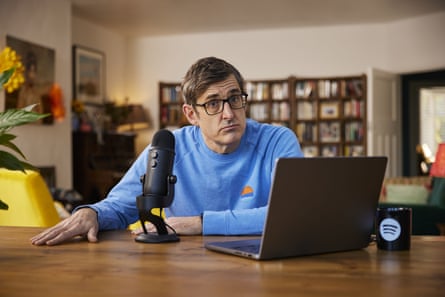
He has described his parents’ decision to send him to board at Westminster (which wasn’t far from home) as “cheating” because they didn’t want to deal with the tricky parenting stuff. “They were the opposite of helicopter parents,” he said. Westminster is one of the country’s most elite schools, so I ask if it gave him that exterior polish so often referred to when describing those privately educated in British public life. Did it help him navigate sticky confrontations in his films?
“No, but come on,” he says, sounding simultaneously bored and annoyed. “I definitely didn’t think, ‘If I just get my charming veneer going, then everything’s going to be fine and I’ll get a high-paying TV job.’” This is not what I meant. “I’m sure I do the same thing you do,” he continues, “try to be approachable and fun to be around, curious, interested and attentive.” He sighs. It’s not a happy sigh.
The story of how he was plucked from obscurity aged 23 by Michael Moore and given an opportunity that he spun into gold is much rehearsed. He lived in New York with his girlfriend, whom he calls “Sarah” in his memoirs, not her real name, a time marked by staying in for days on end to smoke quantities of weed and watch videos hired from the store on the corner. He casts himself as a kind of useless boyfriend, incommunicative, terrified of intimacy and commitment, but they nonetheless married, then drifted, then divorced. He met Nancy at the BBC in 2003 – she was an assistant producer in the history department and he noticed her as she passed him in the corridor on her way out to smoke. He fell in love on their third date. As well as finding her “filmstar beautiful”, she supplied some of the “emotional hinterland” he lacked.
They lived in Los Angeles and then, with two small kids in tow, moved back to Harlesden in north-west London, Theroux continuing with long work trips while Nancy stayed home. The set-up was unsustainable; the source of endless slanging matches, according to his book. (Theroux, “I’ve made lots of compromises.” Nancy, “Name one!”) Theroux said he stumbled into “certain phrases that … I wasn’t supposed to say”. Not least, telling Nancy that she knew this was his job when they met. “What was I doing when we met?” she fired back. “I was making programmes, too. I wasn’t sweeping up bits of rice from under the table.” She called his excuses “bullshit”. Then, during a minibreak for her birthday, she told him she’d had thoughts about other men. The disclosure appears to have been a jolt. They married in July 2012 and in his memoirs Theroux recounts his brother’s best man speech, which drew comedy from a Twitter handle Theroux used, “Loubot2000”. “Its conceit was that I was a temperamental bit of hi-tech kit that needed a troubleshooting guide.” He quotes, “Congratulations on purchasing your new Loubot 2000! … The Loubot 2000 is highly introspective and may sometimes go into power-save mode. To restore normal functionality, try asking one of the following questions: was Jimmy Savile really a paedophile? What do Scientologists actually believe? Are chimpanzees dangerous? This should reboot the system.”
Theroux has described the small joys of domestic bliss: listening to Radio 4’s Loose Ends while cooking; watching Match of the Day. He still reads, not with the drive of youth, when he consumed epic quantities of history and philosophy (a party trick, or at least an interview trick, is quoting Nietzsche). “I’m very boring,” he insists now. “I was thinking on the way here, ‘I think I’m the most boring person who ever lived.’”
It’s true that he brightens most when talking about the “biological tracker” on his wrist. “I’m not going to give its name, because they don’t pay me,” he says before whispering the letters W, H, O, O, P into the tape recorder. It gives him a sleep score, which he checks only once Nancy has left the bedroom (she finds his obsession annoying) and then congratulates himself when he gets 95%. “Sleep is my superpower,” he says.
So addictive is the tracker – and I can’t tell if he’s stalling or he’s genuinely this interested – he finds even bad scores mesmerising. He had the three-week flu recently and couldn’t take his eyes off his slow descent into the “red zone”. “Like, oh my God, I’m barely alive. I’m at 10%. There’s a paradoxical thing where you’re, like, ‘Oh, I want to make it go lower. I want to see how low my life force, can be.’ I’ve gone down to about 7% on a bad hangover and not much sleep. Like, New Year’s Day I’m right down there in deep, deep red.”
He has said that he follows his morning workout with two swift coffees, which makes him sound like a lion roaring at the day, but truthfully he’s easily overwhelmed. He’ll wander around shops forgetting what he came in for. “I think my executive function is rather underdeveloped.” Is that another way of saying he has ADHD? “Well, we all think we have ADHD, don’t we?” Actually when he reads about any condition he tends to diagnose himself. “I’m on the spectrum. I’m bipolar. I tick all those different things. Although I definitely don’t have the one that means you are very decisive or a psychopath.”

I ask, given his mother has trained as a therapist, if he goes to therapy. “No. Do you think I should?” I say the lexicon sometimes leaks into his commentary. “I’m an honorary fellow of the Royal College of Psychiatrists,” he offers. “I’ve never mentioned that in an interview before” – he was invited after doing programmes on anorexia, forensic mental health and postpartum psychosis. “I don’t think I can prescribe drugs, if that’s what you’re thinking,” he laughs, but it’s not a happy laugh.
Drugs, by the way, are something he talks openly about. He supports the legalisation of cannabis, and has said, “without giving too much away”, that mushroom oil could be a really positive experience for some people. On his podcast he asked Michael Palin if he’d ever done a “cheeky line” – meaning cocaine – so I ask him the same question now. “Have I taken a cheeky line?” he repeats back. “I think I’ll try and slip that one. I’ve got children.”
I say that I’d read that he didn’t cry. “No, I can cry. Would you like me to cry now?” I say that I would not. “I’m a man, though, so I don’t cry readily because we’ve been so imprisoned in these gender identities, it’s hard to break free, right?” Is he joking? “Listen to my interview with Germaine Greer.” For a split second he’s the grubby schoolboy again, “That was a good [interview]. I asked her about Wap.” (Later, I do listen to the excruciating moment in which Theroux explains “wet ass pussy” to Greer.)
What might make you cry? I try now.
“Chopping onions.”
Did you cry when your kids were born?
He elongates the word “Wowwwww.” Then, “I don’t think I did, no.”
Did you cut the cord?
“No offence, Charlotte, but that’s a kind of a cheap way of getting to a deep place. That’s like a podcast interview where they go – mocking voice – “‘What was your lowest ebb?’ I joke with my friends about those podcasts, ‘What was your lowest ebb?’ ‘What’s the worst thing that ever happened to you?’ Like, really?”
But I didn’t ask about his lowest ebb, I say. I add that he keeps repackaging my questions into things I haven’t asked. He recovers. “It would be quite weird if I cried all the time. And there’s no judgment, men who cry. But [I cry over] normal relationship stuff. I don’t want to get specific, but it wasn’t because I didn’t win a Bafta. Or because my interview wasn’t going well. It was probably something deep. Human feelings. Arguments. Misunderstandings. Relationship stuff. I cry because of life. How often do you think it’s normal to cry?”
I would like to cry more often, I say. “Me too! Sometimes I’m, like, ‘Come on.’” He mimes screwing up his face trying to cry. Then he tells me a story to illustrate. Last September, while dropping his eldest at university, he thought of the journey they’d started 18 years earlier. He looked around at all the other parents. “Greying dads with glasses, dressing 10-20 years younger than they are, in skinny jeans. I was, like, ‘I’m not an individual, I’m a demographic. I’m just a vector for various sociological forces creating my identity.’ It was a strange feeling.” And then he had a revelation. This wasn’t just a rite of passage for his son, but for him, too. It was his brother Marcel who said to him, “‘It’s a bit like you’ve been delivered a parcel when he’s born, and then you successfully deliver it to the university and your job’s done.’ Which obviously it isn’t, life goes on, but I was, like, ‘Wow, this feels really emotional.’ And then I was, like, ‘I think I’m about to cry. I wanted to, I wanted to cry. And I felt, like, ‘It’s coming. It’s coming.’” He turned to his wife. “‘God, can you think back to when he was born? Do you think we did a good job?’ And she’s, like, ‘Oh, knock it off.’ So we sort of aborted and I didn’t actually cry. But I think I could have done. So that’s what I was talking about: that’s normal relationship stuff.”
I ask about his alopecia. On Instagram he has been documenting his journey with the condition, which causes patches of hair loss, since 2023. “My hair seems to be growing back, not completely, but would you agree?” I say that I can see a huge improvement since the documentary footage. “Unfortunately for my Netflix debut, my hair was at its lowest ebb.” Alopecia is caused, he explains, “by your body attacking itself, thinking that your hair follicles are enemy agents. So, it eliminates them or disables them, as I understand it. I don’t have the hair I had 10 years ago, but the lesions seem to have gone and my hair is relatively normal now.” He shows me where it has grown back white and grey instead of brown. “But that’s all right, I don’t mind that.”
He has no idea what caused it. “I’d love to believe that it was because I was so stressed during lockdown, but I never felt that stressed, so that feels a bit dishonest. Like, it feels like a good card to play in an argument with your significant other – he play-acts a row – ‘Look what you did to me! My hair’s all falling out!’ But I don’t think it was related to stress. Who knows?”
It made him realise, however, how grateful he was for the hair he’d always thought of as unmanageable and unruly. He relates it back to the manosphere. “It’s this strange feeling of ‘Oh, my sexual market value is going through the floor, big time! Cratering!’”
Did losing hair make him think about his own masculinity? “It’d be weird if it didn’t, right? Perhaps that’s one of my gifts as an interviewer or documentary-maker: I am quite available when I’m in a story, emotionally, and also kind of conceptually. I’m trying to be honest and think things through and figure out what part of this is correct, and what part of it is awful. You know what I mean?
“So in terms of the manosphere, yeah. You get a little bit of respect for being a successful broadcaster, but less respect because it’s legacy media, you are part of the highly sus BBC lineage about which they’re obsessed. You get credit when they see how big your social media following is and being 6ft 2in (6ft 3in is optimal). So, I’m thinking, like, ‘Oh wow, I’m kind of ticking a few of the boxes.’ Penis length is another one.” He clocks my face and says, “I know. Is that TMI? Another thing is how much money you have.”
How much money does he earn? “Come on,” he says. He raised it. And he has asked others the question himself. “I probably have. I wouldn’t expect to get an answer.”
What does he spend his money on? He starts mocking me again, “‘What was the most expensive thing you bought?’ I feel like I could write better questions, Charlotte.”
I suggest that interviewing is more difficult than people think. He concedes that it is, especially in the one-to-one format we are doing now. Compared with this, he says, documentaries are “low-pressure”. The podcast keeps him on his toes. “Sometimes you talk to someone who’s not all that forthcoming, but you can still get something interesting out of it and I go away and think, ‘Oh well, I think I did a good job.’” I ask how he copes with people lying or being evasive. “I’m trying not to quote Nietzsche too much, because it sounds pretentious, but he says, ‘Even when you lie, you nevertheless tell the truth with the shape your mouth makes when you’re doing so.’ There’s metadata that gives the game away.” Indeed.