3 months ago
134
3 months ago
134
Swell Maps were a punk band, but only because that word meant something different when they started making records in 1977. It didn’t mean bands called Knuckleheadz or Gimp Fist; it meant unfettered freedom, curiosity rather than rage. Theirs was a music that wandered off in unexpected directions, where songs barely hung together before falling apart, punctuated by peculiar sounds made by whatever happened to be around. It was psychedelia and it was prog and it was krautrock, every bit as much as it was punk. Most of all, it was DIY.
So Swell Maps’ descendants weren’t the kind to get sleeve tattoos and don leather. They, like Swell Maps, were nerds. Sonic Youth’s Thurston Moore described them as “part of my upbringing”. Stephen Malkmus noted that Pavement formed, more or less, as a tribute to Swell Maps and their kindred spirits Desperate Bicycles. Now add all the bands who have tried or still try to sound like Pavement or Sonic Youth, bands who may never have heard of Swell Maps. That’s how you map the scope of their influence.
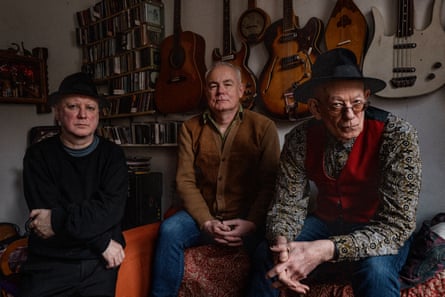
“We took what we were doing very seriously, but we were determined to have a bit of fun doing it,” says 69-year-old Jowe Head, who has convened a group of sympathetic musicians as Swell Maps for a new album, Swell Maps C21, the first newly recorded material since 1980’s Jane from Occupied Europe. “We had a saying: ‘serious fun’. A lot of the bands around at the time – some of the ones on the Rough Trade scene – were very dour and frowning all the time, wearing grey. We weren’t like that.”
Hence being called Jowe Head. His real name is Stephen Bird, but all of Swell Maps took pseudonyms as punk exploded, though they were inspired not by the Damned but by the none-more-hippy band Gong. The brothers Adrian and Kevin Godfrey became, respectively, Nikki Sudden and Epic Soundtracks. They and Head were the constant trio, but three other members wrote or recorded or played live: Phones Sportsman (David Barrington), Biggles Books (Richard Scaldwell) and Golden Cockrill (John Cockrill). And if Nikki Sudden ended up being the most rock’n’roll of the pseudonyms, thank goodness Head and Soundtracks didn’t adopt his suggestions for them: Bondage Pelican and Cleavage Frogdog.
“I was at school with Adrian,” Head says. “This is the early 70s, in our early teens. We used to meet up and do a bit of travelling together – cycle down to the south coast from the Midlands.” They went to gigs together, to see Mott the Hoople, Led Zeppelin and more. But while Adrian adored T Rex and the Stones, Head was getting into prog rock, a taste he shared with Kevin. The three of them, joined by the others, started making music in each other’s bedrooms. The Faust Tapes – the budget-priced sound collage album by the German band Faust – showed them the possibilities of pressing record and play, even if they were just teenagers in Solihull. Then punk arrived: “A catalyst for people with fresh ideas, because the hippy scene was fading out,” Head says.
Emboldened by Buzzcocks releasing Spiral Scratch, Swell Maps hired a studio and recorded their 1977 debut single Read About Seymour. “Adrian, or Nikki as he had started calling himself, turned up with this song, and it sounded like ska or reggae, and he said it was about the king of the mods in the early 1960s.” They were now also able to play gigs, at last. “We weren’t ready before 77,” Head continues. “And it wasn’t until punk that a few venues became more accessible – you didn’t have to send them a demo tape or do cover versions. We could sneak on to a punk night, even though we didn’t look like punks or sound like punks. We were trying to do something a bit different to the Sex Pistols or the Damned or the Clash.”
Things looked bright: John Peel championed Swell Maps from the off on the BBC, and Rough Trade picked up their debut album A Trip to Marineville for release in 1979. Sudden then went to London, expecting his bandmates to join him there and go full-time. Instead, Head and Soundtracks went to art college – the former in Manchester, the latter in Portsmouth – and the band careened to a halt after a disastrous Italian tour in spring 1980.
Before that, Head had been very badly beaten by some skinheads he had sprayed with a waterpistol. He needed surgery and convalescence, and though the band cancelled gigs, the Italian tour came too soon. “It was a terrifying incident, and I was unwell for a considerable period, more than I like to admit,” Head says. “I felt guilty because I’d done something dumb that rebounded on the band, and I was in denial about my condition. In those days there was no term for PTSD, but I was very shaken up, to put it mildly. I had a scar, too, which wasn’t healing, and kept opening up on that tour. That was problematic. Maybe we could have had a break from it for a couple of months, but no, we decided to dramatically split up.”
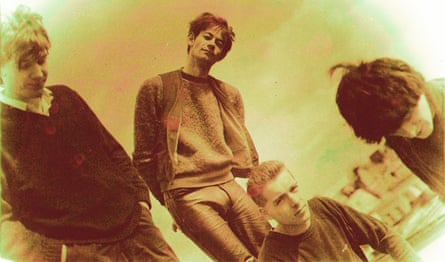
Rather than align themselves with the big punk and post-punk acts, Swell Maps had found kin with the scrappier, stranger likes of Alternative TV, the Pop Group and PragVEC, and Scritti Politti, with whom they had toured the Low Countries in a van. Especially, they found a bond with the Television Personalities (TVPs) and their leader and constant, Dan Treacy. This core of people associated with the two bands – Sudden, Soundtracks, Head, Treacy, TVPs co-founder Ed Ball and Joe Foster – would go on to be the spine of Creation Records through the 1980s, and inadvertent father figures to a whole load of jangling indiepop bands.
Head himself spent a decade with the TVPs after Swell Maps split up, joining in time for one of pop’s most jarring errors of judgment, when in 1984 they were invited – as aficionados of Pink Floyd co-founder Syd Barrett – to open Floyd guitarist David Gilmour’s solo UK tour. On the opening night, Treacy introduced the song I Know Where Syd Barrett Lives by confirming that yes, he did. And he then read out the address on stage. “Dan got a bit carried away,” Head says. “We were in a mischievous mood that night, and Dan the most mischievous of all. We were trying to be a bit satirical. I think we did an extended version of [Pink Floyd’s] Interstellar Overdrive and I had some confetti, and I was throwing that up in the air. They made me go back and sweep the stage after, and then we were bundled off the tour.”
The new Swell Maps lineup includes members who played in latterday versions of TVPs, including the guitarist Lee McFadden. “Television Personalities and Swell Maps had the same thing,” McFadden says. “The TVPs would have people come up to us after the gig and saying. ‘Why didn’t you sound like the record?’ And it’s because we never could.” For both bands, spirit and imagination would always be more important than execution.
Epic Soundtracks died in 1997, followed by Nikki Sudden in 2006, leaving Head as the band’s archivist. He went through the old tapes to put out compilations and persuaded Mute to release an album of the band’s Peel sessions, and in 2022 put out a book about the band. To mark it he persuaded a group of likeminded musicians to join him to celebrate the music of Swell Maps, and from that grew this new record.
It is split between old, rediscovered or unfinished songs, and new ones; Phones Sportsman and Golden Cockrill have both contributed, as has another acclaimed musician inspired by Swell Maps, Luke Haines. And, now the band have ballooned in size, “I am determined that we still stretch the boundaries of what we can do,” Head says. He ponders the band’s nonexistent run of chart success and announces, brightly: “Here come the hits!”