4 hours ago
8
4 hours ago
8
“I love Cissè. I love Cissè.” Ruben Amorim had not yet taken charge of his first competitive game as Milan head coach but already he was furnishing journalists with soundbites and supporters with memes, clippable moments that you just knew we were destined to revisit.
Alphadjo Cissè is a 19-year-old attacking midfielder who signed for Milan from Verona in February but only joined up with them this summer, after completing the season-long loan he had already begun at Catanzaro in Serie B. He scored six goals in 22 games there, missing the second half of the campaign with a thigh injury. Previously he had played a combined 14 minutes for Verona across three substitute appearances in the top flight.
Yet Amorim spoke of Cissè like a man who knew something that the rest of the world doesn’t. More than his words, it was the body language: hands rubbing together in anticipation, lip curled at one corner into an emoji-like version of a smirk.
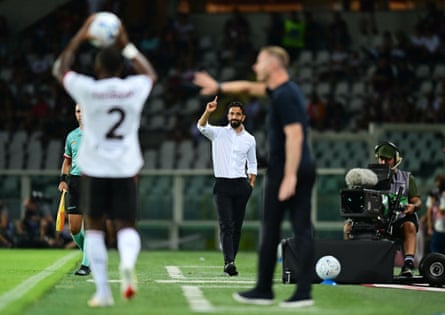
Cissè would start away to Torino the following evening. Within 75 seconds of kick-off, he had taken the first shot of the game: racing forward to hook a Ruben Loftus-Cheek cross into the side netting from an acute angle beyond the far post.
For an Italian teenager to make Milan’s first XI on the opening weekend was already a significant detail. The scarce opportunities afforded to young domestic talent in Serie A has been a national talking point ever since the Azzurri failed to qualify for a third consecutive men’s World Cup.
Data compiled by Football Benchmark found that Italians who qualified for the under-21 category accounted for only 3.9% of minutes played last season, while foreign players in that age group took 8.2%: “In other words, young foreign players receive more than twice as many opportunities as their Italian counterparts.”
There were signs of a possible shift this weekend. The season began with 21-year-old Pio Esposito delivering a man-of-the-match performance for the champions, Inter, in their 4-1 win over Monza, but he was the exception who stood apart already last year.
More surprising were the new faces popping up elsewhere. Cissè, born in Treviso to Guinean parents, was one of three Italian teenagers on the pitch at the Olympic stadium in Turin, with Diego Mascardi and Alessio Cacciamani, both 19, lining up at goalkeeper and left wing-back for the Granata.
The 18-year-olds Matteo Palma (an Italian-German dual national) and Simone Lontani started for Udinese and Parma respectively, and the 19-year-old Mathis Mout for Monza. Even Como, whose project has been criticised for relying almost exclusively on foreign talent, gave Mattia Liberali, 19, some minutes off the bench. It is far too soon to draw conclusions, but certainly a trend worth tracking.
In any case, putting your faith in untested young talent can feel like a greater gamble for a club with Milan’s expectations. After a disappointing fifth-place finish last season under Massimiliano Allegri, the Rossoneri have spent big – appointing Amorim and then dropping a club-record €74m to sign Gonçalo Ramos from Paris Saint-Germain, as well as another €50m on the midfielder Diego Moreira from Strasbourg and €30m on the defender Mario Gila from Lazio.
Amorim has not shied away from ambition, saying his goal is to win the Scudetto, even while acknowledging it may take time to bridge the gap to Inter. More than that, he has won over fans with the promise of a front-footed team who will seek to set the tempo and dictate how games are played – a welcome change from the caution and reactivity of Allegri.
There were promising performances in pre-season – not least the 4-2 win over Amorim’s last club, Manchester United, with Cissè on the scoresheet. But friendlies are not the real thing. Sunday’s visit to a Torino side undergoing a renewal of their own under a new head coach, and former Milan player, Ignazio Abate, was always going to be a fascinating first challenge.
Ramos and Gila started, at centre-forward and on the right of defence. Moreira, who only completed his move on 19 August, stayed on the bench. Cissè was the other truly new face, playing to the left of Ramos in a 3-4-2-1, though Yunus Musah and the right wing-back Samuel Chukwueze were also returning after spending last season out on loan.
Amorim’s approach lived up to billing. From the start, Milan dominated the ball and the pitch – claiming more than 70% of first-half possession while outshooting their opponents by 11 to one. And yet, they struggled to break Torino down in the final third. Aside from one solo effort by Chukwueze, who dribbled in from the right and forced a save from Mascardi, they had rarely looked like scoring.
Serie A results
ShowParma 0-1 Cagliari, Genoa 0-2 Napoli, Udinese 1-1 Como, Inter 4-1 Monza, Torino 1-2 Milan, Atalanta 2-1 Sassuolo, Venezia 0-2 Lecce, Frosinone 0-1 Juventus
Cissè thought he had earned Milan a penalty after the interval, when his cross struck the arm of Nikola Vlasic. That the VAR booth did not call the referee, Luca Zufferli, to take a second look may be an early indicator – together with incidents from other games – of a shift in approach under the new refereeing designator, Daniele Orsato. He has stated a desire to “put referees back at the centre of the match” and return to the idea that technology should only be used for those elusive “clear and obvious” mistakes.
Torino were growing into the game. But that might also have been their undoing. In the 64th minute, Musah turned his man in midfield, surging into space left open by the home team’s press. He fed Adrien Rabiot, a second-half substitute, on the right. The Frenchman crossed to Cissè, who brought the ball down with his waist and curled a half volley into the far corner. The teenager slid to his knees as he celebrated in front of the away fans.
Within moments it was 2-0, Rabiot himself converting a Chukwueze delivery. Torino kept battling, and Scotland’s Ché Adams scored the best goal of the game in injury time, an outrageously nonchalant right-foot volley over his own left shoulder. But the three points went to Milan.
Cissè laughed when the interviewer from Dazn asked him at full time what he thought about Amorim’s professions of love. “It makes me happy,” he said. “But I didn’t hear the press conference. All my friends told me about it instead.”
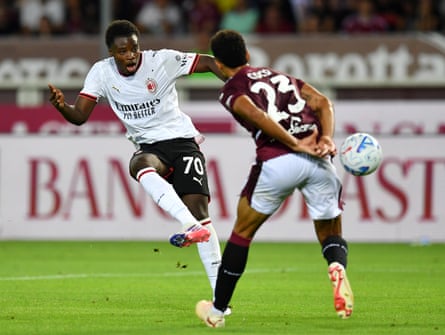
He was still recovering from injury when he first joined up with Milan this summer. Cissè said he had tried to watch training as closely as possible, getting to know what the head coach wanted. Still, he acknowledged, it was “beyond a dream” to get to start, and score, in the season opener.
The numbers say he is the youngest Italian to score for Milan since Patrick Cutrone in 2017, as well as the first Italian to score for them on a debut Serie A start since Daniel Maldini in 2021. Those names should remind everyone not to get ahead of themselves. Cutrone, now 28, was a substitute for Monza this weekend and has only reached double figures for goals once in a top-flight season. Maldini, 24, has played for seven clubs since 2022, and begins this campaign with Cagliari.
But Amorim clearly thinks highly of Cissè, who has represented Italy at various age categories up to under-21, saying he looked at times in the first-half like the most experienced player on the pitch.
The head coach, conducting his interviews mostly in English, said Milan have “a lot to improve”, acknowledging both their struggles to break Torino down early on and the way they faded at the end. “[But] the first thing is also win. That is the most important thing. We talk about ways of playing, but there is one goal in calcio. Vincere.”