3 hours ago
11
3 hours ago
11
Tehran has vowed to retaliate against any country that cooperates with the US attempt to impose fresh sanctions against Iran in what the Treasury secretary, Scott Bessent, has billed as “the single greatest financial offensive ever marshalled against an adversary”.
In advance of the US announcement, the United Arab Emirates, Iran’s single biggest trading partner in the Middle East, announced it was ending all trade with Iran, a move Tehran believes was coordinated between Washington and the UAE.
The US has said it will impose sanctions on any country or entity trading with Iran – what are known as secondary sanctions.
The test of the US rhetoric is likely to rest on whether countries such as India, China and Russia believe continued trade with Iran would lead to credible US reprisals against their economies. China has for decades been the main importer of Iranian oil.
In May, the US threatened sanctions against Chinese refiners and the banks funding them, but the Chinese commerce department directed Chinese firms to ignore US warnings over Iranian oil imports, saying the threats were illegitimate and deploying for the first time a government statute designed to render US sanctions ineffective in Chinese jurisdictions.
The US had imposed sanctions on Hengli Petrochemical (Dalian) Refinery Co in April but Washington largely backed off as Donald Trump realised he was risking a wider trade and tariff war with China that the US was likely to lose.
This time the Chinese foreign ministry spokesperson, Lin Jian, again said China opposed unilateral sanctions that lacked basis in international law and China believed that military means, sanctions and pressure tactics were not the solution.
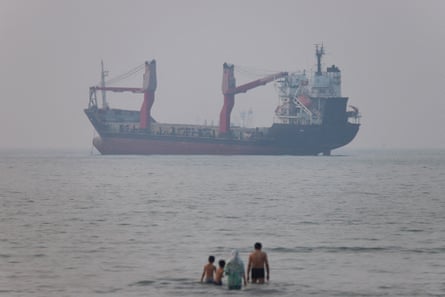
However, unlike in May, Iran’s oil shipments to Asia have already all but ended due to the effectiveness of a US naval blockade of Iranian ports, driving the cost of those cargoes to the highest levels in years. Last week, Iran’s central bank governor, Abdolnaser Hemmati, admitted his country’s crude exports had “virtually stopped” due to the US blockade.
The White House believes the Iranian economy is as a result once again on the brink of collapse due to hyperinflation and lack of foreign exchange income caused by the US blockade of oil exports. The rial was trading at 1.992 million per dollar on the unregulated market on Monday, down 4.5% since the US president announced a “crushing economic operation” against Tehran last week.
“Iran is completely collapsing!!!” Trump posted on social media in capital letters on Monday.
But Iran has been under some kind of US economic maximum pressure campaign for more than 20 years and so far survived.
Iran’s security chief, Mohsen Rezaei, said Tehran would respond with an “earthquake-like” retaliation if Washington proceeded with the proposed measures. He also warned Iran’s Gulf neighbours against joining the US sanctions campaign.
“If the countries surrounding Iran join the Americans in their economic war, not a drop of oil will leave the Persian Gulf and the strait of Hormuz,” Rezaei said, adding that Iran would also target other oil export routes from the Gulf.
Shipping through the strait remained severely disrupted over the weekend, putting further pressure on global energy markets.
Iran’s foreign minister, Abbas Araghchi, dismissed the expected sanctions as a sign of US desperation, arguing that the measures would fail to defeat Tehran. He said the US had shifted from military operations to what he described as “the same old plans”.
Reza Nasri, an international lawyer with links to the Iranian foreign ministry, said: “The announcement is not a measure against Iran. It is a claim of jurisdiction over the world, and every sovereign state on Earth is its real addressee. Iran is merely the occasion. The demand that no country allow its own banks, businesses, airports or ship registries to engage in lawful trade with another country is aimed at everyone else. Sovereignty itself is the target.”
Esmail Baghaei, the Iranian foreign ministry spokesperson, said: “Repeating methods that have previously proven to fail will not produce any different results, except that it shows the extent to which America is hostile and spiteful towards each and every Iranian, because it knows very well that the effects of these sanctions will affect ordinary Iranian citizens.”
He added: “Obliging or intimidating other countries to stop or limit their trade relations with another country means violating the most important foundation of international relations and the most fundamental pillar of the United Nations charter, which is respect for the national sovereignty of countries.”
Hassan Ahmadian, a professor of west Asian studies at the University of Tehran, said: “There isn’t a single new sanction. Everything in Iran has been under primary and secondary sanctions since 2018. Since these sanctions failed to achieve the goals the US and Israel wanted, both sides turned to military action. The big fanfare about an ‘economic war’ is really just a public admission of a major step backward. After failing militarily, Washington is clearly stepping back to square one – the economy.”
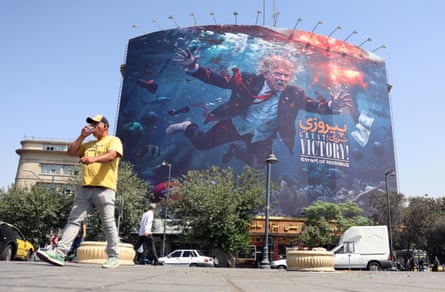
He said Iran had been signalling in recent weeks that US economic warfare was no longer an acceptable option for Tehran and it would prefer going to war rather than standing idly by in the face of the US implementing the blockade. He said this involved “Iranian calculations related to military capabilities, the American domestic situation, and the Iranian domestic situation”.
Last Thursday Bessent claimed in an interview with CNBC that “the US will lead the Islamic Republic of Iran to collapse with the toughest sanctions in history”.
The Treasury secretary claimed “the US government is asking its allies and the rest of the world to stop trading with Iran”. He added that the US “will use all its power against anyone who does not comply with this demand”.
“Either the countries are with us or against us,” Bessent said. “It is time for our allies and the rest of the world to decide, and we will destroy the economy of this regime.” Writing in the Financial Times on Sunday, he said: “Total financial isolation can obviate the need for American force while enlarging the sphere of freedom for our allies. Those who sever Iran’s remaining financial and commercial connectivity will reinvigorate their own. They will deepen their access to global capital, reinforce confidence in their markets and attain the standing they seek in the world economy.”
But China and Russia have so far shown no interest in succumbing to US pressure.
By coincidence, Pakistan’s army chief, Field Marshal Syed Asim Munir, flew to Tehran on Monday where he will explore the opportunity to revive talks on the stalled memorandum of understanding signed in June, but not implemented either by Iran or the US largely due to a dispute about whether the memorandum granted Iran interim control over shipping in the strait of Hormuz.