3 months ago
92
3 months ago
92
“Finally, I feel like our voices are being heard, and like something is going to happen that is positive for the community,” says Monaira*. She was forced to flee her home in Myanmar in 2017, when the military launched so-called clearance operations across Rohingya villages.
During the violence, her brother was taken by military soldiers, shot dead, and his home set on fire. “Children were thrown into the fire in front of my eyes,” says Monaira, who was raped by military personnel.
She is among the survivors of the Myanmar military’s brutal crackdowns on the country’s Rohingya minority, many of whom hope to move a step closer to long-awaited justice on Monday, when a landmark genocide case opens at the UN’s top court, the international court of justice (ICJ).
The case, which was filed by the Gambia, centres on military operations in 2016 and 2017 that forced more than 700,000 Rohingya to flee to neighbouring Bangladesh.
“We demand justice,” says Monaira, who travelled from Cox’s Bazar refugee camp in Bangladesh to The Hague to listen to hearings.
The proceedings are the first genocide case the ICJ has heard at this level in more than a decade and are likely to set a precedent for how future allegations are assessed, including South Africa’s case accusing Israel of genocide.
The Gambia will present its first arguments from Monday until Thursday. It has accused Myanmar’s military of systematic clearance operations against the Rohingya, and of committing mass murder, rape and torching villages, with the “intent to destroy the Rohingya as a group in whole or in part”.
Myanmar has denied the allegation of genocide and will present its arguments from 16-20 January. Unusually for the court, survivors will give evidence in the case. Proceedings will end on 29 January.
Previously, Aung San Suu Kyi, 80, travelled to the court to defend Myanmar against the allegations of genocide. She is being held in detention at the behest of the military, which seized power in February 2021, plunging the country into civil war.
Tun Khin, the president of the Burmese Rohingya Organisation UK, says that after decades of violations of international law, the ICJ case marks “the first time the Burmese military are in court having to defend themselves”.
“It’s a big step forward on the long road to justice and accountability,” says Tun Khin, who is also chair of the Arakan Rohingya National Council.
In 2020, the ICJ imposed emergency “provisional measures” on Myanmar, ordering it to prevent genocidal violence against the Rohingya minority and preserve any evidence of past crimes. However, rights groups say the military has continued to commit atrocities.
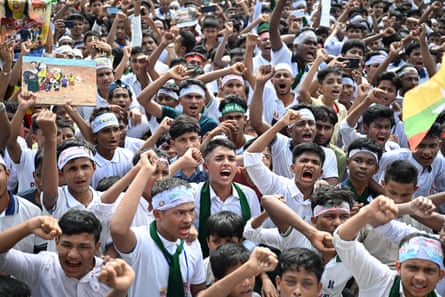
Shayna Bauchner, an Asia researcher at Human Rights Watch, says the Myanmar military’s “vicious cycles of abuse and impunity” needs to end. “This should begin with governments holding the junta to its legal obligation to comply with the ICJ-ordered provisional measures.”
The ICJ case is not a criminal proceeding against individuals but will determine whether Myanmar breached its obligations under the genocide convention.
Separately, in 2019, the international criminal court (ICC) prosecutor opened an investigation into alleged crimes against the Rohingya, and in 2024 the ICC prosecutor requested an arrest warrant for Min Aung Hlaing, the commander-in-chief of Myanmar’s military, alleging crimes against humanity.
The ICJ case could set a precedent for how genocide is defined, including whether genocidal intent can be inferred from cumulative patterns of violence, displacement and rhetoric, rather than explicit orders.
Antonia Mulvey, the founder and executive director of Legal Action Worldwide, which has worked with hundreds of survivors of the military crackdowns, says: “At a time where we’ve seen increased armed conflicts, attacks on international justice institutions, attacks on international law and human rights, it can never be a more important moment to start 2026 with a case like this.”
A judgment could be issued within six to 12 months, she says. Even if the court’s orders are not implemented in the current environment in Myanmar, they would still represent a crucial step forward, Mulvey adds.
“Let us not forget that situations can change and overnight you can have a change of government, and the court order will remain,” she says, adding that the case will also offer long-awaited recognition of what Rohingya people have endured.
* Name has been changed