3 months ago
135
3 months ago
135
It’s hard to believe that Bob Weir, founding member of the Grateful Dead who carried the torch for the band’s music after Jerry Garcia passed in 1995, is gone. He had the vibrant, playful energy, constant curiosity and adventurous disposition of someone who seemed as if they would just always be around. Bobby, as he was affectionately known to fans, helped start the legendary band as a teenager in the mid-1960s and co-wrote and sang many of their most famous songs, including Sugar Magnolia and Truckin’. Much more than that, he kept the Grateful Dead’s spirit and music alive more recently in various forms including RatDog, the Other Ones and Dead & Company.
For so many of us, the Grateful Dead was much more than the music we grew up with; it was an endlessly fascinating culture that spanned generations and an integral part of the fabric and foundation of the American musical vernacular. Bobby’s highly creative and unusual way of playing rhythm guitar was an essential counterpoint to Jerry’s inimitable lead playing. Together they defined the core of the band’s sound which was documented throughout its exhaustive touring history by a live taping and bootleg-sharing culture which they embraced.
My twin brother Bryce and I grew up in suburban Ohio listening to the Grateful Dead and trying to emulate the elusive way in which they played. In 1991, the very first time we played music with Bryan Devendorf, a founding member and the drummer of our band the National, we played the Grateful Dead’s song Eyes of the World for several hours. It was an auspicious beginning. Many years later in March 2012, Bryan and his brother Scott (the National’s bassist) and I would join other peers, including Walt Martin of the Walkmen and the producer Josh Kaufman, at Bobby’s TRI studios in Marin County, California for a live-streamed charity performance of Grateful Dead songs.
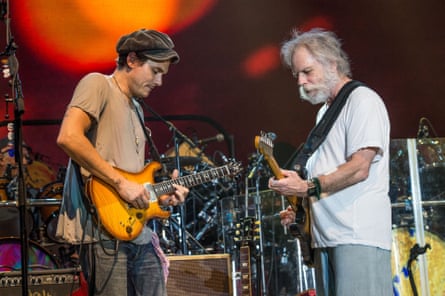
This performance, which was a benefit for HeadCount, a not-for-profit organisation Bobby championed that focuses on voter registration and engagement, became a seminal moment for all of us. To come into contact with Bobby musically felt like entering a portal that was a direct conduit into the mystical, musical landscape and history of the Grateful Dead. When he would scratch off tempos on his guitar to start certain songs, we would all instantly recognise this sound from countless Grateful Dead bootlegs we had listened to growing up. I remember the hair standing up on my arms the first time I heard him do it and being unable to stop smiling – it was the thrill of a lifetime and a reminder of why we started playing music in the first place. We did our best to mainly play in the tight and brisk style of the Grateful Dead’s Europe ’72 live record, a quality that didn’t go unnoticed among the longtime Grateful Dead crew members still present. To this day the experience is a surreal highlight of my entire career as a musician.
Bobby was always so generous with his time and wisdom, telling long and fascinating stories of his years in the Grateful Dead and sharing his fearless musicality and curiosity with all who would listen. I’ll never forget the hand signals he showed us for changing musical modes during extended improvisational sections of certain songs, or how he once looked in my eyes during a rehearsal of Uncle John’s Band and asked me: “Can you play Jerry’s part?” He seemed to remain completely in touch with the fresh wonder and wildness of Grateful Dead music. It never felt as if these songs hadn’t already been performed thousands of times.
My friends and I took to calling ourselves “the Weirmen” after this experience with Bobby, and Josh would go on to produce his brilliant solo record, Blue Mountain, which we all played on. We formed a band with Bobby for the Campfire Tour to support that record, once again performing a wide range of Grateful Dead songs in addition to Bobby’s solo material. During that time, Bobby always treated us like peers – he had the playful exuberance of someone much younger and was always up for a challenge. He was completely present in the moment, continuing the tradition of the Grateful Dead, where the set list and songs were never played the same way twice.
It was only with Bobby’s support that my brother and I, along with our bandmates in the National and our friends, were able to make Day of the Dead in 2016, a five-disc tribute to the Grateful Dead that benefited Aids charities and featured many of our indie rock peers as well as legendary musicians such as the banjoist Béla Fleck and the composer Terry Riley. In a testament to the wide and deep influence of the band, we discovered that even our alternative rock guitar heroes such as Lee Ranaldo of Sonic Youth, Ira Kaplan of Yo La Tengo and Stephen Malkmus of Pavement – in some ways more obvious influences on the National – were also lifelong Deadheads. The album had 59 tracks and was six hours long, but in truth, we only barely scratched the surface of the Dead’s canon. We often joke about how we must soon get back to work on Volume II.
It’s hard to overstate the loss that fans of the Grateful Dead will feel at Bobby’s passing, but his spirit is alive and well in the massive legacy he leaves behind. To quote a classic Bobby-led Grateful Dead song, Cassidy, written with his longtime lyricist partner John Perry Barlow:
Fare thee well now
Let your life proceed by its own design
Nothing to tell now
Let the words be yours
I’m done with mine