1 hour ago
10
1 hour ago
10
Those early season thoughts that Chelsea might be the team best placed to challenge Arsenal are beginning to look over-optimistic. The two chaotic wins with which they began the season were always difficult to read: they might have been useful points picked up on the way to a more solid structure, or they might have represented evidence of significant problems. After three games without a win, it’s beginning to look like the latter.
Brentford’s first home win over Chelsea since 1938 means they remain unbeaten, third in the table, coherent and disciplined. The comparison is impossible not to draw: as one side flails in an orgy of structured spending, their far less wealthy neighbours thrive with a clear plan and sense of direction.
Such is the state of perpetual flux at Chelsea that the usual homilies about the benefits of stability always seem a little redundant when applied to them. With 11 new signings this summer maintaining the sense of the club as a trading hub, learning the names of everybody in the dressing room has probably been a greater priority than worrying too much about boardroom wrangling but, still, their first game since Todd Boehly and Mark Walter agreed to sell their 12.8% stakes in the club to the major shareholder Clearlake Capital felt significant. At the very least, a more harmonious boardroom should be beneficial.
Boehly, the great disruptor, who arrived blithely telling English football it was doing everything wrong, has departed having achieved very little other than splurging £300m on players who didn’t fit and giving Raheem Sterling a £325,000-a-week contract in his shambolic spell as the de facto sporting director. Yet somehow, given the £950m paid for that stake, the club’s enterprise value has climbed to an implausible £5bn, more than double what they paid for it in 2022.
Four years on, after 60 arrivals, do Chelsea look any more like title challengers than they did then? It was, in truth, very hard to say what this looked like, other than a team that is every bit still under construction. Jordan Henderson made his full Chelsea debut at his former club, while Danny Welbeck, Pep Chavarría and Valentín Barco made their first league starts.
Barco, whose overenthusiastic celebrations after Argentina’s winner against England at the World Cup earned him a post-match slap from Jude Bellingham, was booed with impressive consistency by the home fans. The lesson was clear: if you’re going to be a major irritant while in possession of a distinctive shock of hair the colour of burnished copper, there will be consequences. Emi Martínez was jeered as well for the crime of being Argentinian. Henderson, by contrast, was treated relatively gently, his booing as a returnee more sporadic and muted, tending to the perfunctory.
With Chelsea, the sense remains of a club being built on the hoof, even if there is rather greater faith in Xabi Alonso’s capacity to pull that off than at least a couple of his predecessors. The pattern for them was a familiar one: a fast start, fading to something a little scratchier. The opening, for the second successive game, did not produce an early goal, although Pedro Neto would have given them a ninth-minute lead had it not been for a sharp save from Caoimhín Kelleher.
The lack of goals, or even major threats, before the break came as something of a surprise: these were two of the league’s more prolific sides. Chelsea had scored and conceded in every game, while Brentford had scored in every game and kept just one clean sheet. It wasn’t that either was especially cautious or that the game was in any sense cagy. Rather it was frenetic, littered with corners and long throws that never quite came to anything, full of the possibility of chances rather than actual shooting opportunities.
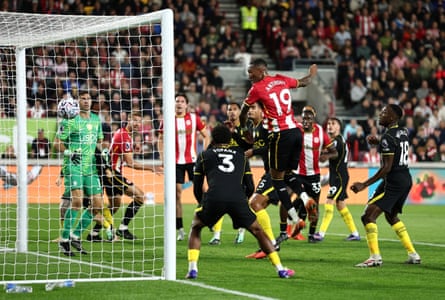
A goal, though, did finally arrive on the hour. Perhaps inevitably, it came from a dead ball; the stats had suggested that Brentford this season had been creating significantly more chances from set plays than they had converted. As modern corner routines go it all seemed very straightforward, Jannik Schuster climbing above the diminutive Barco to head Mikkel Damsgaard’s corner back across goal, where Jaidon Anthony nodded in from close range, his first goal since his summer move from Burnley.
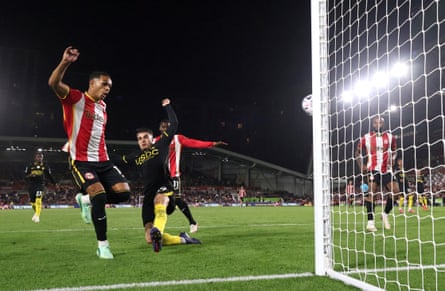
Chelsea belatedly applied some pressure, but although the final minutes were played largely in the Brentford half, they created little beyond corners, as Brentford maintained their composure and structure. The second goal arrived on the break seven minutes from time. Damsgaard, perhaps the tidiest player in the league, led the break, playing in Kevin Schade. Martínez saved his side-footed effort but Igor Thiago guided an awkwardly bouncing ball inside the post for his first goal of the season. Fábio Carvalho lashed home a third in stoppage time to compound Chelsea’s misery.
As Brentford begin to consider that European qualification is a real possibility, Chelsea remain what they have been since the takeover: a work in progress.