1 hour ago
8
1 hour ago
8
It is difficult to find the most remote place in England. There is no public transport, no roads and no sign of any human habitation. Online route finders mistakenly direct cars up a grassy track. But miles along gravel forest roads in the far north of Northumberland is the largest contiguous rewilding site under single ownership in the country.
The vast glacial bowl of 7,500-acre Emblehope Moor has been bought for £8.5m by Restore, a nature restoration company that works with landowners across Britain.
The aim is to bring golden eagles, curlews, black grouse and beavers back to the moor which in former guises was a traditional grouse shooting and sheep farming estate and a dog-training ground.
But the restoration project, which is still seeking to raise £4m to fund its 20-year scheme, also has a unique proposition: after delivering new biodiversity and abundance alongside financial returns for investors and repaying the crucial £4.5m Triodos Bank loan that enabled the purchase, it will hand over the site to local community or charitable ownership.
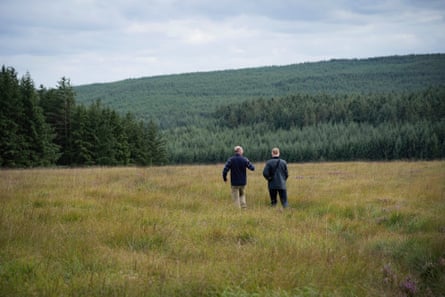
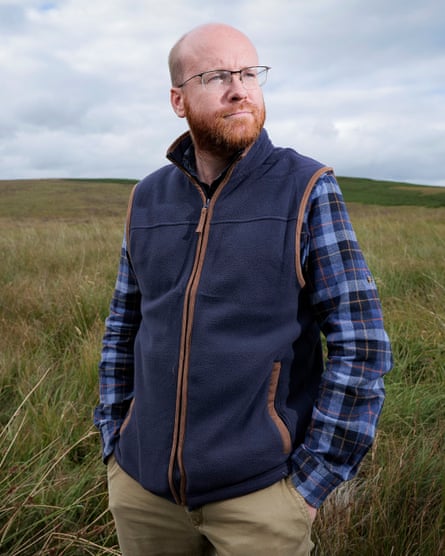
“We want to prove that the bank is paid back, investors get their two-times return but we don’t need to become the next for ever laird,” said Benedict Macdonald, an environmental writer and the founder and director of Restore. “We’re keen to leave a well-funded community project for the future. It’s not an aggressive land-holding model; it’s both a capitalist and community model and I want it to become the national model for the uplands – we’ve got to take the greed out of it for it to work.”
The environmentalist Ben Goldsmith hails the burgeoning mosaic of increasingly wild estates in Northumberland as Britain’s Yellowstone.
Close to Emblehope in the north of Northumberland is Rothbury, the largest estate to come on the market for 30 years, which the Wildlife Trusts are seeking to buy with an unprecedented £30m fundraising appeal that is nearing its target.
Other private estates in the area, including 12,000-acre College Valley and 4,000-acre Hepple Wilds, are accelerating nature restoration while the vast 148,000-acre Kielder Forest is increasingly managed by Forestry England for biodiversity.
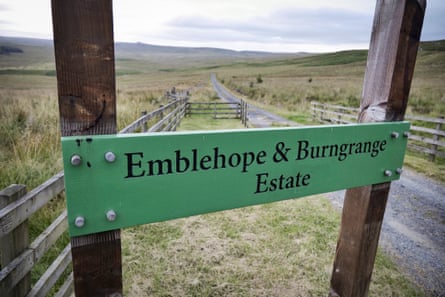
“We’re not the size of Yellowstone but we’re in England’s largest wild landscape by a long factor,” said Macdonald.
Emblehope, a site of special scientific interest (SSSI) which was managed for biodiversity by former owners the Royal Kennel Club for a number of years, already has exciting numbers of raptors, including merlin and prospecting golden eagles. The site’s streams still have trout and salmon, and there are red squirrels and pine martens in the area.
But Restore’s first tasks will be to return water to desiccated peat moorland and remove swaths of non-native sitka spruce.
A hidden network of land drains have left what should be water-soaked peatland completely parched. Patches of sphagnum moss that are usually water-filled sponges even in summer are dry. Modelling suggests Emblehope’s rewetted peat could store an additional 100,000 cubic metres of water, equivalent to about 40 Olympic swimming pools.
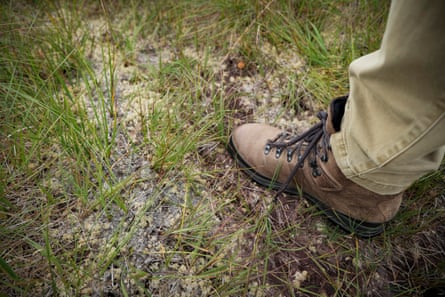
“It’s going to be a massive exercise to identify the exits of water from the land,” said Macdonald.
In the future, they will call on beavers to help hold back more water. There are promising patches of birch and willow growing beside one stream – beaver food – but Macdonald has witnessed beavers making dams out of heather on even more treeless moors in Norway and is confident they will thrive.
after newsletter promotion
Before that, there is a more urgent task for the ponies that are to be introduced on to the site.
The cattle- and sheep-grazing on the estate’s moorland was reduced by the previous owners on the advice of conservationists but Macdonald is alarmed by dry “thatch” beneath the thick tussocks of moorland grass. “It’s quite dangerous from a fire point of view,” he said. His priority is to get Exmoor ponies on to the site, because they will eat down the grassy thatch and reduce the fire risk.
Opening up the site to more diverse grazing animals will reduce aggressive grass species and increase the diversity of the sward. The grass is also currently too thick and long for curlew chicks to survive and find food, and so other species will benefit from the grazing animals.
Destined for the chop are dense sitka plantations, which harbour little life and raise predation to unnaturally high levels because goshawks lurk in them.
On Emblehope, the removal of the trees will hit a few species, such as long-eared owls and crossbills. But these will remain in the wider landscape because there are huge tracts of plantation forestry across neighbouring Kielder.
Restore plans to leave patches of a few older trees but admits the problem with retaining any sitka – and the problem with its Forestry England neighbours – are what Macdonald calls the “little shitkas”, the baby trees that pop up all over the wilding moors from wind-blown seed.
The solution is to plant broadleaved screens around the edge of the site to stop wind-blown sitka seed.
While Restore’s promotional videos have tantalised people with glimpses of lynx, Macdonald is wary of being seen to endorse moves to bring back the lost predator, which many rewilders view as an ideal solution to Britain’s overpopulation of wild deer. While a survey suggests 72% of local people are in favour of reintroducing lynx, many sheep farmers in the area are vehemently opposed to an animal that could make their working lives harder.
“We have no funded plans for lynx, and we have no wish to be in the reintroduction party,” said Macdonald, although he conceded “the economic argument [in favour] is compelling”. Research to be published next year will quantify the potential tourism bonanza to Northumberland.
Although there are proposals to release lynx into surrounding Kielder, one was blocked by Natural England and a second, the Wildlife Trusts-backed Missing Lynx project, is still consulting. Emblehope is unlikely to be a key habitat for the forest-dwelling animal.
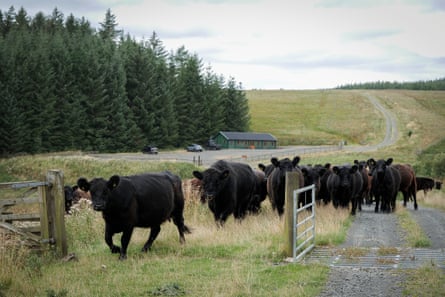
Despite Restore’s wilding manifesto, it is retaining the estate’s farmer and gamekeeper.
“What surprises me is how surprised people are that we’ve retained staff who know so much about the land,” said Macdonald. “The farmer is a real student of the history of grazing here and he’s very open-minded. The gamekeeper has been looking after some of Britain’s highest densities of birds of prey. These guys work 18-hour days, they live and breathe the area.”
Restore will fund the transformation of Emblehope via conventional income from forestry (removing the sitkas) and cattle, sheep and, in the future, education and carefully limited eco-tourism – as well as government environmental land management payments. But it expects most of its income to come from natural capital payments.
These include carbon credits for the sequestration in restored blanket bog and “30x30 Restore units” whereby corporations pay for the restoration of 30-metre by 30-metre patches of habitat. Restore’s vision is that corporations pay not for biodiversity outcomes but for conservation action on the land which provides more wildlife. Macdonald said: “It’s perfectly natural for large corporates to sponsor big sporting events across the world. In nature, in England, this is a big event.”