3 months ago
116
3 months ago
116
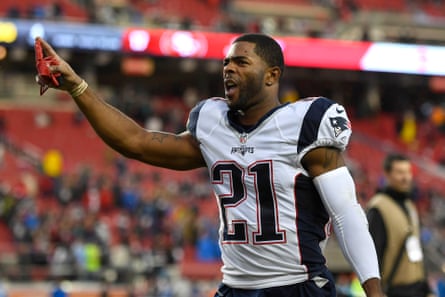
When the New England Patriots faced off against the Denver Broncos in this season’s AFC championship, Malcolm Butler was at home in Houston. He had considered attending the game in Denver or watching on TV in a No 21 Patriots jersey, which he wore in Foxboro for four seasons through the mid-to-late 2010s, but feared he might jinx the outcome. In the end, it was just him and his nerves for company.
Just as Butler was feeling somewhat at peace with that setup, and the Patriots’ prospects, a bad omen intruded: His wifi glitched, delaying the broadcast as the Patriots clung on to a three-point lead in the fourth-quarter. “I was lagging bad,” Butler tells the Guardian. “But I did get the wifi back working. And as soon as I did my phone was ringing like crazy, so I knew something was going right. It’s crazy that we’re back.”
With a 10-7 victory, New England booked their 10th Super Bowl appearance in the past 24 years and the team’s 12th overall. On Sunday, they’ll face Seattle in a rematch of the Patriots’ 28-24 victory over the Seahawks in 2015’s Super Bowl XLIX. Victory this Sunday at Levi’s Stadium in Santa Clara, California, would break the Patriots’ stalemate with the Pittsburgh Steelers for the most Super Bowl victories by a franchise ever, at seven. And New England’s success story couldn’t be told without Butler.
Two years into retirement, the 36-year-old remains one of football’s biggest emotional triggers – the defensive back who reshaped legacies and kindled a lasting firestorm on one mind-bending play. “It’s most definitely been life-changing,” he says. “It’s one of the best plays ever made in Super Bowl history – in NFL history.”
For those who somehow missed it: in Super Bowl XLIX, Seattle were four points behind against New England with a minute left. They had four cracks to all but win the game from the Patriots’ five-yard line. After Seattle’s Marshawn Lynch gained four yards to set up second-and-goal from England’s one-yard line, most assumed the Seahawks would hand the ball again to Lynch – the Skittles-scarfing bruiser whose impact was once measured on the Richter scale.
Instead, with a green light from head coach Pete Carroll, Seahawks offensive coordinator Darrell Bevell called a pass play – a quick slant to Ricardo Lockette. The basic idea: Jermaine Kearse, staggered just inside of Lockett on the far side of the field, would take out his man – Patriots corner Brandon Browner – and Lockette would slip in underneath the block for the catch and leave Butler, an undrafted rookie, in no-man’s land. The Seahawks had exploited the Patriots’ tight man coverage schemes throughout the game with their rub concepts. All Seattle quarterback Russell Willson needed was one more completion to revel in confetti as a two-time Super Bowl winner and, likely, the game’s MVP.
Allow content provided by a third party?
This article includes content hosted on embed.bsky.app. We ask for your permission before anything is loaded, as the provider may be using cookies and other technologies. To view this content, click 'Allow and continue'.
But in a turn no one watching – and I mean no one – saw coming, Butler thundered down to the goalline, crashed into Kearse and intercepted the pass to thwart the Seahawks comeback. Two Tom Brady kneel downs sealed a fourth Patriots’ Super Bowl win that still feels like a rip in the space-time continuum: The Seahawks had the game in the bag – and Malcolm Butler swiped the bag. “I ain’t got nothin but one job to do,” he remembers telling himself. “If they throw this ball, it’s mine.”
Butler’s interception still stands as one of the most dramatic plot twists to ever unfold with a championship on the line – more cosmically random than Bill Buckner’s between-the-legs World Series error or Steve Bartman’s NLCS souvenir, more crushing than the Golden State Warriors blowing a 3-1 NBA finals lead in 2016 or the Atlanta Falcons wasting a 28-3 Super Bowl lead, wilder than Zinedine Zidane headbutting himself out of the World Cup final, more outrageous than Lewis Hamilton’s being controversially denied an eighth F1 title. Down the years Carroll has said that the Seahawks would have definitely won more Super Bowls if a certain Patriots cornerback hadn’t gotten in the way. “Sometimes you can’t be greedy,” Butler says. “Just take the win. I don’t know if there was something wrong with who wanted to be MVP or whatever, but it’s selfish.”
A year before Butler’s epic turnover, I found myself in the Seahawks locker room after they crushed Denver 43-8 in Super Bowl XLVIII, watching defensive players mutter and shake their heads over not keeping Peyton Manning off the scoreboard entirely. It was terrifying to imagine all the winning this young team might do in the years ahead, simply in the name of pride.
But Butler’s pick cracked something fundamental in the Seahawks; once touted as a dynasty in the making, the Seahawks devolved into a Dynasty-level soap opera. Richard Sherman, Michael Bennett and other members of Seattle’s vaunted Legion of Boom defense came to publicly resent Wilson for, in their view, hoarding credit for the team’s success, and Carroll and general manager John Schneider for protecting the quarterback, opening a rift in the locker room that led to the defense’s dismantling.
Wilson slowly transformed from one of the NFL’s most admired players into its most polarizing; since being traded to Denver in 2022, he has bounced around two teams and could well wind up on a third when his contract with New York Giants expires in March. In 2024 the Seahawks parted ways with Carroll, the architect of their most successful era. Only Schneider hung on long enough to steer the Seahawks back in a Super Bowl – and with the franchise’s future ownership in flux amid talk of a post‑game sale, there’s no guarantee he’ll be around for the next one.
“We [were] at the peak of our careers with a chance to go ahead and start a dynasty,” Lynch said in a 2023 podcast appearance, “and we fumbled the bag on the [one]-yard line.” The Seahawks’ Bennett and Bruce Irvin only compounded the damage after Butler’s interception, drawing flags for encroachment and fighting as New England, already pushed back by penalties for their overzealous celebration of Butler’s pick, inched closer to their own end zone. Those Seattle penalties eliminated any chance of a fumbled snap, a safety or even a lucky touchdown if the Pats had somehow turned it over – leaving only two stress-free kneeldowns for Brady.
The fallout from the Seahawks’ choice not to run the ball, which helped start a streak that saw Brady win two more Super Bowls in New England over the next four years and now sets the stage for another possible run with second-year Patriots quarterback Drake Maye, has only made it easier to second‑guess that final play – and the Monday morning quarterbacking is hardly restricted to media and fans. In 2023 Carroll appeared on Richard Sherman’s podcast to unpack the whole episode and said he made the call based on feel. But – and consider this a flaming hot-take warning – not only was Carroll not numb to the situation, he made the correct call.
To recap: The Seahawks had four attempts at the end zone from the Patriots’ five-yard line with about a minute left – and a timeout in their pocket. It’s logical that at least one of those plays would be a pass to keep the Patriots’ defense guessing – and who better to pick on than Butler, a vagabond of college football’s lower tier who had agreed to sign with the Patriots for a deal that notably did not include a signing bonus. Kearse had already beaten Butler on a pair of completions earlier in the game, the most memorable a spectacular juggling catch on his back for a 33‑yard gain that put Seattle at New England’s doorstep just a few plays earlier.
After Lynch’s four-yard carry, the rub route was the next logical play call – and, with Butler playing eight yards off Kearse, it was set to work flawlessly. But Butler was well prepared. “Being around great coaches and players, you understand situational football,” he says. “From the one-yard line, the only thing Kearse can do is run a slant or an out route. I didn’t know the pick to set up the slant was coming, but I only had one job to do and that was cover the guy and make a play.”
With slightly better execution from the Seahawks, he might not have. “[Kearse] could have run a harder route to make us both break up the throw,” Butler says. “But I just wanted the ball more.” Still, he concedes the story might have been different if the game had come down to him and a handoff to Lynch, a running back it usually took a mob to bring down. “If they run the ball,” says Butler, who, at a listed 190lbs, was giving up at least 25lbs to Lynch back then. “I’m not making that tackle.”
“I cannot believe the call,” NBC’s Cris Collinsworth screeched on the telecast, oblivious to how much his outraged first-hand impression would shape future discussion of the touchdown pass that wasn’t. “If I lose the Super Bowl because Marshawn Lynch can’t get it in from the one-yard line, so be it. But there is no way … why?!” Conversely, had the pass play worked, Collinsworth almost certainly would have spun it as a testament to Carroll’s gumption and Bevell’s acumen, all while anointing Wilson the next Tom Brady.
While the Seahawks were reduced to a short-run playoff contender in the years after that play – “as catastrophic as any moment can be,” Carroll described it to Sherman in their 2023 sitdown – Butler cemented his place on the Patriots defense and added another championship after New England came back from 28‑3 down to win Super Bowl LI in 2017; years later, he signed a blockbuster contract worth more than $30m in guarantees with the Tennessee Titans to play for Mike Vrabel, the ex-Pats player turned coach who will lead New England against Seattle on Sunday.
After Brady was named the Super Bowl MVP against the Seahawks, he gave Butler the grand prize – a brand new Chevy Colorado pickup truck, the last car ever given to the game’s top performer. “Everybody that saw that play knows what it means,” says Butler. “But to me, it’s just waking up in my house, taking out the trash and looking at my Tom Brady truck.”
The good run of fortune is why he has no regrets about Bill Belichick suddenly benching him for the Patriots’ upset defeat to Philadelphia in the 2018 Super Bowl, and why he feels compelled to defend his former coach after his recent hall of fame snub. “This man is top three in everything he’s done: winning, postseason victories, Super Bowl rings,” says Butler, who also credits Belichick for facilitating his Patriots return in 2022, essentially as a retirement gesture. “I know sometimes you just gotta ignore stupid stuff, but I don’t agree with it.”
These days Butler dedicates himself to giving back – hosting free football camps at his Mississippi high school for the past 11 years, donating free coats and meals through the United Way and collaborating with the American Diabetes Association to raise awareness. For the past three years he has served as the volunteer assistant defensive backs coach at Houston’s St Thomas High, and the team hasn’t missed the playoffs yet. But Butler’s players’ loyalty to him doesn’t necessarily guarantee loyalty to his old team, a fact he learned not long after the Patriots-Seahawks matchup was set.
“A couple of my players are Seahawks fans. One of them texted me: ‘You’re not playing this time,’” says Butler. It’s not unlike the hesitant acknowledgements he receives from heartbroken Seahawks fans who respect the player, hate that game and remain endlessly haunted by the play that forever lives in championship infamy. “Usually, they’ll be like, ‘Good play, bro. We should’ve ran it.”
Every morning he wakes up grateful they never did.