3 months ago
135
3 months ago
135
Scrawled in chalk on the pavement near a secondary school in eastern Slovakia, the messages were short and to the point: “Enough Fico,” read one, echoing a popular anti-government slogan, while the other joked about the Slovakian prime minister providing sexual favours to Vladimir Putin.
Appearing hours before the prime minister, Robert Fico, was due to speak at the school, the messages struck a nerve. Similar comments swiftly began sprouting up across Slovakian pavements in what was labelled the “Chalk Revolution” by some and “November Chalk Wave” by others.
For the 19-year-old who scrawled the initial messages, the momentum came as a surprise. “I really didn’t expect it to become as big as it did,” said Michal, better known by his nickname Muro. “Apparently I’m not alone in my opinion.”
After hearing that Fico would be visiting his school, in the north-eastern city of Poprad, to give a lecture on Slovakian foreign policy in early November, Muro knew he had to do something.
For years, he had watched Fico, now in his fourth term, embrace a pro-Russian stance that sought to normalise relations with Moscow while challenging the EU’s policies over Ukraine. To Muro, who asked that his last name not be published, chalk messaging seemed a harmless way to express his exasperation with the government. In his eyes, it had done too little to address corruption and the soaring cost of living, and was investing little in education and healthcare, which was, in part, causing an exodus of young people.
Reaction to his chalk messages was swift. Fico postponed his visit, “which was funny because, damn, I would not want to be someone who is afraid of a chalk message”, said Muro. Police turned up at his school to bring him in for questioning.
Hours later, when he emerged from the police station without charges, a movement had got under way. “Social media did its thing,” said Muro. “And then the messages started pouring in.”
Across Slovakia, chalk has swiftly become a means for people to channel their frustrations with a government accused of rolling back human rights, steadily dismantling the rule of law and politicising the cultural landscape. It started with students posting images of their messages, traced out in chalk in front of schools or along the pavement that flank the country’s parliament, and soon swelled into a wider movement. “You could see it in almost every village, in every town, in squares and wherever,” said Muro.
It peaked just as Slovakia prepared to mark the anniversary of the 1989 Velvet Revolution, which helped to end to decades of communist rule in the former Czechoslovakia.
The result was a moment in which many sought to mark the past while questioning the direction in which the country was heading.
Thousands flocked to rallies organised by opposition parties and civic groups to deplore what they saw as democratic backsliding. “Fico attacks independent institutions, culture, media … exactly like the communists did,” the leader of the opposition Democrats, Jaroslav Naď, told the crowd.
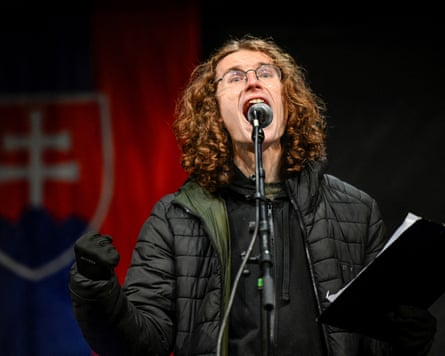
Muro, who echoed the concerns, was invited to speak at a rally in Bratislava after the chalk messages went viral. “I talked about the fact that we need to realise: what the hell are we actually voting for?” he said. “You’re voting for the return of everything you fought for 40 years to escape and to destroy. And now it’s back and you’re welcoming it with open arms.”
Weeks later, he spoke to the Guardian on a video call, flipping the camera to show snow on the ground when asked why the wave of messages had slowed. “It’s pretty hard to keep writing with chalk,” he said.
But the movement was far from over, he hoped, given that elections are scheduled for 2027. “The message needs to be said again, of course, but it needs to be said at a more relevant time, when people are actually deciding who to vote for.”
In recent weeks, protest actions have continued across Slovakia, from those opposed to the government replacing the country’s whistleblower office to the dozens of students, dressed in black, who walked out on Fico when the prime minister returned to Poprad to give his postponed lecture.
Meanwhile, Muro has found himself catapulted into the spotlight, facing both praise and a barrage of personal attacks, as government members liken him to the man accused of attempting to assassinate Fico last year, while others accuse him of being paid by Fico’s political opponents.
He brushed off the allegations: “I’m non-partisan, I don’t endorse any candidates or specific political party.”
For him, the focus is on the many people who joined him embracing chalk as a means to express their vexation. “Despite all the harassment I’m getting online, I still think it was the right thing to do,” he said. “I think it’s a great form of protest. It’s a great form of civil disobedience that is still obedient enough to not be legally prosecuted but express an opinion and in a pretty visible way.”