3 months ago
143
3 months ago
143
Countries should look to rewild their land borders as a deterrence to invasion and build up other geographical defences to attack, Europe’s environment chief has said.
Jessika Roswall, the EU’s commissioner for the environment, water resilience and a competitive circular economy, said nature should be used to improve national security. “Investing in nature and using nature as a natural border control is necessary, and actually increases biodiversity. It’s a win-win,” she said.
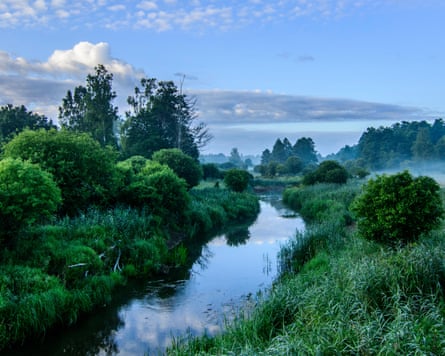
Poland and Finland, which both share land borders with Russia or Russian allies, have rewilded areas near their frontiers, making invasion more difficult. “I’ve visited them: they transfer the land to more hostile nature, leaving bushes and trees. Then it’s not so easy for others to cross it,” she told the Guardian.
Restoring wetlands also provided a natural barrier, she added. “It’s very difficult for big tanks to go through.”
Roswall wants countries to treat nature as a defence asset, and to consider the national security implications of their environmental failures. Having a thriving natural environment was a core part of food supply and water security, both of which should be seen as essential national security assets, she said.
“We need to invest in nature. Water is the most obvious example. If we don’t have water, we don’t have [security]. Look at Ukraine [where water infrastructure is under attack]. It is crucial to invest in the infrastructure, and protect the infrastructure,” she said.
Protecting towns and cities against flooding should also be seen in security terms, she argued, in an interview with the Guardian before the US-Israel invasion of Iran. To reduce the impact of floods and droughts, “we have to invest in nature – nature-based solutions like sponge cities”, she said. “That’s also a security issue. It’s another part of security.”
Many parts of Europe were already “absolutely at water crisis”, she said, owing to scarcity, pressure on resources and in some cases a lack of rainfall. Though these problems varied according to region, one further problem was common to all, she added, and needed to be tackled urgently. “If you look at pollution, the quality of water, you have a problem all over Europe,” she warned. “We are at a junction where we really need to focus on water. We need to work together when it comes to water scarcity, but also the quality of water.”
She refused to say whether the UK, whose problems with sewage pollution began before Brexit but have received government attention since leaving the EU, should look to nationalise its water industry, which is the norm in EU states. “The main objective is to have affordable water to everyone, we are not addressing who is managing water plants.”
Roswall also wants the EU to address the issue of “forever chemicals”, known as Pfas, which have not been subject to strong controls to date, and whose risks to human health, through water and soil contamination, have only recently been understood. “I am really trying to push to speed this up, so we can give some clearance and guidance this year,” she said.
She pointed to the pharmaceutical and cosmetic industries as two potential polluters who should have to pay for cleanups, but said others could also be on the hook, as well as governments. “The cleanup is bigger than that, because we have a lot of contaminated hotspots where we probably don’t know who is the polluter. And at the end of the day, some of this might have to be paid for with public money.”
Roswall played down rows between the UK and the EU over the divergence of the UK from the EU’s high environmental standards since Brexit, and insisted that the EU was not backing down on its green agenda in the face of opposition from rightwing populists.
“I met Emma Reynolds [the UK environment secretary] many times, and I think we both share the same view of objectives, that having high ambition when it comes to environmental standards is a necessity, not only to the planet but also our industries, [which are] dependent on a healthy environment,” she said. “This is not just good to have – it’s about our prosperity, our competitiveness and our security.”
She added: “We are not backtracking [on efforts to cut greenhouse gas emissions and protect nature]. We are doing it green and clean. We are focusing on implementing [environmental standards] but we need to do it in and efficient and simplified way. We’re doing this because our industries are doing the green transition, knowing that this is the most competitive advantage they have in the world we are living in.”