2 months ago
33
2 months ago
33
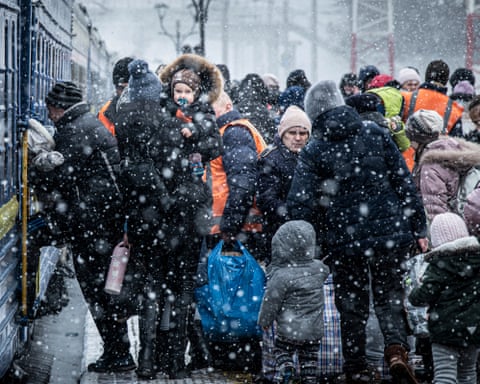
From fierce flooding and escaped pigs to birds that can’t fly due to the weight of plastic in their stomachs, mankind’s biggest challenges are on stark display at Summit Photo 2026
Desperate scenes … refugees from Mykolayiv leave Odesa railway station bound for Lviv. Photograph: Simon TownsleyThu 16 Jul 2026 08.00 CESTLast modified on Thu 16 Jul 2026 10.58 CEST
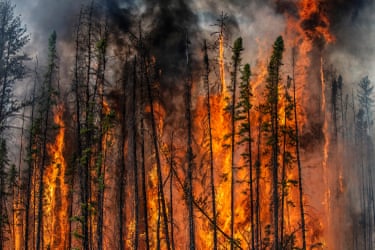
James Balog: Flame Front #6 near Fort Providence, Northwest Territories, Canada, 2015
Summit Photo, the Royal Geographical Society’s interactive forum, celebrates the power of environmental and humanitarian photography and film-making, bringing together some of the world’s leading photojournalists and film-makers to confront the defining ecological and human challenges of our time. Summit Photo runs 17–19 July, in London and onlinePhotograph: Earth Vision Institute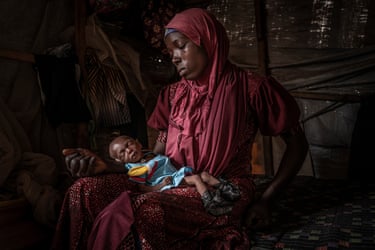
Simon Townsley: Bashirya Murtala, 20, and Rahila, two months
Nigeria is enduring a serious economic crisis. Initiated by the removal of fuel subsidies and exacerbated by a fragile security environment, the country now faces immense food insecurity. Displaced families take refuge in the partially built ‘Emir’s Palace’ in Anka, north-western Zamfara state. Bashirya Murtala and Rahila arrived at the palace three years ago. Driven off their farm by bandits, her husband now earns just 500 naira a day, a quarter of a British penny.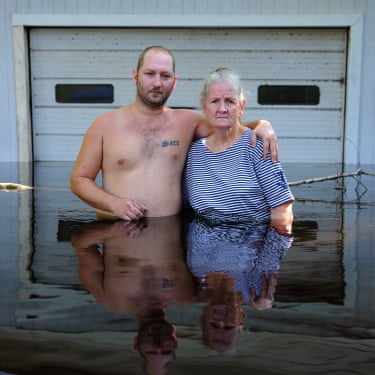
Gideon Mendel: Terrence McKeen with his mother, Gloria, Middleburg
Hurricane Irma caused huge amounts of flooding, death and destruction in its path. ‘The water surged to over 28ft, completely covering our one-storey house, the home that I grew up in,’ says Terrence. ‘There’s no way to describe the pain I felt when we returned. My mom and I burst into tears. Everything was gone. Climate change played a big part in this. The only time it isn’t 100 degrees round here is winter time. But we will never be homeless. My family is here for me, and so are my friends. People close to us have our backs.’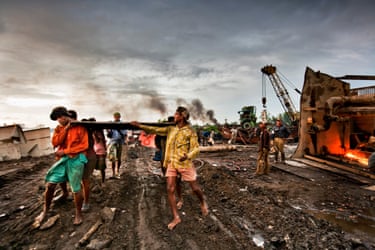
Shahidul Alam: Workers at Shipbreaking Yard,
Chittagong, Bangladesh, 2008Shipbreaking workers carrying metal sheets that can weigh up to a ton. Such heavy loads require extreme coordination. A misstep could lead to serious injury and possible death. In order to walk in unison, the workers sing songs to keep rhythm as they walk barefoot over the slippery muddy clay. Workers die and suffer injuries on a regular basis. Some receive modest compensation, others do not. According to workers, many deaths are simply not registered, with the bodies being ‘disappeared’ by the owners.Photograph: Drik/Majority World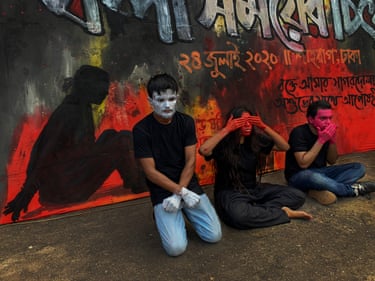
Shahidul Alam: The cry of the imprisoned
A 2020 protest organised by Baki Billah, Sarwar Tushar and Shaikat Amin against the imprisonment of journalists, writers, poets, cartoonists and other artists under Bangladesh’s draconian Digital Security Act. The event featured songs, poetry, drama, illustrations and film at Shahbag Square in Dhaka, the Bangladeshi equivalent of Egypt’s Tahrir Square. A record number of arrests were made during the Covid-19 period. Here we see artists Sohan Mahmud, Humaira Fehrooz and Khuddho Ganguly perform at the event.Photograph: Drik/Majority World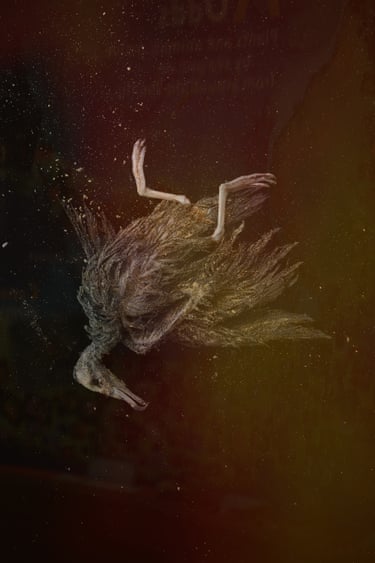
Mandy Barker: Still Falling, Flesh-Footed Shearwater
Barker joined scientists on Lord Howe Island (situated between Australia and New Zealand) in April 2019 during the short window of time when the fledgling chicks leave their burrows and migrate to the Sea of Japan to begin their new life. Instead, with the scientists, Barker found the birds dying on the shoreline, unable to fly because of the weight of plastic in their stomachs. This work is a response to the ongoing situation on Lord Howe Island and the increasing decline of the flesh-footed shearwater.Photograph: Mandy Barker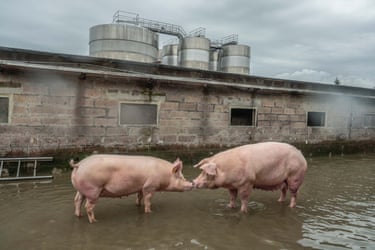
Selene Magnolia Gatti: May 2023, Lugo, Emilia-Romagna, Italy
These pigs survived in a pig factory farm that had been severely affected by floods. Canals and rivers in the area had overflown after heavy rains and extreme weather conditions. The floods came after years of severe drought in the region, which compacted the soil, reducing its ability to absorb rainfall. Factory farms can create a biological health risk after weather-related catastrophes, contaminating water with pollutants and waste.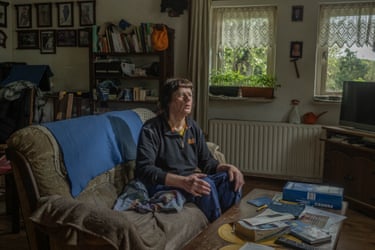
Selene Magnolia Gatti: Zeeland, Brabant, Netherlands, April 2024
Portrait of Jan, a local resident who lives a few metres away from a large pig factory farm. Jan’s health is affected by the presence of the farm. He is also a Q fever survivor still struggling with the long-term impacts of the disease.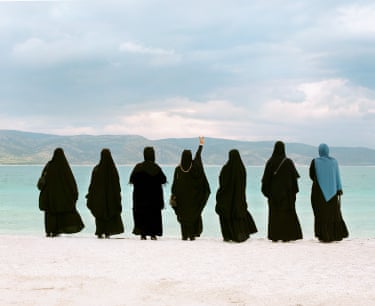
Rhiannon Adam: Three generations, Lake Salda
Three generations of Muslim women on the banks of Lake Salda, AKA ‘the Turkish Maldives’; which is also Earth’s closest match to the geology and mineralogy of the Jezero crater on Mars. To avoid Haram, the women’s backs are turned away from the camera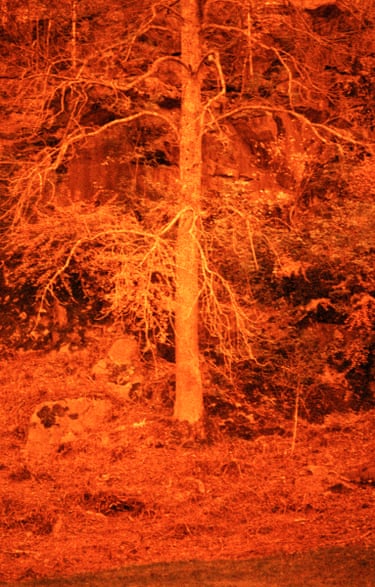
Erdiola Kanda Mustafaj: The landscape of shadows from An Unusual Face, Stockholm, 2025
Mustafaj is the recipient of the Hidden Narratives Residency, a collaboration between the Italian Cultural Institute, Photoworks and the Royal Geographic Society. It embeds contemporary artistic practice in one of the most significant, worldwide geographical image collections. The residency activates the archive as a site of enquiry where photographs are re-read through present crises. Mustafaj’s selection reflects a shared institutional interest in landscape, displacement and environmental memory,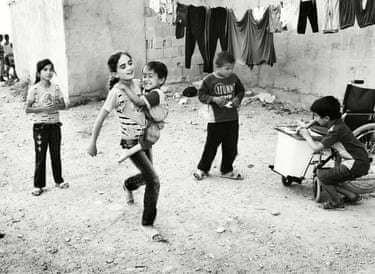
Giles Duley: Aya, Lebanon, 2014
Aya, 7, has spina bifida, and after losing her Syrian home in 2012 the family fled to Lebanon, where they camped by a cement factory. Conditions were difficult and they were moved to Tripoli, before finally being relocated to France. ‘Aya struggles to sleep,’ explained Sihan, ‘but on the first night I was able to say to her, “it’s OK Aya, this is your home now”.’ Aya is in school and receiving full support for her medical needs. She is enjoying her education, playing with friends and being fully integrated in her local community.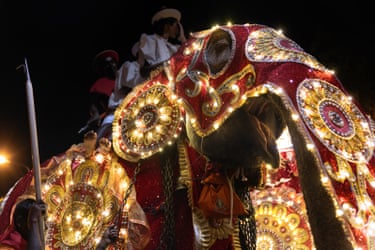
Aaron Gekoski: Under the Lights
An elephant carries riders through the Colombo streets during the Perahera. The heavy fabric obscures her ears, restricting movement and limiting one of the primary ways of regulating body heat, whilst exposed to loud music and crowds. Elephants are central to the Perahera procession, symbolising power, protection, and continuity, but welfare concerns persist. This event is organised in partnership with the Royal Geographical Society, Photoworks and the Royal Photographic Society, and supported by official sponsor Rolex. https://www.rgs.org/events/summit-photoExplore more on these topics