3 months ago
129
3 months ago
129
Women’s rights activists in Chile are bracing as the most conservative president since the Pinochet dictatorship prepares to take office on Wednesday.
José Antonio Kast, a 60-year-old ultra Catholic whose father was a member of the Nazi party, has consistently blocked progressive bids for women’s rights and equality across his three-decade career in politics.
As a congressman, Kast voted against divorce when Chile became one of the last countries of the world to legalise it in 2004 and vehemently opposed the legalisation of abortion under limited exceptions when it was passed in 2017. He has since pushed to revert to a total ban on abortion and require parental consent for the morning-after pill.
Chile allowed abortion for medical reasons from the 1930s until Gen Augusto Pinochet issued a total ban in 1989 as one of his final decrees. An unapologetic supporter of Pinochet, Kast upholds much of the regime’s antiquated values on society and patriarchal family order.
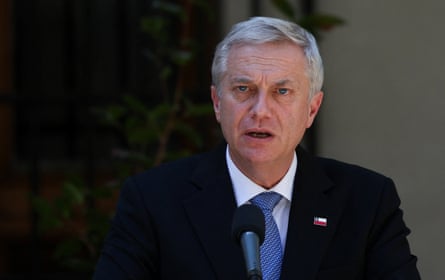
Such regressive views stand in contrast to feminist and gay rights movements across Latin America since the 2010s, including the “green wave” that successfully pushed for free abortion rights in Argentina, Colombia and some Mexican states.
Kast’s appointment of 30-year-old evangelical Judith Marín as women and gender equality minister further underscores his hardline stance. Marín, an anti-abortion activist, disrupted a senate session on abortion decriminalisation in 2017, shouting “return to the lord” while being forcibly ejected by police.
Andrea Álvarez Carimoney, assistant professor in public health at the University of Chile, said: “It’s very provocative, because this person – whose opinions were once considered marginal – is now going to be the one who holds power.”

Kast was a founding member of the Republican party, whose members in 2023 announced plans to repeal the current abortion law, which permits access under the exceptions of rape, if the mother’s life is in danger, or if the foetus is unviable.
While Kast focused his presidential bid on issues of immigration and security, he has said his stance regarding abortion has not changed.
“They could make access to abortion much more complex,” says Álvarez, explaining that even without the backing to abolish the current abortion law, the government could modify the three legal exceptions to restrict access further.
Government statistics show that around 7,000 legal abortions have taken place since the three-exceptions clause was introduced in 2017, but studies estimate that more than 100,000 induced abortions take place each year in Chile.
Divisions within Chile’s feminist groups have also strained attempt to protect hard-won rights.
The movement brought hundreds of thousands of women into the street and was a major engine behind a 2022 effort to rewrite the country’s Pinochet-era constitution. The new draft enshrined abortion as a constitutional right alongside equal participation quotas for women in public institutions.
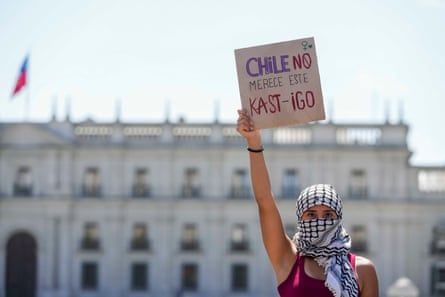
But it was criticised as being unnecessarily complicated and far-reaching, and the public emphatically voted against it. A second attempt to rewrite the constitution was led by Kast’s Republican party in 2023, which similarly failed for its explicit partisan bias.
The performance of the outgoing Boric administration, which labelled itself as “feminist”, has also caused divisions among activists, with some criticising the government for delaying the presentation of a free abortion bill, which only entered congress in 2025.
“Boric campaigned on reproductive rights and our autonomy to decide, but introduced the bill too late and without enough momentum to push it through in the parliamentary debate,” said Vesna Madariaga, a spokesperson for the Coordinadora Feminista 8M, one of Chile’s largest feminist organisations.
The outgoing women and gender minister, Antonia Orellana, defended the government’s actions, saying its priority had been to improve conditions for those requiring abortion under the three-exceptions rule.
This has included an inspection manual for health professionals to ensure compliance and issue fines to any medical worker or institution that violates the rights of those seeking abortions.
She said the government had also lacked a majority in congress to ensure backing for the wider abortion bill, which seeks to allow termination up to 14 weeks: “We have a legislative minority. Where do we move forward?”
She added that public approval for the wider abortion bill had reached a record high during their government. “In Latin America, for many years, the strategy has been to promote social debate to generate majority in favour of abortion, leading to its legalisation.”
Despite the recent setbacks, Sunday’s annual International Women’s Day march drew an estimated 500,000 women to the streets, demonstrating the persistent force of the feminist movement.

Members of the grassroots abortion network Con las Amigas y En La Casa were among hundreds of groups taking over Santiago’s central avenue, shouting pro-choice chants through a loudspeaker in unison.
With multiple chapters across the country, the network provides vetted information on the safe use of medication for those facing unwanted pregnancies. While their social media channels have repeatedly been blocked over complaints by anti-abortion campaigners, the group has existed for over 10 years and has amassed nearly 170,000 followers on Instagram.
“Women are having abortions right now, they will be doing it tomorrow, and they will keep doing it – no rightwing government will stop that,” said one member, who asked not to be named. “Kast is very dangerous, but we know that women in Chile are strong and organised. We are confident we will keep moving forward.”