5 hours ago
5
5 hours ago
5
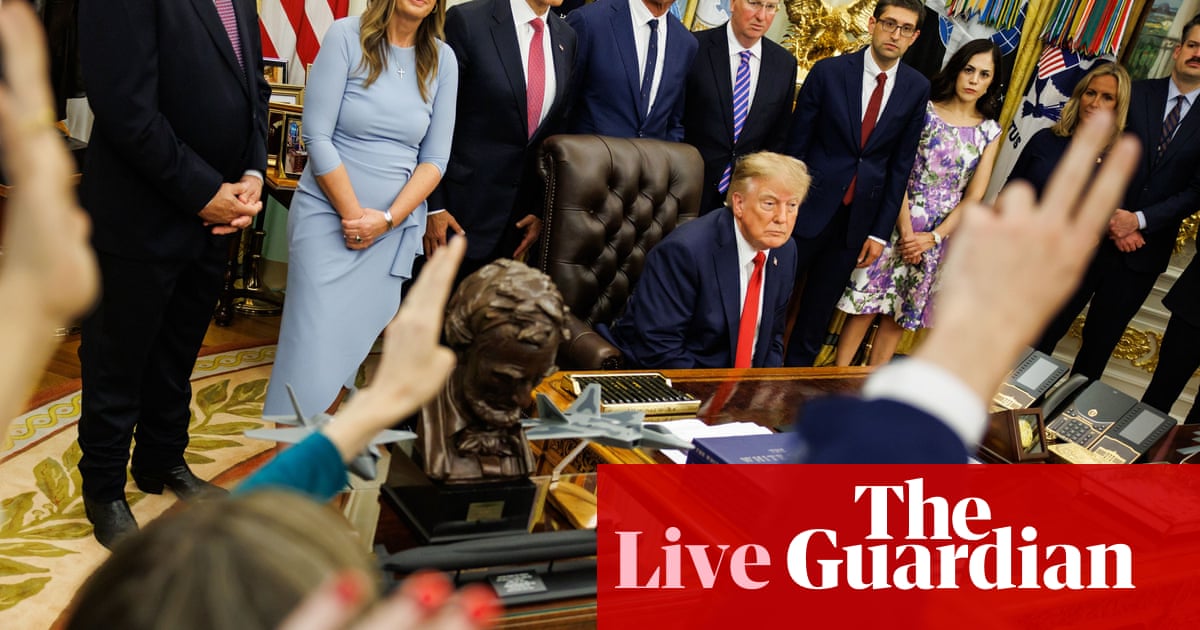
Donald Trump is “so much a creature of the 80s but even in the 80s, everyone made fun of him,” Jonathan Kaufman said. General Electric CEO Jack Welch, “the most prominent business figure in the country, maybe in the world, mocked him. No one took him seriously.
“Even today, if you look at the [White House] ballroom, you look at all the things he’s doing, it’s this 1980s aesthetic, right? You can just see the way he looks at the world: the glitz, the cheapness, the gold brocade everywhere. That screams 1980s. All he needs is big hair and leg warmers and listening to, I don’t know, synthetic pop, and he’d be right back in 1985.”
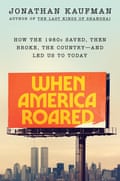
Kaufman’s new book, When America Roared, tells the story of “How the 1980s Saved, then Broke, the Country – and Led Us to Today”, a time when Trump has to be taken seriously as he breaks us all over again.
A Pulitzer-winning reporter, Kaufman worked in the 80s for the Boston Globe and the Wall Street Journal. Now director of the School of Journalism at Northeastern University and the author of three books on Jewish culture and history, he has written a page-turning account of the decade, its activists and reactionaries, its failures and successes. Trump included.
“All my books have been in a sense biographies, trying to understand through people,” Kaufman said. “I think there’s this tendency to talk about the 1980s or the 1960s as if they’re this concept that sort of landed and changed everything but in fact it was people making decisions, so some of the choices [of subjects] were prominent. Jack Welch: that’s an easy call if you’re writing about business.”
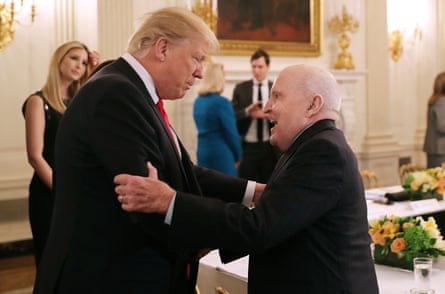
Welch died in 2020, aged 84. Kaufman shows how at GE he broke the American corporate model, energizing profits but brutalizing workers, his blast-like impact earning him the nickname “Neutron Jack”. A complex character, his portrait in When America Roared is rigorously journalistic, sympathetic but unsparing. It arrives with the fruits of his labor present for all to see, in figures showing US workers are less rewarded than at any time on record.
Also “intrigued by some of the things that were going on that maybe didn’t get as much attention”, Kaufman “was drawn to Karen Nussbaum”, the feminist labor leader and activist, still campaigning at 76, decades after providing the name and “the inspiration for the film 9 to 5, which Dolly Parton wrote the famous song for and which was a huge movie that came out in December 1980. Ronald Reagan loved it. If you watch it today, it’s still a great film. It’s a comedy with Jane Fonda, but the real story wasn’t known as well, and I wanted to understand that.
“John Rogers was someone I’d met in the 80s who is now the most prominent Black person on Wall Street. When I met him, he had just opened this little firm in Chicago, and he had voted for Reagan. I was working for the Journal, so he was a great source for me. But then over time, when I went back to him, he had become very close to Barack Obama, and his views had changed.
“In a way, the most intriguing person I wrote about was someone I’d lost touch with: my old college roommate, Evan Wolfson. We were at a reunion, and people were coming up to him almost as if he was kind of this mythical figure. He led the gay marriage movement. It succeeded in 2015 but he came up with the idea in the 1980s. He was at Harvard Law School and wrote this 100-plus-page paper about gay marriage, and everyone laughed at him. It seemed such an absurd idea. Aids was everywhere. I reconnected with him, then discovered that he had really put together this extraordinary strategy of how to win gay marriage, which I think today is relevant because once again we’re in very conservative times.”
Journalism and history have their cliches: journalism is the first draft of history, history teaches us to avoid past mistakes. A journalist at the time he now writes about, Kaufman aimed to write “the second draft of history”, a highly readable story with lessons to teach.
Considering “people who were maybe below the radar who had more of an impact than we thought”, Kaufman said “probably the most important of those is this fellow Mark Fowler, who was sort of an obscure bureaucrat”, Federal Communications Commission chair under Ronald Reagan.
“My wife [Barbara Howard] is also a journalist. And when we started going out in the 80s, she was working in radio journalism for commercial stations, and she used rail about the FCC. I was like, ‘Who ever heard of the FCC? Who cares?’ But she was talking about deregulation and what was going on, and was she right … I connected with Fowler [now 84], and he turns out to have been pivotal in all the media changes. He paved the way for Rupert Murdoch to move into television, paved the way for the polarization of media.”
Reading Kaufman’s account of how Fowler – “a very charming guy, I have to say, very affable” – made possible Fox News and all that came with it, Rush Limbaugh and talk radio too, it’s impossible not to think of Brendan Carr, Trump’s FCC hatchet man attacking critics, clearing the way for rightwing voices, mocking first amendment rights. Speaking to Kaufman, Fowler disapproved of Trump’s methods and character but approved of his results. It’s a pointer to why so many Americans have tolerated Trump’s brutal assault on norms and structures beyond the media sphere. For free marketeers as well as anti-woke warriors, Trump has delivered.
“The Democrats could not figure out for 12 years how to beat Reagan,” Kaufman said. “That’s something very important to think about because I think the Democrats are going through some of the same disputes now: liberal versus conservative, ‘Are we out of touch?’
“But it also struck me that Republicans always talk about the ‘deep state’ and this belief that it runs everything. Frankly, if you look at deregulation of the media, or how the Federalist Society started rebuilding the judiciary , it’s the Republicans who created the deep state, in many ways – and incredibly effectively, too. I think they systematically changed the way people think about business. They changed the media. They clearly changed the courts, and now that thinking continues in their war against universities and so forth.”
Trump may have been formed by the mob lawyer Roy Cohn, who he met in the 70s, but he came to fame in the 80s. His rise to the White House in 2016 would not have been predicted in that day-glo decade, but here we are. Republicans “did get everything they wanted”, Kaufman said, “and I think Democrats and liberals are still flailing around, trying to figure out how did they do it, and how do we fight back.”
-
When America Roared is out now