3 months ago
181
3 months ago
181
Donald Trump is not impressed by soft power. He respects hard men with military muscle. But he can be moved by pageantry, which is the purpose of King Charles’s visit to Washington this week. Trump is flattered to rub shoulders with majesty. The good vibes are then supposed to radiate warmth through a political relationship that has been chilled by the war in Iran.
It might work, but not for long. Trump’s irritation with Keir Starmer and other European leaders for what he calls cowardice in the Middle East is aggravated daily by evidence that the war is a strategic calamity.
The president seems incapable of admitting fault or conceding that an adversary has outsmarted him. Blaming Nato freeloaders is an attractive alternative to taking responsibility for the mess he has made.
The vengeful mood in Washington was revealed in a leaked Pentagon memo suggesting the US could oppose Britain’s claim to the Falkland Islands. Trump has threatened to bin UK-US trade deals and impose new tariffs.
This sharpens the focus on something that was already pretty clear. The current White House administration doesn’t do alliances, except on the model of a protection racket. The price is paid in sovereignty: let the boss use your military bases; drop taxes and regulations for his cronies’ businesses; give him Greenland. He doesn’t like to be told no.
Adapting to this mercenary approach has not been easy for Britain. The asymmetry of power is familiar, but there is a difference between the US as domineering sibling and imperial master.
More alarming still is the way this imbalance grows in a world where the US, spurred by rivalry with China, is pulling away from Europe in terms of technological power.
That concern was raised in a speech yesterday by Liz Kendall, the science, innovation and technology secretary. She argued that AI is the “currency of the future”, buying economic, scientific and military advantages. Countries such as Britain are at risk of dependency on a handful of companies with oligopolistic control over vital digital infrastructure.
A speech on AI sovereignty was never likely to draw Westminster attention away from the ongoing Peter Mandelson saga, although the issues Kendall raises will be relevant long after everyone has forgotten who was alleged to have put pressure on whom to expedite a diplomatic vetting process.
Coincidentally, Mandelson’s last public policy intervention as ambassador, only days before he was sacked, was a lecture on the geopolitics of technology. He argued that Britain was destined to side with Washington in a world carved into Chinese and US spheres of digital influence.
Kendall takes a different view, calling for cooperation among “middle powers” – fellow democracies in Europe, Japan, South Korea, Canada and Oceania – to develop a resilient digital ecosystem that isn’t reliant on “the powerful, unaccountable few”. That echoes the call by the Canadian prime minister, Mark Carney, at Davos earlier this year for a strategic alliance of law-abiding, middle-ranking powers to balance out the bullying swagger of authoritarian behemoths.
Each step-change in AI heightens the urgency. Even if you correct for marketing hype and take grandiose forecasts of godlike intelligence out of the equation, the machines are getting fiercely good at tasks that frighten politicians. Mythos, the newest version of Anthropic’s Claude model, is so efficient at finding flaws in computer code – making it a potential cyber super-weapon – that the company last week said it was restricting access to a handful of trusted users.
Sceptics speculate that Anthropic’s caution may have been a stunt to ramp up excitement about the product, and that maybe the company just lacked the computing power to serve too many users anyway, but Mythos’s hacking prowess has been attested independently.
Anthropic’s chief executive, Dario Amodei, seems more safety-conscious than some of his peers. His company has been blacklisted as a national security risk by the Trump administration because it refused to license Claude for use in autonomous lethal weapons systems and domestic surveillance.
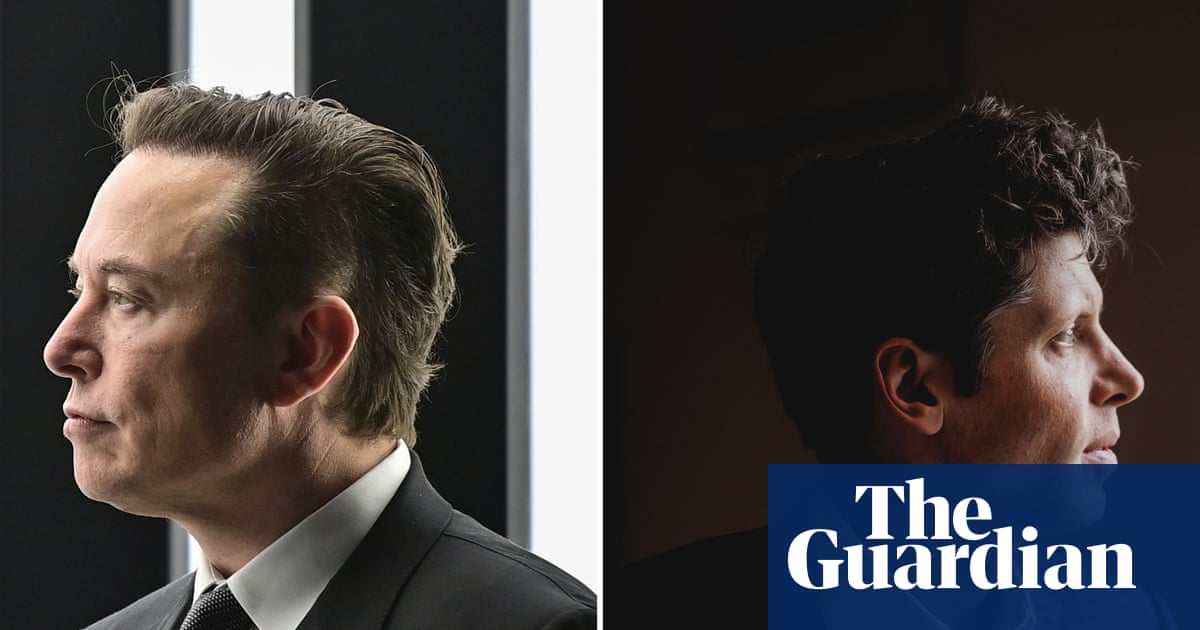
Tech-bro ethics are not a reliable regulatory system. Sam Altman, CEO of OpenAI, creator of ChatGPT, comes across from well-sourced profiles as a man whose ruthless ambition verges on the sociopathic. Earlier this month, Alex Karp of Palantir, a data company with close Pentagon ties and whose systems are also embedded in NHS and Ministry of Defence IT networks, published a manifesto rejecting “vacant and hollow pluralism” in politics. He made it clear that Palantir’s mission is to serve US economic and cultural supremacy. That was posted on X, the social media plaything of Elon Musk, a prolific disseminator of far-right propaganda whose AI chatbot, Grok, once called itself “MechaHitler”.
Musk owns Starlink, a satellite communications network that has been vital to Ukraine’s ability to function under Russian attack. UK ministers and advisers who have discussed the scenario where Musk controls the flow of military intelligence in a European war find the prospect, as one puts it, “terrifying”.
Mitigating tech dependency is not straightforward. For the foreseeable future, US companies are essential sources of investment. Businesses linked to the Chinese Communist party are hardly more attractive. Building any kind of indigenous capability is fraught with political tensions and cost constraints.
Brexit, as ever, complicates the picture. There is tension between the theoretical benefit of nimble regulatory autonomy outside the EU and the gravitational pull of alignment with the single market. Computing infrastructure is spectacularly greedy for energy and thirsty for water. Ugly, carbon-intensive datacentres that employ a few hundred people at most are not everyone’s idea of an industrial renaissance. A backlash against them is well under way in the US.
The current exuberant mood around AI investment and claims about its potential are exactly what you would expect in a bubble shortly before it bursts. That doesn’t negate the likelihood that this is a transformational technology. Boom and bust cycles in 19th-century railways didn’t disprove the importance of trains. The internet still mattered when the great dot-com bubble of the 90s burst. AI doesn’t have to fulfil the wilder predictions of its sci-fi evangelists to change global power dynamics to the detriment of countries that get left behind. That is already happening.
Many of the people driving this change look driven by greed and millenarian fanaticism. The most extreme among them see dissent as impurity and global governance as a conspiracy against the US by failing, degenerate civilisations.
The tools they are developing have the potential to be more effective as instruments of political influence and economic coercion than anything the current White House administration uses to bend foreign leaders to its will.
Trump is volatile, capricious and unreasonable. He also has simple appetites. He likes money and status. He can be charmed by a king. The fulfilment of his tyrannical temperament is circumscribed by organic, human weaknesses – vanity, stupidity, age. It hardly feels like a mercy now, but Trump’s ambition is contained within the old world of analogue power. He could be the last president of whom that might be said.
-
Rafael Behr is a Guardian columnist