3 months ago
188
3 months ago
188
“It’s an exercise that is necessary and frankly has been missing for the past 47 years,” said Mehrdad Marty Youssefiani, a founding member of a new group seeking to act as an umbrella for Iran’s disparate exiled opposition.
The Iran Freedom Congress – which includes republicans and monarchists, Marxists, right and centre – met for the first time last month in London, aiming to create an ethnically diverse “platform for coordination, dialogue, and cooperation between Iranian pro-democracy and pluralist individuals, parties, institutions, and organisations”. Since the conference, the body has been given a legal entity, and elections for a chief executive are under way.
It does not claim to be a government in waiting, or a new political party. “We cannot claim from exile to return after 47 years and run a country which is by and large foreign to those that have not been there for 50 years,” said Youssefiani, who until 2018 was an adviser to Reza Pahlavi, the son of the former shah. “The patronage or help must come to those inside Iran who are capable of moving the needle.”
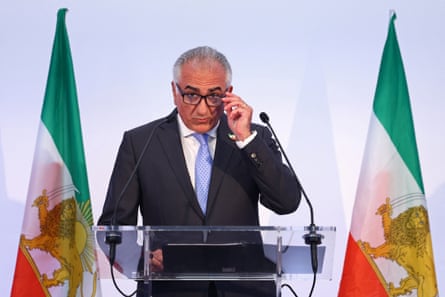
He said the group had a “responsibility to break out of the classic pitfalls of exile politics by creating a pluralist movement to help the democratic forces inside the country”.
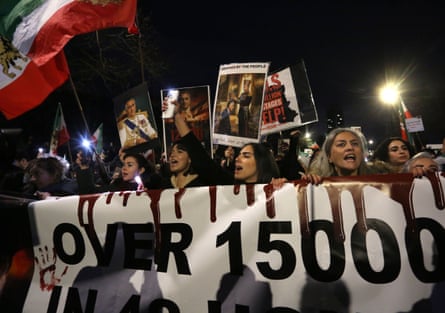
The bloody crackdown on anti-regime protests at the start of this year was the catalyst for many of its now members. “After the shock of thousands [being] slaughtered in January … the moment came when we said: ‘Enough is enough,’” Youssefiani said. “At the time the threat of war was looming. We just saw our boys and girls killed and we equally share the blame, or the shame of this. For too long there was a lack of imagination, there was only classic exile politics, an inability to get along. It was a terrible failure.”
Funding for the group has largely come from Majid Zamani, the founder of investment company Kian Capital, who was previously jailed in Iran for his support of the Green Movement in 2009.
Former political prisoners and longstanding opposition intellectuals have all been involved. The political breadth of the congress can either be seen as mature pluralism or a source of incoherence. The group rejected sending an invitation to Pahlavi – and, due to divisions, decided to take no position on the US-Israeli attack. Middle East Eye published emails showing pro-Israeli lobbyists were active around the group, unknown to the organisers, and Youssefiani works for the Middle East Forum, an Israeli-sympathetic thinktank in Washington.
The congress has to navigate between the movement surrounding Pahlavi, which sees him as a future leader, and the rhetoric and actions of the US president, Donald Trump.
“Arms will not bring democratic change, as we have seen, and we worry about what is the end goal of the war,” said Youssefian. “No one has defined what is peace, and this is where our problem is. Personally I am enormously concerned by the war, since the outcome was not thought through. There were those that thought they could chop off the head of the snake, and all would fall into place, but that misunderstands Iran.”
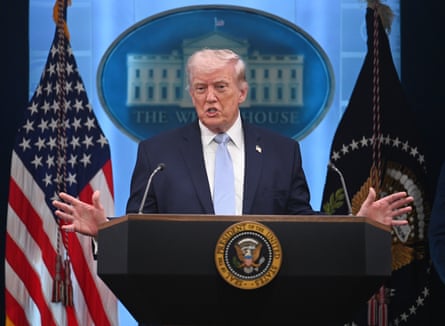
He said Trump’s threat that a “whole civilisation will die tonight, never to be brought back again” was disastrous in that it forced the people closer to a regime they despised. “When 90 million Iranians hear these words, they see them as a threat to their existence, not to their government,” he said. The sight of some in the diaspora celebrating the bombing had caused incalculable political damage, he added.
“The war has gone on so long we worry the impact on civil society – that campaign of civil disobedience – has been severely crippled,” he said. “So if the regime survives, there may be no appetite for reform, or the regime will have no choice but to use the heavy hand of repression. One thing is for sure: there has been no regime change.”
Youssefian said he was not ruling out any outcome in Iran so long as it was democratically reached. However, he clearly feels concerned with the brand of Pahlavi, his former colleague, and the way in which the monarchist movement has been positioned, saying Pahlavi had neglected strategic nuance while some of his followers had displayed a “blind acceptance” of Trumpian rhetoric.
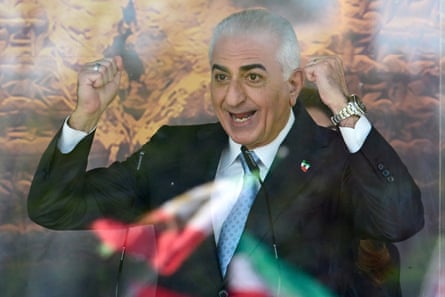
“One assumed, when Pahlavi offered with great confidence that more than 100,000 Islamic Revolutionary Guard Corps (IRGC) and uniformed asset had defected to him and would rise up, he offered hope and confidence to Iranians inside Iran,” he said. “I remain devastated not to have seen any evidence of that, and so thousands of mourning families, if not already, will ask: what went wrong? Who misinformed whom?
“I cannot know the answer because I don’t know the details. And yes, it’s easy to be a Monday morning quarterback, but every word of advice, position and tweet of a sovereign matters.”
Will the regime crumble if the pressure continues? “The difficulty in Iran today is that those who own and control the guns also own and control the butter,” said Youssefian. “The IRGC own and control billion-dollar enterprises. If there is a defeat, these people are not going to go to Paris or London. Their wealth, power and assets and their ideology is deeply rooted in Iran’s ground.”
He said regime change would require the regime to have lost legitimacy, the repression machine to weaken and an inclusive plural movement inside Iran to emerge that could credibly replace the regime. “All we can do is help in this process.”