3 months ago
117
3 months ago
117
'Iran is not seeking war but is fully prepared for war' - foreign minister
We have some more comments from Iran’s foreign minister Abbas Araghchi, who has been addressing foreign ambassadors in Tehran.
“The Islamic Republic of Iran is not seeking war but is fully prepared for war,” he said, as he warned adversaries against any “miscalculation”.
“We are also ready for negotiations but these negotiations should be fair, with equal rights and based on mutual respect.”
Araghchi said Iran is “more prepared” than during its 12-day war with Israel in June (when over 1,000 people were killed when Israel bombed Iran for nearly two weeks with almost complete impunity).
Key events Show key events only Please turn on JavaScript to use this feature
China has said it opposes the use of force in international relations and said it hopes the Iranian government and public are “able to overcome the current difficulties and maintain national stability”.
Chinese foreign ministry spokesperson Mao Ning said this morning that Beijing:
Always opposes interference in other countries’ internal affairs, maintains that the sovereignty and security of all countries should be fully protected under international law, and opposes the use or threat of use of force in international relations.

Patrick Wintour
The Guardian’s diplomatic editor, Patrick Wintour, has written an analysis piece exploring the factors the US is considering as it weighs up a potential attack on Iran. Here is an extract from his story:
A major intervention by Washington, some are warning, will only fuel the fire of an Iranian government narrative that the protests are being manipulated as part of an anti-Islamic plot being led by the US and Israel.
Trump has promised that he will “shoot at Iran” if Iranian security services attack protesters; however, analysts suggested the speed of the crisis meant his team has no developed response ready.
There has been no major movement of US military assets, and many of his closest Middle East partners such as Qatar are urging restraint. Military options and other possibilities were being placed in front of the unpredictable president, the New York Times and Wall Street Journal reported. The US secretary of state, Marco Rubio, spoke to the Israeli prime minister, Benjamin Netanyahu, on Saturday.
The population density of Tehran – where roughly 12 million Iranians live – means it is hard to mount a targeted campaign from the air without risking many civilian casualties, as the US-Israeli assault in June showed. More than 1,000 Iranians died, creating a new, now apparently dissipated, nationalism.
'Iran is not seeking war but is fully prepared for war' - foreign minister
We have some more comments from Iran’s foreign minister Abbas Araghchi, who has been addressing foreign ambassadors in Tehran.
“The Islamic Republic of Iran is not seeking war but is fully prepared for war,” he said, as he warned adversaries against any “miscalculation”.
“We are also ready for negotiations but these negotiations should be fair, with equal rights and based on mutual respect.”
Araghchi said Iran is “more prepared” than during its 12-day war with Israel in June (when over 1,000 people were killed when Israel bombed Iran for nearly two weeks with almost complete impunity).
We have some pictures in that are reported to show mourners carrying coffins during a funeral procession for members of security forces and civilians killed in the protests in Iran yesterday:
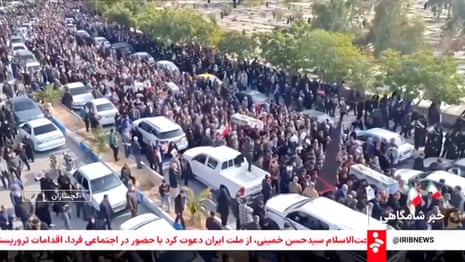
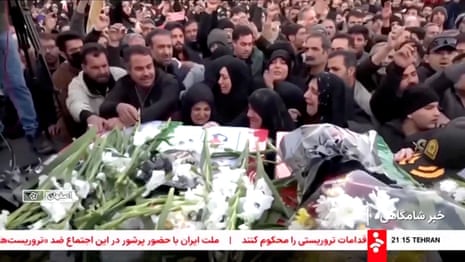
The protests, which began in Tehran on 28 December, were triggered by the collapse of the Iranian currency – the rial - and soon morphed into nationwide anti-regime demonstrations with people also angry at social and political restrictions imposed by the government.
As my colleague William Christou notes in this story, the currency has continued to depreciate, while the government announced the end of a subsidised exchange rate for importers – a move that caused the price of groceries to soar.
In September, widespread UN sanctions against Iran came back into effect for the first time in a decade after being triggered by the UK, France and Germany (the ‘E3’) as Tehran failed to convince western powers it would address their concerns over its nuclear programme.
They were are a “snapback” of measures frozen in 2015 when Iran agreed to major restrictions on its nuclear programme under a deal negotiated by the former US president Barack Obama.
Iran was already under huge economic strain caused by US sanctions that cut the country off from global finance.
International sanctions have played a major role in worsening economic conditions for ordinary Iranians who are having to contend with high inflation, soaring prices and a huge devaluation of the rial.
We have some comments from Germany’s Chancellor Friedrich Merz, who is on a diplomatic visit to India. He said Iranian authorities using “disproportionate and brutal violence” against protesters was “a sign of weakness”.
“We condemn this violence in the strongest possible terms,” he added. “This violence is not an expression of strength, but rather a sign of weakness. This violence must end.”
Iran’s foreign minister says internet to be restored soon
The Iranian foreign minister, Abbas Araghchi, also reportedly said this morning that internet connectivity would shortly be restored in Iran, including to embassies and government ministries. He did not say how long it would take for the internet to be restored.
Iran’s internet shutdown has now lasted over 84 hours, according to internet tracking agency NetBlocks.
The tracking agency said the blackout could be circumvented with shortwave radio, connecting to cell coverage at borders, Starlink and satellite phones.
Protests 'under total control', Iranian foreign minister claims
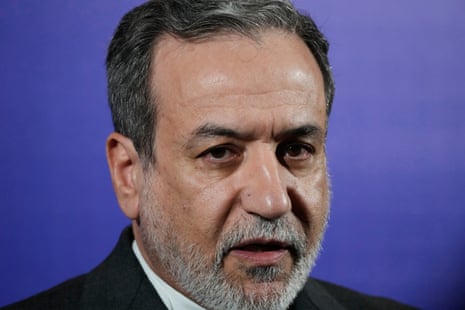
Iranian foreign minister Abbas Araqchi has claimed the protests have now “come under total control” after the violence spiked over the weekend, according to comments being carried by Al Jazeera, which we have not been able to verify the veracity of yet.
Araqchi was also quoted as having said the protests “turned violent and bloody to give an excuse” for the US president, Donald Trump, to intervene.
He went on to say the demonstrations – which spread to almost all provinces and dozens of cities – were “stoked and fuelled” by foreign elements and vowed that security forces will “hunt down” those responsible.
Because of the internet blackout it is difficult to get a clear picture of what is going on in Iran as it is hard to obtain information from the ground.
Opening summary
Donald Trump said he is considering “very strong” military action against Iran’s ruling regime amid its crackdown on protests that have shaken the country and reportedly sent the death toll soaring.
But the US president also claimed on Sunday that Iran’s leader had reached out to him and proposed negotiations. “A meeting is being set up ... They want to negotiate,” Trump said, while adding that “we may have to act before a meeting”.
Tehran has also ordered counter-rallies in Iran in an effort to regain the initiative, as well as warning the US earlier not to attack and vowing to hit back if it did.
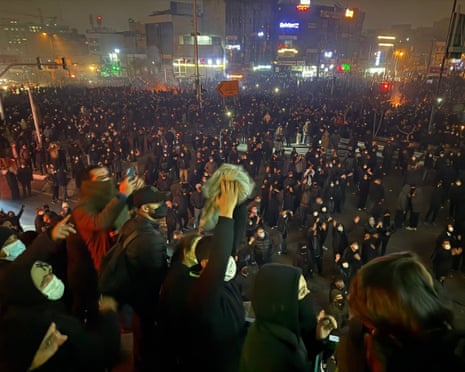
At least 538 people have been killed in the violence surrounding demonstrations, according to the US-based Human Rights Activists News Agency, including 490 protesters. The group reported that more than 10,600 people were arrested by Iranian authorities.
Another rights monitor, the Norway-based Iran Human Rights group, said on Sunday it had confirmed the killing of at least 192 protesters but that the actual death toll could already amount to several hundred or more. It denounced a “mass killing”.
The protests – now in their second week – were initially sparked by anger over the rising cost of living and have evolved into one of the biggest challenges to the rule of supreme leader Ayatollah Ali Khamenei, 86.
In other key developments:
-
Protests have grown in recent days despite an internet blackout that has lasted more than 72 hours, according to monitor Netblocks. Activists say the shutdown is limiting the flow of information.
-
President Masoud Pezeshkian accused the arch-foes of Iran of “trying to escalate this unrest” and bringing “terrorists from abroad into the country”, in an interview broadcast Sunday with state media.
-
Dozens of bodies have accumulated outside a morgue south of Tehran, according to footage on a video whose location was authenticated by the Agence France-Presse news agency on Sunday.
-
State TV has aired images of burning buildings, including a mosque, as well as funeral processions for security personnel, with authorities confirming members of the security forces have been killed.
-
Trump said on Saturday he would “rescue” protesters if the Iranian government killed them and reiterated his threat to intervene, posting on his Truth Social platform: “Iran is looking at FREEDOM, perhaps like never before. The USA stands ready to help!!!”
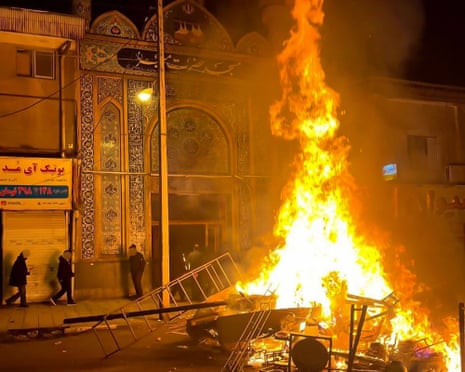
-
The Iranian government on Sunday declared three days of national mourning for “martyrs” including members of the security forces killed, state television said.
-
Pezeshkian urged people to join a “national resistance march” of nationwide rallies on Monday to denounce the violence, which the government said had been committed by “urban terrorist criminals”, state television reported.
-
Reza Pahlavi, who is the US-based son of Iran’s ousted shah and has played a prominent role in calling for the protests, said he was prepared to return to the country and lead a transition to a democratic government.
With staff and news agencies