3 months ago
132
3 months ago
132
When Ian Evans’s grandfather opened a hardware shop on Anglesey in the 1930s, the Menai Bridge was instrumental in ensuring its success.
The wrought-iron chains from the early 19th century had just been replaced with tensile steel, making the suspension bridge stronger and wider. This allowed it to carry heavier freight and the Evans family was able to order bottled gas from the newly established Calor Gas company, bringing widespread energy access to rural Anglesey (Ynys Môn).
“My grandfather and his brother went to pick it up from Bangor or Treborth station, I think, the first ever delivery. We still sell it today,” said Evans, 61.
“I look at the bridge every day from my living room window and people come from all over to see it, they park outside my house and wander over. It’s a big part of our community and our history.”
Friday marked 200 years to the day since the official opening of the bridge, a masterpiece of engineering that revolutionised the economic and social landscape of north Wales, as well as transport and communication links between Great Britain and Ireland.

Designed and built by Thomas Telford, the first president of the Institution of Civil Engineers, Menai became the first major suspension bridge in the world when it opened on 30 January 1826.
Several designs were discarded before Telford found a way to build over the dangerous strait at a narrow point where tall warships could still pass underneath, said William Day, an engineer who took part in major repair works on the bridge in 1999.
“It’s an icon of civil engineering,” added Day. “The precision, the quality control, thinking ahead about ease of maintenance and sustainability … and he needed to figure out how to erect it over wild water. He hung the iron cable chains down the banks to rafts, and then used ropes and pulleys on the other side to winch it up. He established how to do it in future, and some of his ideas are still in use today.”
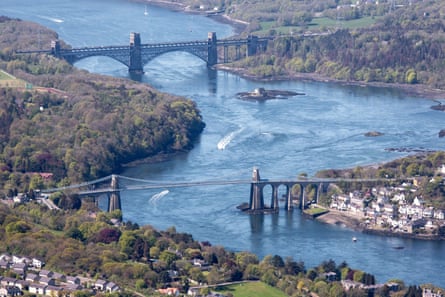
Edward I built a pontoon bridge across the Menai strait in 1282 for his invasion of Wales but Telford’s bridge was the first permanent structure over a waterway made especially dangerous by conflicting tides.
The engineer made use of meticulous measurement to create hundreds of huge iron cables, all of the same size, that could be used anywhere on the bridge – a practice unheard of at the time. They had adjusting links to compensate for imperfections in size and shape, and tunnels and chambers were cut into rock to move the chains, aided by suspended cradles and webs of scaffolding.
It was the last link in the new London-Holyhead road, dramatically reducing travel times to Ireland and making the journey much safer. The project helped earn Telford the nickname “the Colossus of Roads”. Born into poverty in Dumfriesshire, he was a hero of 19th-century Britain whose legacy survives in roads, bridges and canals across the country.
While still much loved by Monwysion – Anglesey residents – the bridge has been plagued by safety issues, leaving severe traffic problems.
The Welsh government announced on Monday that more defects had been found and another round of repairs is now not expected to finish until February next year.
“Our priority has always been and remains to safeguard the bridge for the future,” said a statement from Ken Skates, the Welsh government’s cabinet secretary for transport. “We continue to invest in maintenance and preservation … extensive inspection, strengthening and refurbishment activity [is ongoing] to ensure the structure’s long-term safety and performance.”
Celebrations of the bridge’s bicentenary include the unveiling of a plaque and a day of history talks and stories hosted by Bangor University.
Despite the repair issues, the bridge’s future remains bright, according to Day. “The masonry in that bridge is 200 years old, but if you took a sample from it, it could have been laid yesterday,” he said. “It’s already astonishing how well it has lasted, but if it’s looked after properly, it could be in use for another 200 years.”