3 months ago
104
3 months ago
104
For years, an older man nicknamed “Uncle” came to get dinner each night from a Coalition for the Homeless van that stopped in Hudson Yards.
Volunteers could not convince him to go to a shelter because he feared getting attacked. He was often barefoot, but when the organization offered him sneakers, size 12, he only accepted them if they were scuffed because he didn’t want to get robbed.
“He had a very good way about him, just kind of very quiet, kept to himself,” said Juan De La Cruz, the Coalition’s director of emergency relief services.
In late January, New York – along with vast swathes of the US – was mired in more than a week of bitter cold temperatures, and volunteers had not seen Uncle in weeks. During that time, at least 10 people were found dead outdoors in New York.
The city has not released their names, so De La Cruz does not know if Uncle is among them.
“I pray for the best, but I wouldn’t be surprised if it’s the worst,” De La Cruz said.
Cold-related deaths often happen if people, like Uncle, won’t go to a shelter because of past bad experiences in the system, De La Cruz and others say.
“There are certain shelters that they can’t go to because of interpersonal violence with another guest that was staying there or because they felt threatened,” said Dr Michael Liu, who practices internal medicine at Brigham and Women’s Hospital in Boston and co-authored a study on cold-related deaths. “That then leads to disastrous consequences when it’s frigid outside.”
New York is, of course, not alone in having seen a spike in cold-related deaths in the past week. More than 70 people have died because of the winter storm across the United States, NBC News reports.
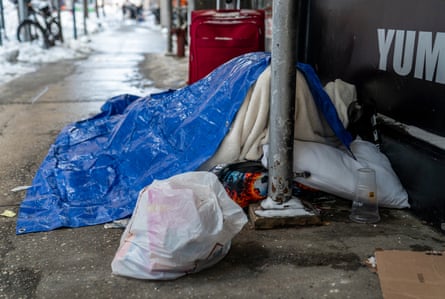
In New York, the city recorded an average of 30 cold-related deaths each year between 2018 and 2022, data shows. In the five prior years, the city averaged 14 such deaths.
David Giffen, executive director of the Coalition, has been involved with the organization since 1988 and said that he could not recall 10 people dying outdoors in the cold in such a short time.
He attributes that number to the especially brutal temperatures and an increase in homelessness in recent years.
In November, more than 100,000 people slept nightly in New York City shelters, and thousands slept in public spaces, the Coalition reports. In January 2020, 68,000 people slept in shelters.
On a single night in January 2025, there were more than 4,500 unsheltered people – meaning those who sleep in public spaces, like streets, parks and subways – according to the city’s Department of Homeless Services. On a 2016 night, there were less than 2,800 unsheltered people in the city.
The biggest problem is a lack of affordable housing, Giffen said.
“People who are sleeping out in the subways and in parks and in doorways will get swept up and rounded up by the police or involuntarily brought to hospitals where maybe they are stabilized – maybe not –and then that day, or three days later, they are back out sleeping on subway platforms again because there is no place for them to sleep,” Giffen said.
The city actually does have enough shelter space, Giffen said, as mandated by the state’s “right to shelter” law.
But he said there are not enough “safe haven” shelters designed for people who have trouble navigating the general shelter system and often have a mental illness or cognitive disability, Giffen said.
“They are low barrier, smaller shelters with looser rules,” Giffen said.
During such a winter storm, each night the organization deploys volunteers in three vans to help get people outdoors to shelters or warming centers and buses. They also distribute blankets, clothing and food.
“If it’s an individual that has had a bad experience in the shelter system and is reticent to go back … that person can be offered to go just to a warming bus,” Giffen said.
When De La Cruz, who has worked with the homeless population for almost two decades, asks people on the street in winter to get indoors, the most common response is “‘OK, OK, thank you,’” he said. “That leads me to think that they are not really going inside.”
Despite the organization’s best efforts, among the eight males and two females who recently died, six had been connected to the city’s department of homeless services, Mayor Zohran Mamdani said at a press conference Wednesday.
On 24 January, when the temperature dipped to 12F, staff at St Barnabas Hospital in the Bronx discovered a 60-year-old man outside the facility. They brought him inside, where he was pronounced dead, according to the New York police department, which has not released his name.
The deceased also included a 90-year-old woman, Doreen Ellis, who had dementia and left her Crown Heights apartment overnight. She walked down the block and into a backyard, the Gothamist reported. She was discovered dead in the snow in the morning of 26 January.
“It should never happen,” De La Cruz said of such deaths. “It’s also angering because we live in a country that should be able to provide the basic necessities to folks.”
In New York, freezing temperatures are forecasted to continue until at least 7 February.