3 months ago
152
3 months ago
152
“I’m not sure what else we can do to be honest,” Paul Loebenberg said, of the people lined up at his bar. “Maybe there’s something I’ve missed, but we’ve tried everything.”
To anybody who frequents pubs and dislikes feeling as if they are waiting at a bank, Loebenberg’s exasperation is all too familiar.
Pubs, bars, taprooms and watering holes of all descriptions are a cornerstone of British culture, where, for as long people have been able to buy ale, an unspoken system has been in place: come to the bar and a bartender will serve you at their leisure.
This system, however, has seemingly been upended by a new way of ordering drinks.
Landlords around the country have noticed the rise of queueing at pubs, with a growing number of people – usually a younger cohort – electing to wait in a single file line, standing one behind the other, before being called forward to order as if going through border control.
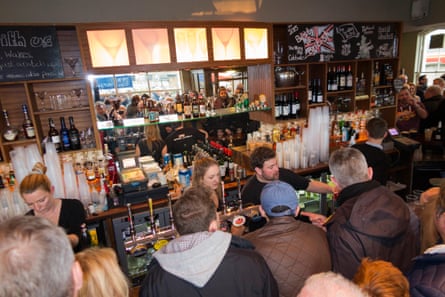
At Wolfpack, a taproom in north-west London, run by the brewing company of the same name for whom Loebenberg is the managing director, the problem has come from nowhere but is hurting business and the experience of his customers.
“It’s like the one person did it once and since then everyone has followed like lemmings, they all just copy each other’s behaviour,” said Loebenberg. Staff at Wolfpack have had to begin walking over from behind the taps to free customers from the queue and send them to the bar to get served.
“We’ve trained our guys to say: ‘Please come forward, don’t queue,’” he said.
“If we could figure out why, then we would find a remedy. But there’s no rhyme and reason.”
Jess Riley, a manager at Wylam Brewery, a large bar and events space in Newcastle, believes that the pub queue epidemic began around the same time that a different outbreak spread across Britain.
“I think it was the pandemic,” said Riley. “It wasn’t a thing before 2020, and then all of a sudden people really started to like a single-file line after Covid. I know we’re British and we like a queue, but it’s ridiculous.”
Riley says that despite Wylam having multiple bars to get served from, with the largest measuring over 20ft (6 metres) in length, there are still customers who insist on forming an orderly queue, no matter how much it annoys the bar staff, with lines of customers sometimes “snaking around the building” owing to people refusing to spread across the available space.
“We’re a big place with massive bars, but some people just refuse to stop queueing,” said Riley.
“I’ve argued with customers who queue before because I serve people who come to the bar and they’ve said it’s unfair, and I just said: ‘The whole bar is empty, why are you standing there when there’s all this space.’”
According to John Drury, a professor of psychology at the University of Sussex, people’s attitudes around public activities such as going for drinks and attending music and sports events have changed since the pandemic, sometimes negatively.
“For people who work in these industries, when we’ve spoken to them, a lot say that behaviour has gotten worse post-pandemic,” said Drury.
“They say it has become normalised, and when you ask the general public, their response is more mixed, because not all of them realise that their behaviour has changed.”
Drury, who is himself a supporter of the queueing system at pubs, believes that it adds an element of fairness that is not found when “crushing around the bar”.
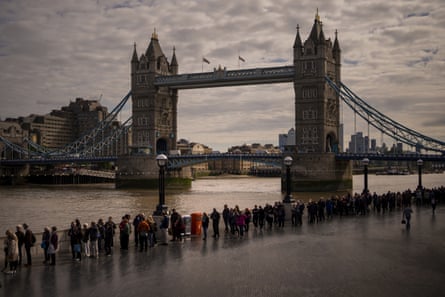
He specialises in the behaviour of crowds and was a consultant for the planning of the queue to pay respects to Queen Elizabeth II after her death in 2022. He believes that despite the fact queueing at the bar is at times illogical, social pressure means that it is likely to persist.
“Its a new norm and norms are neither rational nor irrational. A norm means not only something that people generally do, it also means something that people in your group think is the right thing to do, so if you resist it, you are going to be regarded as a deviant, a troublemaker, a pain.
“And people don’t want to be put in that position,” said Drury, adding that even though data shows that the amount of time people wait when queueing rarely goes down, “people may still prefer it, knowing they’re waiting just as long as the person in front of them”.