3 hours ago
14
3 hours ago
14
No politician craves obscurity, but it is better to be unknown than despised. That is consolation for Liberal Democrats, gathered in Brighton for their annual conference, fretting about Ed Davey’s low profile and wondering whether a more prominent leader would hoist their flagging poll ratings.
Renewal by decapitation is a concept that has succeeded twice this parliament for other parties. Labour’s fortunes were transformed when Andy Burnham entered No 10. The Greens enjoyed a polling surge last year when Zack Polanski was elected leader. In the fidgety culture of British politics, Davey’s six-year reign feels like an aeon. But the experience of other parties has little to teach the Lib Dems.
Keir Starmer didn’t suffer from underexposure. The country watched a showcase of his abilities and didn’t like what it saw. Polanski’s talent for harvesting clicks on social media has expanded his audience, especially among younger voters, but the Green leader hasn’t shown that he can sustain that interest. Increased scrutiny may not do him any favours. The chart mapping his favourability ratings since taking the job shows a stable core of fans beneath a steadily rising line of disapproval, suggesting that, outside a Green comfort zone, the more people see of Polanski, they less they like. The equivalent picture for Davey tells a story of flat indifference.
Voters don’t have a clear sense of what the Lib Dem leader stands for, but they don’t feel threatened by him, which is an underrated value in a leader whose prospects depend on tactical voting. His supporters aren’t relaxed about a polling slump but they argue that the party’s tally of seats in parliament and on local councils is evidence that more has gone right than wrong in recent years.
They have a point. There are 72 Lib Dem MPs – a record high – and reasons to expect that number to grow at the next election. The party prides itself on tenacious incumbency, digging in deep and fortifying each seat with local activism. Lib Dems are resented by rivals for the same reason, compared to cockroaches for their stubborn resistance to removal. Those tactics can’t protect a popular local candidate if a national tide turns against the party, as happened in 2015 when the Lib Dems were crushed almost to death by the weight of amassed resentment over their coalition collaboration with the Tories. But sometimes the party finds itself swimming with the current.
To the extent that any forecast can reliably be made about Britain’s choppy political waters, it looks likely that a decisive factor at the next general election will be the question of Reform UK’s suitability for power and, assuming he is still the leader, Nigel Farage’s candidacy to be prime minister. The result will then depend on the organisation of tactical anti-Farage voting (and levels of dysfunction in any putative Reform-Conservative pact) at constituency level.
That dynamic can work in Davey’s favour if the question of who is best placed to stop the radical right is unambiguous. Conservatives are the challengers in nearly all of the Lib Dems’ current constituencies and the incumbents in most of the party’s target seats. Given how porous the ideological membrane is between Tories and Reform, Lib-Dem campaigners in key battlegrounds can correctly argue that a vote for Labour or Greens serves only to enable Faragism.
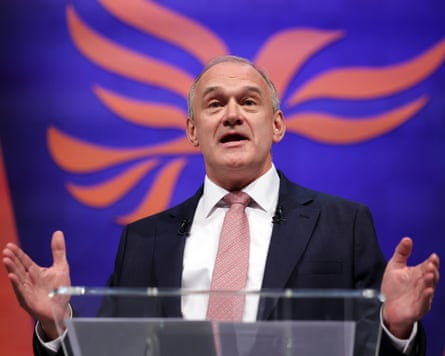
Davey is already building that case. He presents his party’s bloc of MPs as a “firewall” to stop British politics being captured by a brand of demagogic nationalism that is inspired by Donald Trump and bankrolled by unsavoury billionaires.
An obvious inference from that position is that Davey would facilitate Burnham staying on in Downing Street in a hung parliament. Speculation on that question, years before an election is even due, is tedious but necessary for the Lib Dems. They find it demeaning to be cast as parliamentary handmaids waiting to serve a grander political master, but at least that status keeps them relevant. Coalition is the mechanism by which Davey can plausibly get manifesto commitments enacted. It is an important point of distinction from what Lib Dems see as sideline pressure-group politics practised by the Greens.
The strategy gets trickier if the Lib Dems already maxed out the anti-rightwing tactical vote in 2024, when there was the pressing matter of a Tory government to evict. Where do they go next?
A suite of victories in that campaign established a base for the party in the “blue wall” of affluent southern towns and suburbs. These are places that once dependably voted Tory but where the old allegiance has been sundered by a combination of demographic change (younger voters moving in), rank incompetence (Boris Johnson; Liz Truss) and unhinged Brexit fanaticism.
The cultural shift is not superficial, but nor is it baked in so hard that the Lib Dems can afford to lean too far to the left. Consolidation and growth depend on expansion into the vacant space on the political spectrum where moderate “one nation” Tories once dwelt and that Kemi Badenoch is not reclaiming.
That risks causing discomfort to Lib Dems in the party’s orthodox social-democratic tradition, or who campaign in seats where the opposition is Labour. They want to compete in radical colours – a reddish shade of orange, not a pale orangey-blue. They don’t see themselves as a party of the centre-right.
Davey has a balance to strike. He needs to signal progressive credentials to reassure tactical voters and Lib Dem activists that his anti-Farage firewall will be suitably robust. He also needs to consolidate and expand his support among former Tory voters who might be liberal on social matters but are still classically conservative on the economy.
after newsletter promotion
His conference speech on Tuesday was crafted with those twin tracks in mind. He led with impassioned denunciation of far-right thuggery on British streets, connecting it to Reform’s anti-immigration agenda, but the headline retail offer was a big income tax cut – raising the personal allowance and the 40p threshold. The latter would be a gift to people who, like everyone else, feel squeezed by inflation and stagnant wages but are far from the neediest end of national income distribution.
It is an expensive gamble. In theory, the £17bn cost to the exchequer would be recovered once the British economy was restored to the EU single market and thriving as a result. Spending a reverse-Brexit dividend on tax cuts is a cute political message for middle-class remainers. It wouldn’t pass a Treasury test of fiscal neutrality given the complexity and upfront cost of the accession process.
Davey is prepared to take heat in accusations of sketchy budgeting, verging on denial of fiscal reality, if the row also sheds light on his pro-European, tax-cutting ambition for the benefit of people who care about both of those things.
It is a targeted bet on raising the Lib Dems’ profile with the specific voters who will decide how many seats the party wins. That number can’t be extrapolated from midterm opinion polls.
Local elections next year will give some indication of whether Davey’s method is working. A byelection in a winnable seat may settle Lib Dem nerves. But the plan only comes to fruition as the sum of tactical choices made in polling booths in a general election, once voters confront the prospect of Reform in government.
Right now, it may not be obvious what purpose the Lib Dems serve, but if they hold enough seats to thwart a Faragist majority, their utility to British democracy won’t be in doubt. That is the uncertainty inherent in a firewall. You only find out whether it works when you need it most, and then you don’t get a second chance.
-
Rafael Behr is a Guardian columnist