3 months ago
144
3 months ago
144
One of the great strengths of populism, in all its rightwing and leftwing varieties, is its readiness to blame people. When democracies are discontented, as most are now, the old early 21st-century politics of relative consensus and moderation is seen by many voters as insincere and inadequate, as many unpopular centrist leaders have discovered. Societies are always divided between clashing interests, especially under the current, ultracompetitive version of capitalism, and populism recognises that. In some ways, it is more honest than conventional politics.
But only in some. Rightwing populism in particular relies on an ever-expanding list of enemies – from urban elites to benefit claimants, immigrants to deep-state bureaucrats, diversity officers to leftwing radicals, net zero “zealots” to mild liberals – yet this list always contains a striking omission. In Britain as in other countries, many of the social trends that rightwing populists and their supporters say they hate, and want to reverse, are partly being driven by populist voters themselves.
The decline of pubs and high streets, the struggles of small farmers, the retreat of Christianity, the shrinkage of British manufacturing, the fracturing of the traditional family, the reliance on foreign labour, and the fading of local distinctiveness and pride: all these are caused, to a large extent, by changes in consumer habits and social norms. And these are changes in which many supporters of rightwing populism are participants, like everyone else.
For that reason, you might not expect Reform UK’s traditionalist and xenophobic vision to have huge appeal in Britain: a nation of supermarket shoppers that often prefers foreign food and goods, lives increasingly online, is having fewer children and likes to travel and settle abroad. Yet it does. Like other conservatives over the centuries, rightwing populists offer a way for people to object to shifts in the status quo, while erasing any uncomfortable thoughts about their complicity.
Rightwing populism performs a similar disappearing act in party politics. The roles played by key Reform UK figures such as Nigel Farage, Robert Jenrick, Danny Kruger and Suella Braverman in creating what the party calls “broken Britain” are magicked away. Austerity, Brexit, the “Boriswave” of immigration: all were promoted or permitted by these politicians, either directly, as Conservative ministers, MPs or advisers, or indirectly, for example by Farage ordering his Brexit party not to properly compete with the Tories at the 2019 election. Reform UK likes to present itself as a rebellion against an establishment “uniparty”, combining Labour and the Conservatives, but for most of the past decade the real uniparty has been a populist alliance of Tory nationalists and Farage’s various vehicles, backed by most of the press.
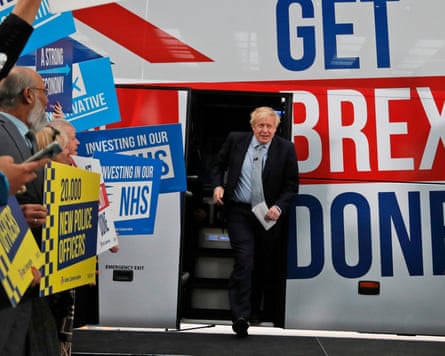
In 2019, this alliance got 14.6m votes, a huge total for a British general election. So it’s reasonable to assume that much, and possibly most, of Reform UK’s current supporters voted for Boris Johnson – already known as a very casual administrator – to continue as prime minister. Thus, inadvertently or not, these populist voters helped facilitate the looseness at this country’s borders which so enrages them now. Before Johnson, plenty of these rightwing Britons probably also voted for the hard-Brexit government of Theresa May and the slash-the-state administration of David Cameron as well, given the similarities between May and Cameron’s policies in those areas and those of Reform UK now. Part of the political class which Farage’s voters say they intensely dislike was empowered and sustained with their considerable help.
Democracy always involves voters avoiding responsibility for their decisions, to some extent. It’s our right to make a bad choice of government, and then, when it fails, make no apology and, in the anonymity of the polling booth, choose to replace that government with something else.
With election turnouts in long-term decline, and the electorate fragmenting to an unprecedented degree and in unpredictable ways, politicians are even more scared than usual of suggesting that voters could in any way be at fault for the frayed and unhappy state of the country. During the last general election campaign, Labour strategists called defectors from the Conservatives “hero voters”: a revealingly deferential term for people who had previously supported the disastrous Johnson. A similar reverence for voters, however fickle or factually inaccurate their views, underlies much of modern political journalism.
Yet if rightwing populism is to be pushed back in Britain, there may have to be more acknowledgment of the wide range of factors which are behind the country’s current problems, rather than Reform UK’s scapegoats. Britain has had plenty of inadequate leaders and ministers since the 2008 financial crisis, whom MPs have often failed to call to account. The performance of the devolved governments and local councils has sometimes been poor, as well. Political journalists have often preferred to cover personalities and scandals rather than systemic problems. But to carry on pretending that the public have nothing to do with any of this dysfunction – as media consumers, as voters – is to accept a caricature of democratic politics, which suits rightwing populism’s narrative of endless betrayal by elites and outsiders.
Besides, all Reform UK’s pious talk about speaking for “the great British people” is actually quite cynical, as this population excludes those the party disagrees with politically or doesn’t recognise as legitimate citizens. This rhetoric also pretends that all those Britons the party finds acceptable are of the same mind. Populism’s greater honesty about social conflict is often contradicted by the fictions it presents about national unity.
Even further to the right than Reform UK, other reactionaries are organising, perhaps waiting for the party to be insufficiently hardline in government. Yet these movements, too, are entwined with the modern Britain they claim to despise. Last September, as Tommy Robinson’s “unite the kingdom” march in London was winding down, I came across two of the participants, identifiable by the huge union flag which one of them had draped down her back, in a clothes shop nearby which I know well.
On the shelves and rails around these two nationalists were brands from all over the world. While they browsed, some of the shop’s international, multiracial staff waited attentively but silently in the background. Rightwing populists like to accuse immigrants of taking from today’s Britain without contributing. In that critique, they really describe themselves.
-
Andy Beckett is a Guardian columnist