3 months ago
121
3 months ago
121
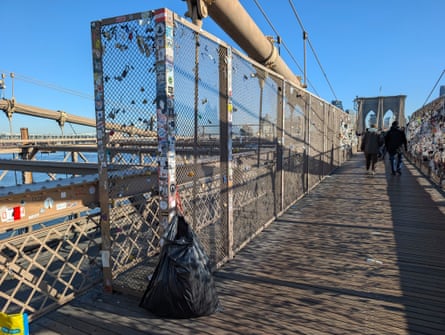
On a blisteringly cold day earlier this month, Ellen Baum was not in the best mood as she walked across the Brooklyn Bridge to meet some friends in Manhattan.
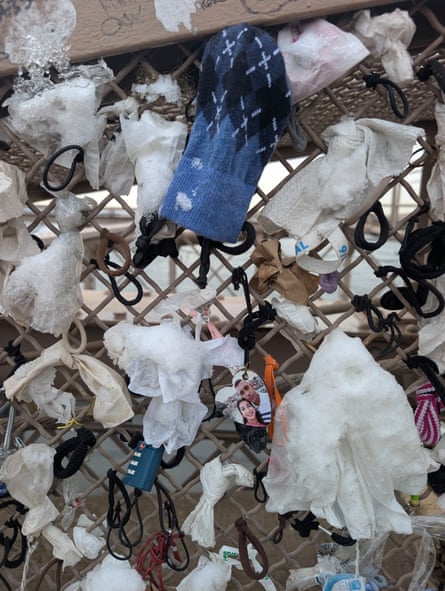
“I had read particularly horrible news that morning about, you know, the general state of the world,” said Baum, who is 37 and works in tech. And then there was the garbage. Baum stared at the dirty tissues, hair ties, trash bags, and socks affixed to the suspension bridge’s frame – sometimes she even sees condoms and tampons woven into the fencing – and had a thought. “I can’t do anything about some of these big problems that the world and the city are facing. But I can do one modicum of something nice.”
So she started cleaning up.

It took her eight days and about 16 hours to finish clearing the north side of the littered section, with Baum putting in 90-minute to two-hour shifts. Her trash-collecting crusade gained the attention of local media and concerned New Yorkers who have joined the effort to clean up a bridge she considers her “back yard”; Baum lives in Brooklyn Heights, located just over the East River from Manhattan. “You can find community in the strangest places,” she said.
The Brooklyn Bridge, which turns 143 this year, is one of the titans of New York’s skyline. It is heavily trafficked – the city’s department of transportation estimates 28,845 pedestrians traverse it each day. But the National Landmark is also a dumping ground.
Since at least the mid-2000s, lovers have etched their names on locks, attached them to the bridge, and thrown the keys into the water below for good luck. Those who do not have locks and “want to be a part of it”, as Baum says, opt for a more obvious form of vandalism: hanging hair ties, tissues and socks.
Paris’s Pont des Arts, which rises over the Seine, is best-known (and reviled by locals) for love locks; in 2014, two American ex-pats campaigned against the practice, calling it “visual pollution”. Parisian officials regularly change out the bridges’ metal panels to lighten the load.
Love locks proliferated during the early years of social media trends and provided the backdrop for many a wedding photoshoot. But in 2014, the New York Times reported that the practice is much older than that; a first world war-era Serbian folktale tells of a schoolteacher who fell in love with a soldier, who then left to marry another woman. After she died heartbroken, young women in town began placing locks on a spa town bridge to ward off similar misfortune.
There are love locks all over the world, from London, Budapest and Australia to Ohio, Wisconsin and San Antonio. Many local governments forbid the practice and charge fines; getting caught attaching one to the Brooklyn Bridge, for instance, risks a $100 ticket. Venice used to fine offenders 3,000 euros; that’s since been lowered to 100. In 2013, a New Yorker writer followed self-professed “love pickers”, lock-picking enthusiasts who traveled to Brooklyn to dismantle the chains.
Officially, the city’s department of transportation is responsible for removing the trash and locks (though it likely has been distracted of late by blizzards and bone-chilling temperatures). Baum and others such as the trash cleanup group Pick Up Pigeons have stepped in, but there are limits to what they can do. The transportation department takes boltcutters to locks, but Baum does not have those, so she focuses on merely cleaning up refuse.
“I’m not a curmudgeon,” she said. “I have a lot of love in my life, but I’ve never felt the need to make a physical marker of it on a historic landmark.”
Dave Colon helps run the New York Groove, a journalist-owned and member-supported outlet that covers life in the city. He’s also a longtime love lock hater. “If you really want to feel the New York of it all, you can go find the people on the bridge who will hustle you and take a picture of you and charge you for it,” he said. “There are so many other ways in which you can mark your time at the Brooklyn Bridge that you just do not have to leave us with your awful fucking garbage.”
The locks are primarily associated with tourists who flock to the Brooklyn Bridge. The late pop historian David McCullough detailed its laborious construction in his 1972 book The Great Bridge; he called the site “the Eiffel Tower of America”. But it’s actually more popular: 11 million pedestrians visit annually, compared to 7 million at its French counterpart.
Love lockers may feel as if they’re taking part in a decades-old tradition. Colon – who clarified his stance in a recent blog post titled “If you tie your garbage to the Brooklyn Bridge you should be thrown off the bridge” – urges them to reconsider.
“It’s that old thing: if you saw everyone jumping off a bridge, you would do it too?” he asked. “I guess now it’s ‘if you saw a bunch of people tying condoms to a bridge, would you do it too?’ And the answer is, unfortunately, yes.”
Baum can attest to that. During a recent interview with a news team about the project, a woman walked up behind her and tied something to the bridge. “People put things up as I’m cleaning it,” Baum said. “They have no shame.” Undeterred, she plans to coordinate a monthly meetup where anyone can join in.