3 months ago
159
3 months ago
159
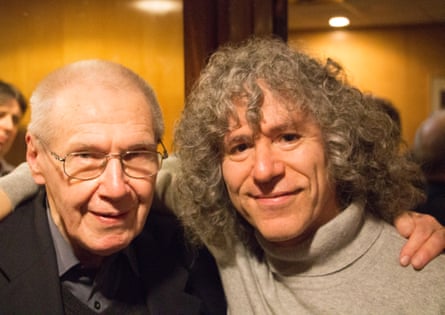
I vividly remember my first meeting with György Kurtág. It was 40 or so years ago at the International Musicians Seminar in Prussia Cove, Cornwall. I was sitting in the dining hall there, when a man with grizzled hair and an unusually fervent countenance came up to me and, with barely any introduction, started talking about my pizzicato playing in a performance he’d heard of the Schubert quintet some years earlier, in which I’d taken the second cello part. This man was none other than Kurtág – accompanied then, as almost invariably during those years, by his wife Márta; she hung back somewhat, but didn’t miss a word.
I was immediately struck by his magnetic intensity, his fierce passion for music and his unique way of speaking English – punctuated by frequent utterances of “er-er-er” (Many years later, Kurtág was to tell me: “Stuttering is my natural mode of expression.”) He and Márta simply embodied – he still embodies – music. I had never met anyone to whom each note mattered so much. They both reminded me of what a friend once said about Beethoven: “He didn’t know the meaning of the words ‘it doesn’t matter’.”
At some point early in our friendship, Kurtág handed me a piece of his for solo cello, Gérard de Nerval, and asked me to play it for him. Knowing nothing about his music apart from its sterling reputation, I looked at the short piece, managed to learn the notes after a fashion, thought that it seemed poetic – it was based on a poem, in fact – and a few days later played it through for him and Márta. It was then that I understood that I had understood absolutely nothing! He took me through the piece note by note, explaining, singing, demanding, creating visions and weaving a spell of emotional profundity that was a revelation.
From that time on I have played to him as often as possible. (Also to Márta, herself a gifted pianist, who was almost always at his side, making comments as probing and helpful as his; her knowledge and understanding of every note of his music was astonishing.) For the most part, we work on Kurtág’s own pieces, though very occasionally he coaches me on music by others.
Playing to him is transformative in every way. His imagination is boundless; he will produce startling, unexpected images – or point out connections, musical or extramusical – that illuminate his meaning. For instance, at the beginning of his short work for solo cello entitled Schatten (Shadows), a scurrying, dark piece with frequent abrupt silences, played with a “hotel mute” on the cello bridge to bring the sound almost to the point of inaudibility, he told me to think of the opening scene of Hamlet, where the ghost of Hamlet’s father flits tantalisingly across the castle battlements, impossible to pinpoint. (“’Tis here … ’Tis here … ’Tis gone.”) That concept really helped me to capture the unsettled, unsettling atmosphere of the music. Or he will describe silence: in my notes on the same piece, I see a quote from our session: “Rests represent motifs you don’t play; only the essential is told.”
Animals often figure in his teaching. I have notes telling myself to play “like the neighing of a horse”, “like a snake”, “a cat’s miaow” and, most surprisingly, “like a dog biting God’s feet”. (That one remains a challenge!) Or he will point out veiled references – from Gesualdo, for instance, or Beethoven’s Grosse Fugue – within his pieces. There is always a tonal centre to his music, so he will sometimes tell me to bring out the colour of a certain key. And he will always – after some searching (“… How to tell you?”) – find a new way to describe the phrase on which we are working.
Lessons can go on for a long time, but I’ve never felt tired, only elated. He gives you the feeling that you are working towards the same end, searching together for a reading that makes sense, that reflects the formidable vision behind the notes. I find it hard to describe the satisfaction I feel when he is finally satisfied – perhaps it’s something akin to the sensation a mountaineer experiences on reaching a seemingly unassailable peak? He always insists, when our work together has reached a natural conclusion, that the piece is now mine, and that it is henceforth up to me to play as I feel. But the feeling of responsibility, of doing his music justice, is quite palpable, whether he’s present or not.
Anyone who attended one of the few concerts given by Kurtág and Márta will have witnessed something extraordinary. I was lucky enough to catch their final recital, at the Queen Elizabeth Hall in London. There they sat, close together on a wooden bench, their backs to the audience, playing on a specially softened upright piano – being amplified by their son György – weaving a magical spell, alternating seamlessly between Bach arrangements and original Kurtág. We were transported, and it was especially moving to see their bond played out in music. Not that their relationship was always without tension … My favourite story about the two comes from a day on which they were rehearsing for a concert down in Cornwall. At one point, Kurtág did one of his signature gestures – his arm descending through the air infinitely slowly to land on a note, producing an almost inaudible pianissimo. Márta turned and snapped at him: “Why are you playing so aggressively today?”
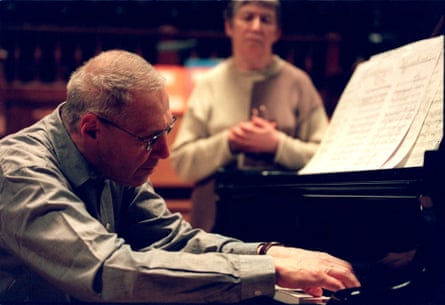
Today, Kurtág, despite alas losing Márta some years ago, is – touch wood – remarkably active, continuing to compose, as well as teaching regularly. While he is physically frail in some ways, his mind is as alert as ever. On one of my recent visits to him in Budapest, he informed me that he was free only until 7.30pm. “And what are you doing at 7.30?” I asked. “I have a Latin lesson.” Ah yes, of course … In fact, the latest of the four pieces he’s written for me (so far) is based on a Latin text. Circumdederunt for solo cello, composed in memory of our beloved mutual friend Rita Wagner, is a characteristically powerful testament, sparsely textured, full of intense grief, but tempered with hope.
The first draft he sent was entirely in the key of F major, but then came a new version, with the faster middle section now transposed to F sharp – a startling, quite jarring change, exacerbated by the fact that it is to be played “sul ponticello” (on the bridge). During my first lesson on the piece, he kept urging me to play it more violently – or, in his words: “More stinking.” It took me many tries before I was able to convey the passion he was demanding. I couldn’t keep up with his energy. But of course it made absolute sense, throwing into sharp relief the radiantly peaceful ending.
Kurtág lives today on the top floor of the Budapest Music Centre, where he is adored by everyone – even the staff at the building refer to him as “Uncle Gyuri”. There are two concert halls on the lower floors; occasionally, he will take the lift downstairs and attend a performance, emerging in his wheelchair from the lift doors, being treated as a living deity. His presence ensures that musicians will give absolutely all that they have in them – everyone is so desperate to earn his approval.
Long may this great man and musician prosper. My opening to any conversation with him is to ask him how he is. I always await the answer anxiously, ardently hoping that I will hear the familiar words: “Thank you. Working.” Then I can breathe a sigh of relief knowing that all is well in planet Kurtág.