2 months ago
52
2 months ago
52
Before Monday morning, Folkestone and Hythe’s backbench Labour MP Tony Vaughan was best known for his slick, pro-government Instagram reels.
In one, he dives into the brown sea off the Kent coast, ignoring a no swimming sign, to show constituents that Labour has made progress tackling water pollution; a few minutes later, he emerges in his trunks, as the 007 theme tune plays. In another, he is filmed by a drone striding along the shingle, wearing Ray-Ban aviators and a crisp white shirt, praising the government’s investment in coastal flood defences.
But this week, his social media output shifted from party loyalist to something more combative. On the morning the government announced its much-trailed changes to the asylum system, Vaughan began articulating his fierce opposition to them on every available platform.
“The idea that recognised refugees need to be deported is wrong. We absolutely need immigration controls. And where those controls decide to grant asylum, we should welcome and integrate, not create perpetual limbo and alienation,” he wrote on X. “The rhetoric around these reforms encourages the same culture of divisiveness that sees racism and abuse growing in our communities.”
His interventions were particularly unwelcome to the government because they came from a uniquely well-informed source: an MP representing a constituency at the frontline of the immigration debate, who, prior to his election in 2024, worked as an immigration barrister at the same chambers where Keir Starmer once practised. Vaughan has represented refugees and asylum seekers, and victims of human trafficking at the supreme court, and was appointed as a KC earlier this year.
As home secretary Shabana Mahmood unveiled details of what was billed as the biggest shake up to the UK’s asylum system in 40 years, Vaughan was on the radio and television explaining why the new approach was inflammatory, objectionable and unlikely to work.
He was particularly uneasy about the weekend briefings to media that jewellery and other assets could be stripped from asylum seekers and, more fundamentally, the decision to change refugee status from a permanent to temporary position.
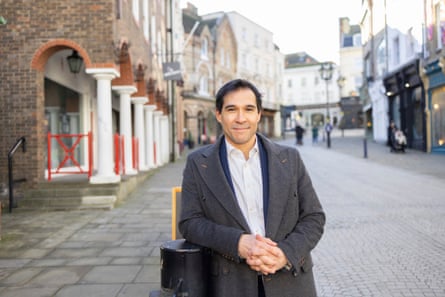
Vaughan’s outlook is shaped by his legal career, but also by years spent living on this stretch of coast, with its views across the Channel towards France, 23 miles away. A few years ago he spotted a small boat arriving carrying about 20 people from the window of the house overlooking Sandgate beach where he was living then with his wife and two young sons. He called the coastguards, but they were already en route.
“To actually see that with your own eyes in relatively close proximity to your house, really brings home the human element to this,” he said, in an interview on Thursday in the constituency. Despite rising support for Reform in the area, Vaughan is convinced that many locals want asylum seekers to be treated humanely. “I think a lot of people in this area who have seen boats arrive on this bit of coast are sympathetic to their plight.”
But even a brief visit to the constituency reveals how the issue divides residents. Although there are no asylum hotels in the area, Napier Barracks, which has provided temporary housing for about 320 male asylum seekers since 2020, remains the site of regular pro and anti-immigration demonstrations, despite being scheduled for imminent closure.
One of 231 new Labour MPs elected in last year’s landslide election, he benefited from Reform eroding the Conservative vote; it was Folkestone’s first non-Conservative victory since 1885. He took a 3,729 majority, but the Electoral Calculus website currently estimates he has a 6% chance of winning; the Conservatives are at 3%, and Reform 91%. Vaughan is in a group of about 33 so-called “bonus MPs”, politicians in non-target seats that Labour had little expectation of winning last year. Unconstrained by the prospect of long political careers, the bonus MPs have reputation for political disobedience.
He is sanguine about the possibility that his comments have detonated any prospect of promotion. “I’m not one of the people who decided they wanted to be prime minister when they were a kid,” he said. He refuses to say whether he received a Malcom Tucker-style monstering from whips in response to his comments, simply noting that some colleagues were “frustrated” by his intervention, while others quietly expressed support.
“You’re doing a great job. Keep doing it,” one woman said as she passed him in the Old High Street on Thursday. His comments on immigration have also attracted critical emails to his office inbox. Talking to constituents in the Romney Bay area, where there are a scattering of St George’s flags, it is clear that how Labour handles this issue will determine whether people vote for Vaughan or Reform in the next election.
Janice Biffen, a retired NHS matron, who voted Labour in 2024, is thinking about switching to Reform. She is concerned about pressure on hospitals, which has intensified in the decade since she retired, and local housing shortages, both of which she connects to the rising numbers of asylum seekers coming in small boats. “We haven’t got the facilities in the area to accommodate people coming through unauthorised routes. Farage says a lot of positive things about how to solve it. I probably would consider voting for him,” she told Vaughan.
after newsletter promotion
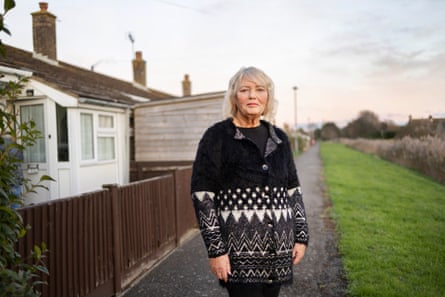
Her neighbour, Tony Cooper, a Labour and Co-operative district councillor, said he felt much of the local unease about irregular migration had its roots elsewhere. “People are angry not necessarily at the level of immigration or illegal arrivals, but at substandard NHS services they’re receiving,” he said.
Vaughan listened politely and agreed that tackling small boats represented an existential problem for Labour, although he felt that the tone of Mahmood’s suggestion that “illegal migration is tearing our country apart” was inflammatory.
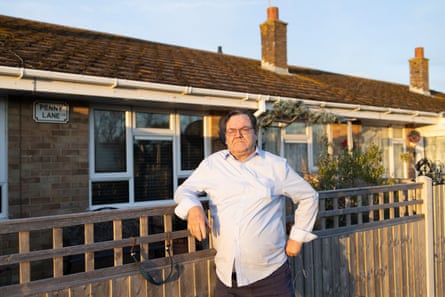
“I totally support the objective of the government to address the irregular arrivals; I agree that it is the most significant political issue, along with the cost of living and the NHS, which Labour has to tackle. I’m not pretending that there isn’t a political challenge here of monumental importance,” he said.
The first politician of Filipino heritage to be elected to parliament, Vaughan is the son of a care assistant who moved to the UK in the early 1970s and spent 30 years working for the NHS. His mother’s occasional experience of racism at work has made him think carefully about policies that incite division. “Once you are granted asylum, you should be supported, integrated, and you shouldn’t have a sword of Damocles hanging over you for 10 or 20 years, questioning whether you belong. We cannot pretend that there is no link between narratives that demonise refugees and constituents telling me that they are being subjected to racial abuse in the street,” he said.
His solution would be a radical scaling up of the one-in-one-out UK-France agreement, to allow more small boat arrivals to be returned instantly to France, which he sees as a more powerful deterrent than the longer-term prospect of potential withdrawal of refugee status. He was more comfortable with the government’s initial focus on tackling criminal smuggling gangs in Europe and speeding up the processing of asylum cases. He places responsibility for the surging numbers of boat arrivals firmly with Nigel Farage, noting that people smugglers now tell migrants that Brexit has removed the prospect of being deported from the UK. “Because we left the EU and tore up our returns agreement, there is a lesser chance of being returned to France. These are Farage’s boats,” he said.
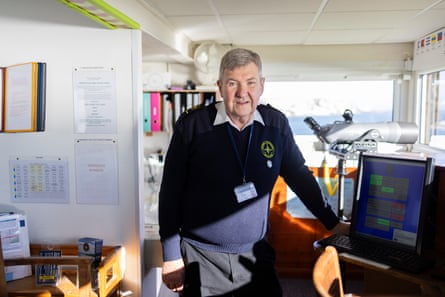
Les Dawson, a retired police officer who has been a volunteer coastguard for six years, used to spot boats arriving on the local beaches, although for the past three years, Border Force cutters have routinely intercepted them at sea, and transferred passengers from the dinghies to the bigger vessels, before taking them to Dover for processing, so small boats now rarely land on Kent’s beaches. “It’s got to be stopped. These people are cheating proper immigrants,” he said, as Vaughan visited the Folkestone viewing station. He was uncertain about whether Labour’s newest initiatives would work. “We’ve heard so many things, stop the boats, smash the gangs. It would be nice to see something happen.”