5 hours ago
17
5 hours ago
17
Death toll from Nepal-China flood disaster exceeds 1,000, authorities say
The death toll from the catastrophic flooding in Nepal and China has passed 1,000 as of Tuesday morning, officials said, with authorities reportedly burying hundreds of unidentified victims after the flood disaster overwhelmed morgues.
Nepal’s disaster agency said in an update on Tuesday that 987 deaths had been counted there, with 3,916 people missing, including 583 foreigners.
Chinese authorities, in their latest update on Sunday, reported 16 deaths and 546 people still missing.
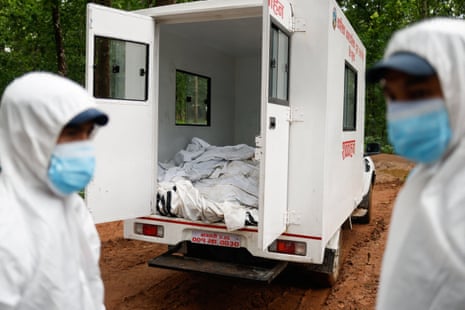
The initial 72 hours after a disaster are viewed as critical to a rescue operation and there are fading hopes that the missing will be found alive.
Rescue efforts nonetheless persist, but have been complicated by challenging terrain, persistently high flood waters and difficult weather.
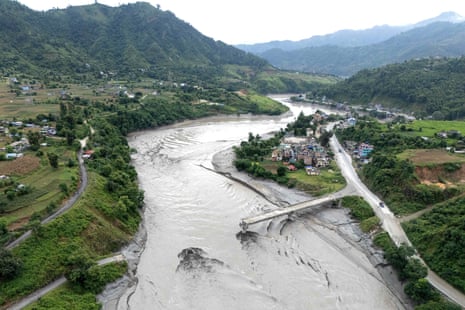
The devastating floods occurred last Wednesday when a huge section of a glacier in the Himalayas came loose and crashed on to the valley floor in Nepal’s Langtang national park, unleashing a massive wall of water and mud that rushed down rivers and valleys.
The resulting floods obliterated villages and destroyed vital infrastructure such as power stations, roads and bridges.
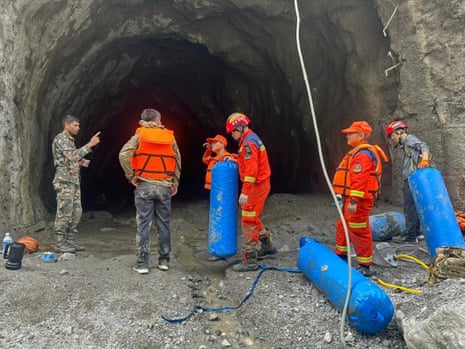
Much of the rescue efforts are now focused on trying to reach the 900 or so missing hydropower workers, hundreds of whom are feared trapped in the tunnels and underground areas of 12 hydropower projects in Nepal.
“A large amount of debris has been deposited and that is posing us a big challenge to open the tunnels,” the Nepal army spokesperson Raja Ram Basnet told the Reuters news agency on Monday.
About 250 people were rescued from the Upper Trishuli hydroelectric project over the weekend, and army engineers began blasting operations at the site to rescue another 42 workers thought be missing, as my colleague notes in this story.
Many people are feared to still be trapped in the sprawling network of mud-filled tunnels at hydropower sites along the Trishuli River, which flows through central Nepal.
Key events
Warning signs visible days before Nepal glacier collapse, report suggests
Three months before last week’s devastating floods, experts from China and Nepal met in Kathmandu, Nepal’s capital, on 27 May to discuss the risk of disasters in the border area and to coordinate on how best to monitor and respond to hazards such as floods, according to the Reuters news agency.
The participants called for joint risk-reduction measures, including inventories of glacial lakes and hazard mapping, but two Nepali officials told Reuters they did not receive as much information as they wanted from China on glacier risks and water levels after the meeting.
Now, a rapid hazard assessment of the Nepal-Tibet disaster prepared by HiRISK, comprised of a group of scientists that produce risk data in the High Mountain Asia region and create guidelines for policymakers, said there were “pre-event indications” of the avalanche, raising more questions about the effectiveness of disaster preparedness.
The assessment was prepared by HiRISK on 28 August, according to ABC News (Australia), which first reported the findings. Jakob Steiner, a co-author of the report and a geoscientist with the University of Graz who has researched lake bursts in Nepal, told the outlet that early warning systems for construction workers were “very weak”.
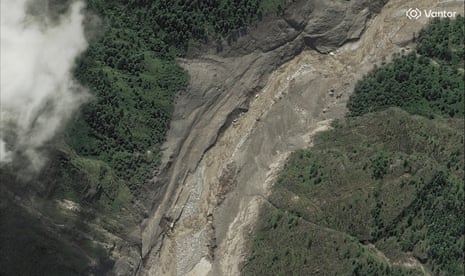
The HiRISK report noted that no early warning system for glacier-related hazards had been established in the affected area.
“Given the rapid speed of the initial avalanche, warning time from conventional … systems would have been minimal and likely insufficient for successful evacuation at the Nepal-China border check point at Rasuwagadhi (Gyirong Port),” it said.
“Further downstream, with warning times of 10 minutes or more, comprehensive and well-capacitated systems could have saved a significant number of lives.”
It is unclear what data – if any – China had before the disaster of the conditions of the glaciers in the area, especially those lying outside its borders.
At least 11,814 people have been rescued so far, according to Nepalese authorities.
Emergency crews are using aircraft to reach stranded communities in areas where roads and bridges have been destroyed by the flooding and landslides.
Nepal tourism department publishes list of names of missing people
Nepal’s tourism department published a list of the names of the people still missing, as of Sunday evening, after the catastrophic flooding in the district of Rasuwa, one of the worst-hit provinces in Nepal. It said there were 164 people from Nepal that remain unaccounted for and 25 from China.
It said a total of 583 foreigners were missing, with the highest number from India (183), followed by the US (64) and then Malaysia (55). There are 33 people from the UK that have been identified as missing.
Beijing’s state media reports that 16 people died in Tibet, with 546 missing, but advocacy groups have accused China of heavily underreporting the death toll from flooding in border regions with Nepal, raising questions about Beijing’s official account of the scale of the disaster.
The Red Cross estimates that more than 93,000 people have been affected by the disaster, heightening fears that the climate crisis is destabilising the geology of mountain and polar regions.
The Nepali prime minister, Balendra Shah, said the flood was an “unprecedented and devastating natural disaster” and that it was difficult to compile a complete assessment of the damage.
The flood was “caused by glacier instability under the long-term effects of global warming”, China’s state-run CCTV reported, saying it was a “new and prominent feature of cryosphere disasters” on the Tibetan plateau.
Two Nepali officials said China had not shared much information on glacier risks and water levels after a meeting to strengthen cooperation earlier this year, and they feared that could hamper future disaster preparedness.
You can read more in this story by my colleagues, Cait Kelly and William Christou, here:
Death toll from Nepal-China flood disaster exceeds 1,000, authorities say
The death toll from the catastrophic flooding in Nepal and China has passed 1,000 as of Tuesday morning, officials said, with authorities reportedly burying hundreds of unidentified victims after the flood disaster overwhelmed morgues.
Nepal’s disaster agency said in an update on Tuesday that 987 deaths had been counted there, with 3,916 people missing, including 583 foreigners.
Chinese authorities, in their latest update on Sunday, reported 16 deaths and 546 people still missing.
The initial 72 hours after a disaster are viewed as critical to a rescue operation and there are fading hopes that the missing will be found alive.
Rescue efforts nonetheless persist, but have been complicated by challenging terrain, persistently high flood waters and difficult weather.
The devastating floods occurred last Wednesday when a huge section of a glacier in the Himalayas came loose and crashed on to the valley floor in Nepal’s Langtang national park, unleashing a massive wall of water and mud that rushed down rivers and valleys.
The resulting floods obliterated villages and destroyed vital infrastructure such as power stations, roads and bridges.
Much of the rescue efforts are now focused on trying to reach the 900 or so missing hydropower workers, hundreds of whom are feared trapped in the tunnels and underground areas of 12 hydropower projects in Nepal.
“A large amount of debris has been deposited and that is posing us a big challenge to open the tunnels,” the Nepal army spokesperson Raja Ram Basnet told the Reuters news agency on Monday.
About 250 people were rescued from the Upper Trishuli hydroelectric project over the weekend, and army engineers began blasting operations at the site to rescue another 42 workers thought be missing, as my colleague notes in this story.
Many people are feared to still be trapped in the sprawling network of mud-filled tunnels at hydropower sites along the Trishuli River, which flows through central Nepal.