2 months ago
103
2 months ago
103
Most of the foreign families of suspected Islamic State fighters have left al-Hawl camp since the Syrian government took control of the facility, prompting security and humanitarian concerns over their whereabouts.
About 6,000 women and children from 42 different countries were previously held in the foreigners’ annexe of al-Hawl camp in north-east Syria, which housed some of the most radical former members of the extremist group. The foreigners’ annexe was separate from the part of the camp that contained about 20,000 Syrians and Iraqis.
All of those held in the camp are arbitrarily detained as they have not been tried or charged for their alleged involvement in IS, and many of the residents are young children.
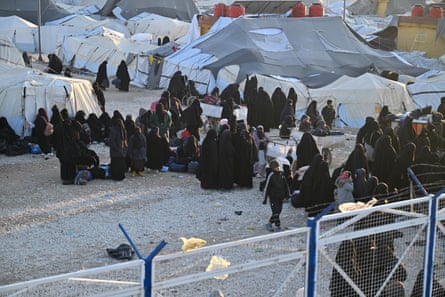
On Friday, humanitarian groups said the foreigners’ annexe had been emptied almost entirely of its former residents and that most of the families left for Idlib. They said foreign women and children had been gradually leaving the foreigners’ annexe since the Kurdish-led Syrian Democratic Forces (SDF) abandoned the facility to the advancing Syrian government forces on 20 January.
“All of the foreign women have escaped in this period,” said Jihan Hanan, who directed the al-Hawl camp until its takeover by Damascus last month. “Every day, cars would come and take them at night and take them to Idlib. It wasn’t done in an organised way.”
The escape of IS-linked individuals from al-Hawl and other detention facilities was a long-running concern for the international community, which warned that a mass-exodus could help IS reconstitute itself across Syria and Iraq. The US military had transferred about 3,000 IS detainees to prisons in Iraq over the past month and was expected to finish the transfer of about 4,000 more over the coming days, which could facilitate the exit of US military forces from Syria.
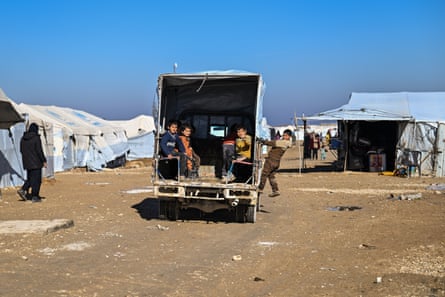
It was unclear how exactly the families left al-Hawl, whether they were let out or they escaped. A camp resident of central Asian descent told the Guardian that she was able to escape by “crawling through the fence” and that she was now in Idlib.
An NGO worker said they were aware of at least one case where a woman who escaped the camp crossed into Turkey and suggested others may have done the same, but cautioned that the lack of oversight made it impossible to know where residents ended up.
The Syrian government has been approached for comment. It has previously blamed escapes on the SDF, which it said abandoned the facility without coordinating with Damascus.
Beatrice Eriksson, a spokesperson for the rights organisation Repatriate the Children, said: “The past two weeks, children and mothers have been moved or released in a highly chaotic context, without clarity on who is responsible or what protection measures are in place.”
During two visits to the camp in the week after its handover to Syrian government forces, the Guardian saw cut fences and frequent escape attempts by residents of the foreigners’ annexe. Fighters of central Asian descent were taking women from the annexe into their cars, with their destination unknown, while others clamoured at the outer walls of the camps, arguing with guards to let their relatives out.
Of the dozen or so women the Guardian spoke to in the camp, almost all expressed their desire to be released to Idlib, where they said relatives were waiting for them. Security guards and fighters expressed sympathy for the detainees, saying their continued detention was an injustice.
Outside the camp’s gates, security officers from the interior ministry guarded the gates. Some took off running as their walkie-talkies squawked: “They escaped, they escaped!” Their supervising officer laughed as the men ran, joking that if it were up to him, he would just open the gates.
It was unclear where the families who left the camp would go next. Some women told humanitarian workers they believed they would be repatriated – something that would require the consent of the home government.
Eriksson said the disorganised nature of the release left women and children vulnerable to trafficking or recruitment to violent extremist groups and urged states to intervene to repatriate their citizens.
She added: “Ending arbitrary detention is necessary, but the immediate priority must be to identify and protect these children and families, and to move them through safe, dignified processes involving international cooperation – not to leave them to navigate a conflict zone on their own.”
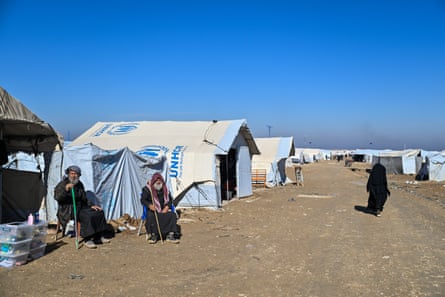
Many states have refused to take back their nationals, despite the pleas of Kurdish forces who guarded the camp and humanitarian groups who said detention conditions were substandard and unlawful.
“We’ve lost everything, all those years that we’ve been working on this issue,” said Hanan. She shared a video of a camp resident standing in her ransacked office, with the man vowing to find and kill her, referring to her by name and calling her a “pig”.
“I know this man. I tried to get him released from the camp, but the security agencies said he was a risk. Now that he’s out, I and all the humanitarian workers are in danger,” Hanan said.