3 months ago
175
3 months ago
175
Russian strikes on Ukraine 'escalatory and unacceptable,' with Kremlin 'using fabricated allegations to justify attack', UK says
UK prime minister Keir Starmer, French president Emmanuel Macron, and German chancellor Friedrich Merz have condemned Russia’s use of the hypersonic Oreshnik missile in western Ukraine as “escalatory and unacceptable,” Downing Street said.
The three leaders spoke on the phone this afternoon to coordinate on foreign policy issues, it said.
A spokesperson for Starmer said the leaders “reflected on the strong unity in support of Ukraine at Tuesday’s meeting” in Paris and “the good progress made on next steps.”
Starmer said that “it was clear Russia was using fabricated allegations to justify the attack,” his spokesperson said.
The three leaders also discussed “security in the High North” - read: Greenland - with Starmer saying “the Nato alliance needed to step up in the region to deter adversaries such as Russia.”
They also talked about Iran, stressing the need to closely coordinate their responses to the events unfolding there.
Key events 12m ago Poland's Tusk says prospect of Ukraine peace 'still remains distant' 27m ago European leaders condemn Russian strikes on Ukraine 48m ago Kyiv mayor calls for temporary evacuation as blackouts continue 1h ago Russian strikes on Ukraine 'escalatory and unacceptable,' with Kremlin 'using fabricated allegations to justify attack', UK says 1h ago Irish MEP vows to vote against Mercosur agreement in European Parliament 2h ago EU's Mercosur deal will be bulwark against China, think tank says 2h ago EU ambassadors sign off Mercosur deal – snap analysis 2h ago Ukrainian security services classify Russian hypersonic missile attack as 'war crime' 3h ago German industries welcome Mercosur deal 3h ago EU-Mercosur deal provisionally approved despite farmers' opposition 3h ago Meloni reiterates her support for Ukraine 4h ago Italy's Meloni says she doesn't believe US could launch military action on Greenland, calls for Nato to step up its operations in Arctic 4h ago US releases two Russian crew members of seized oil tanker 4h ago Half of Kyiv's apartments without heat supply after Russian strikes, mayor Klitschko says 4h ago Respect will of Venezuelan people, Pope Leo says 4h ago Pope Leo calls for 'immediate ceasefire' in Ukraine and dialogue to end war 4h ago Pope Leo says 'deplorable' public resources are used to 'suppress life', criticises 'safe abortion' movement 4h ago Pope Leo warns about 'Orwellian' language of inclusion, and backs right to 'conscientious objection' 5h ago Pope Leo criticises military attacks on civilians 5h ago 'War is back in vogue,' Pope Leo warns at meeting with diplomats 5h ago Russian strikes on Ukraine overnight - in pictures 6h ago Ukrainian PM accusses Russia of 'energy terror' as 500,000 left without power in Kyiv 6h ago Russian strikes kill four, damage Qatari embassy, Zelenskyy says, as he calls for 'clear reaction' against Russia 6h ago Morning opening: So much for Putin's intentions to end the war Show key events only Please turn on JavaScript to use this feature
Poland's Tusk says prospect of Ukraine peace 'still remains distant'
Polish prime minister Donald Tusk has just responded to the overnight Russian attacks on Ukraine, saying “the world today is being shaken by various disturbing events,” and “first and foremost, Ukraine, the Russian aggression against Ukraine.”
But he conceded that “the prospect of peace, or at least a ceasefire, certainly still remains distant,” despite this week’s discussions on EU and US security guarantees for Ukraine in Paris.
European leaders condemn Russian strikes on Ukraine
We also had other reactions from top EU politicians to the overnight strikes on Ukraine, including the Oreshnik strike on western city of Lviv.
EU foreign policy chief Kaja Kallas said on X that “Russia’s reported use of an Oreshnik missile is a clear escalation against Ukraine and meant as a warning to Europe and to the US.”
“EU countries must dig deeper into their air defence stocks and deliver now. We must also further raise the cost of this war for Moscow, including through tougher sanctions.”
Estonian prime minister Kristen Michal said that “Russia’s answer to Ukraine’s and its partners’ efforts for peace is ballistic missiles, damage, civilians killed and wounded.”
“Homes without heat, electricity, or water in the middle of winter. This is not a step toward negotiation. This is terror. Russia deliberately prolongs the war.”
He added the EU needs to keep pressure on Russia as it “does not respond to goodwill; it responds only to force.”
Meanwhile, German chancellor Friedrich Merz insisted that “threatening gestures are intended to instil fear, but they will not work.”
We stand with Ukraine.
Kyiv mayor calls for temporary evacuation as blackouts continue
Following the Russian attack overnight, Kyiv’s mayor Vitali Klitschko has urged the residents of the capital to consider temporarily leaving the city “for places with alternative sources of power and heat” amid worsening weather conditions and extensive blackouts caused by the strikes.
It’s currently -8 degree Celsius in Kyiv and it’s set to fall to -17 tomorrow night.
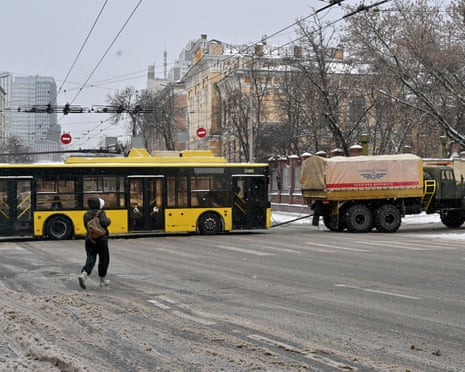
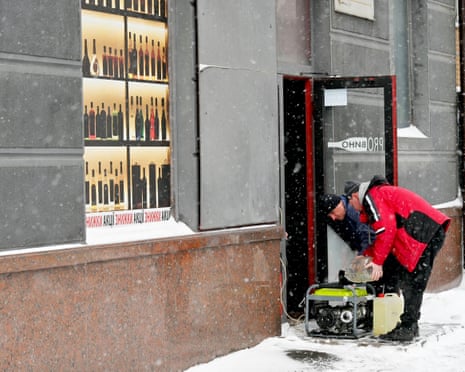
But AFP journalists at train and bus stations in the capital saw no signs of large crowds or panic.
Russian strikes on Ukraine 'escalatory and unacceptable,' with Kremlin 'using fabricated allegations to justify attack', UK says
UK prime minister Keir Starmer, French president Emmanuel Macron, and German chancellor Friedrich Merz have condemned Russia’s use of the hypersonic Oreshnik missile in western Ukraine as “escalatory and unacceptable,” Downing Street said.
The three leaders spoke on the phone this afternoon to coordinate on foreign policy issues, it said.
A spokesperson for Starmer said the leaders “reflected on the strong unity in support of Ukraine at Tuesday’s meeting” in Paris and “the good progress made on next steps.”
Starmer said that “it was clear Russia was using fabricated allegations to justify the attack,” his spokesperson said.
The three leaders also discussed “security in the High North” - read: Greenland - with Starmer saying “the Nato alliance needed to step up in the region to deter adversaries such as Russia.”
They also talked about Iran, stressing the need to closely coordinate their responses to the events unfolding there.
Irish MEP vows to vote against Mercosur agreement in European Parliament

Lisa O’Carroll
The adaptation of the Mercosur deal is “devastating” for Irish farmers, a Sinn Fein MEP said, as she vowed her party would vote against the deal when it goes before the European parliament.
The Irish MEP Kathleen Funchion called on other Irish MEPs, who previously supported the deal, to also vote against it given the Irish government representatives voted against the deal today.
“We know this is a bad deal for Irish farming, public health, and the environment. It contradicts so many other policy objectives, not least among them food security, protecting farm incomes, and supporting farm succession.
It will see Irish farmers forced into unfair competition with Mercosur ranchers who produce under far less strict regulation.”
“Furthermore, the so-called safeguards are far from adequate to protect our farmers, and there have been no changes to the deal since it was announced in December 2024,” she said.
EU's Mercosur deal will be bulwark against China, think tank says
Lisa O’Carroll
The EU’s deal with Latin American countries will act as a vital bulwark against China, giving the bloc a chance to reduce dependency on Beijing in key industries, a leading think tank has said.
“The deal is not only about economics. Latin America is a region of intense competition for influence between western countries and China. Failing to sign the EU-Mercosur free trade agreement risked pushing Latin American economies closer to Beijing’s orbit. The conclusion of the deal also signals that Europeans are serious about diversifying their export markets away from the US,” said Agathe Demarais, senior policy fellow.
China already controls up to 90% of rare earths and has a stranglehold on the world’s supply of refined lithium, the end product used in electric vehicle batteries.
Demarais pointed out that Brazil accounts for around 20% of the world’s reserves of graphite, nickel, manganese and rare earths.
But it also holds 94% of global reserves of niobium, a metal that is used in the aerospace industry, while Argentina is the third largest producer of lithium, a material used in batteries in electric vehicles.
“By lowering tariffs on EU exports to Mercosur economies, notably for chemicals (currently facing an 18% tariff) and machinery (hit by tariffs of 14-20%), the deal could help convince EU firms to develop production lines in Latin America instead of China,” she said.
EU ambassadors sign off Mercosur deal – snap analysis
Lisa O’Carroll
European nations have backed the biggest ever free trade agreement with a group of South American countries, ending 25 years of negotiations but risking further tensions with farmers around the bloc.

France, Poland, Austria, Ireland and Hungary opposed the deal in the face of protests from the agricultural sector, but Italy dropped its opposition allowing the landmark deal to be adopted under the majority voting system.
The deal with Brazil, Argentina, Paraquay and Uruguay, must still get the approval of the European parliament but bar any major U-turns by member states, it could be signed off as early as next week by European Commission president, Ursula von der Leyen.
The European Commission, which concluded negotiations a year ago, had hoped to get the deal over the line at the European Council summit but it was pulled from the agenda at the last minute after opposition by France and Italy, two of the bloc’s biggest agricultural producers.
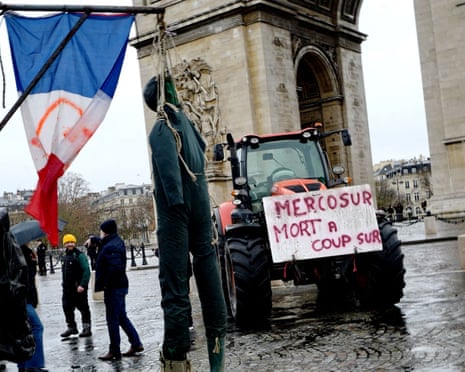
On Thursday night, French president Emmanuel Macron announced it would vote against the deal after farmers rolled into Paris on tractors in the latest protests against the pact which they fear will flood the bloc with cheap and substandard meat.
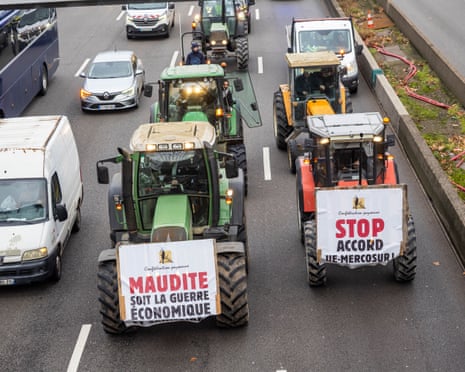
A senior European Commission official described Ireland’s decision to also vote against the deal as “disappointing” claiming the country’s concerns had been addressed.
Belgium abstained from the vote, reflecting differences in the federal government.
Supporters of the deal say it will help the EU diversify and compensate for the new trade barriers erected by Donald Trump and lower tariffs on the equivalent of just 1.5% of beef produced in the EU.
It will see import duties phased out on 91% of EU goods and allow freer access to critical raw materials like lithium needed for batteries in the European car industry.
Greenpeace has slammed the EU’s provisional approval of the Mercosur trade deal as a “harmful” agreement that will ultimately harm the Amazon and cause further deforestation.
“This agreement encourages the import into Latin America of highly polluting and health-damaging products like cars, plastics and pesticides from Europe, in exchange for commodities often sourced from deforested areas,” said Greenpeace Brazil senior forest campaigner Romulo Batista.
Ukrainian security services classify Russian hypersonic missile attack as 'war crime'
Back to Ukraine, the Security Service of Ukraine said it classified the Russian strike with the hypersonic Oreshnik missile on the western city of Lviv as a “war crime,” stressing it appeared to be targeted at civilian critical infrastructure.
“By attacking civilian objects of our state near the border with the European Union, the Kremlin attempted to destroy the region’s life-support infrastructure in the face of rapidly deteriorating weather conditions,” the SBU said.
The investigators looking at the strike found a number of parts of the Oreshnik missile in the area, which they said confirmed the type of weapon deployed.
Earlier today, a senior Ukrainian official said the ballistic missile was likely carrying inert or “dummy” warheads, and it struck the workshop of a state enterprise.
German industries welcome Mercosur deal
Lisa O’Carroll
Meanwhile, the German federation of industries has welcome the Mercosur deal, saying it is an important day for the Germany and European economies.
Tanja Gönner, the managing director of the federation, said: “The European Union is demonstrating its ability to act and sending a strong signal in favour of free trade. The agreement proves that the EU can be a relevant geostrategic actor.”
She said the deal would mean a saving of around €4bn a year annually in tariffs and give European businesses access to one of the biggest markets in the world accounting for 750m people.
It will also give it ready access to critical raw materials such as lithium and copper, particularly important for Germany’s auto industry and wind turbines.
“Europe remains under pressure as the US and China systematically expand their spheres of influence. Mercosur can therefore only be the beginning. The EU must further diversify its strategic partnerships and open up new markets. This includes the trade agreements with India and Indonesia,” she added.
EU-Mercosur deal provisionally approved despite farmers' opposition
Elsewhere, we are getting a line from Brussels that EU ambassadors have given their provisional backing to the controversial EU-Mercosur trade agreement, despite growing farmers’ protests against the deal.
Ireland, France and Poland are reportedly among the countries that opposed the deal, but found themselves in minority.

Meloni reiterates her support for Ukraine
Meloni also reiterated her support for Ukraine, while acknowledging that there are contrasting views on what’s the best way to stave off the prospect of war with Russia.
But she insisted that the best way to do that is to stand with Ukraine, as she talked about the need to put forward strong security guarantees for Kyiv in case of a ceasefire or a peace deal with Russia.
She also made it very clear that it was “absolutely premature” to talk about readmitting Russia to G8.
Italy's Meloni says she doesn't believe US could launch military action on Greenland, calls for Nato to step up its operations in Arctic
Meanwhile, Italian prime minister Giorgia Meloni said she still didn’t believe that the US would launch a military action to take control of Greenland.
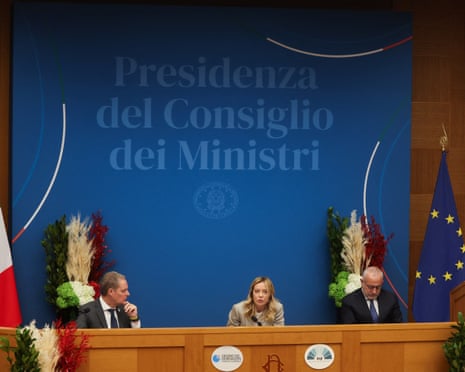
Asked about it during her annual major press conference, Meloni also stressed she made it clear that she would not support any such move and she believed it would “not be in anyone’s interests, not even the US”.
She argued that the Trump administration wanted to use its “highly assertive methods” to “draw attention” to the issue of strategic importance and security of the high north.
“I continue to believe that the message the US wants to send is that it will not accept excessive interference from other foreign actors,” she said.
She added that Greenland should be classified as a priority area for Nato, with “a serious debate” on how to protect it, and “to ease the pressure” on the issue.
Pressed on that a bit further, she added that “the implications” of any potential US military movement on Greenland were “clear to everyone”, which is why she didn’t consider them “realistic.”
But she stressed that Europeans should show they treat US warnings about the region’s importance seriously and do more to secure the Arctic, including a “serious and significant presence” of Nato forces there.
US releases two Russian crew members of seized oil tanker
We are also getting a line from Russia that the US has released two Russian members of the crew of a Russian-flagged oil tanker seized near Iceland earlier this week.
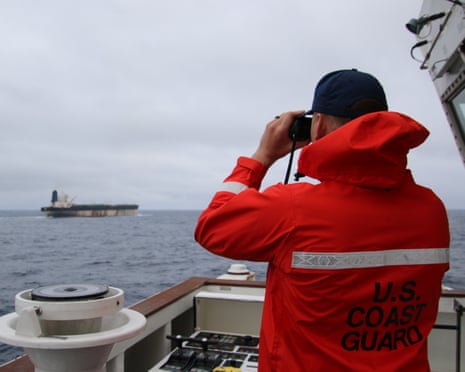
AFP quoted Russian foreign ministry spokesperson, Maria Zakharova, as confirming the release by the US in response to a Russian request.
“We welcome this decision and express our gratitude to the US leadership,” she said, quoted by AFP.
Russian envoy Kirill Dmitriev said on Telegram that Trump decided to release “all Russians” on board the Marinera tanker.
Half of Kyiv's apartments without heat supply after Russian strikes, mayor Klitschko says
Back to Ukraine, Kyiv’s mayor Vitaly Klitschko said that half of the city’s apartments are without heat supply due to the damage sustained in overnight Russian attacks on the capital.
“We are doing everything to [restore supply] as soon as possible. But the combined attack on Kyiv last night was the most painful for the capital’s critical infrastructure facilities,” he said.
He added that “city services are working in emergency mode,” but acknowledged that “the weather conditions, unfortunately, are forecast to be difficult in the coming days.”