3 months ago
175
3 months ago
175
Introduction: Oil surges over $100 a barrel in frenzied trading
Good morning, and welcome to our rolling coverage of business, the financial markets and the world economy.
Stock markets are tumbling today after the oil price surged over $100 a barrel for the first time in four years.
Crude prices rocketed last night as soon as Asia-Pacific financial markets opened for the new week, with US crude and Brent crude both nearing $120 a barrel in frenzied trading.
Oil is on track for its biggest daily jump since the turmoil of the Covid-19 pandemic, after at least five energy sites in and around Tehran were hit by strikes, prompting accounts of “apocalyptic” scenes in the Iranian capital.
Kuwait’s national oil company also announced a precautionary production cut amid retaliatory attacks by Iran, and there were reports that output from Iraqi oil production from its main southern oilfields has fallen by 70%.
With traders betting that the Middle East confict will lead to supply disruptions, the jup in the oil price is threatening an inflationary surge that would hurt economics around the world and create a new cost of living squeeze.
The stock market response has been brutal this morning. Japan’s Nikkei has plunged by almost 5% today, while South Korea’s Kospi has shed 6.5%. Australia’s S&P/ASX 200 has dropped by 2.85%.
European and US stock markets are all set for losses too.
Ipek Ozkardeskaya, senior analyst at Swissquote, says hopes for peace have waned after Mojtaba Khamenei, the second son of the late Iranian supreme leader Ayatollah Ali Khamenei, was chosen as his successor.
Ozkardeskaya says this decision that did not please the US at all, adding:
The choice suggests that Iran will not back down to the US, and that means a potentially prolonged war in the Middle East – which is home to about 50% of global oil reserves and around 40% of the world’s natural gas reserves.
About 20% of the world’s oil and LNG flows through the Strait of Hormuz, which is presently closed, making it one of the most critical energy chokepoints in the global economy.
The agenda
-
12.30pm GMT: G7 members and IEA to hold call to discuss the impact of the Iran war
-
2pm GMT: Eurozone finance ministers to hold Eurogroup meeting
Key events Show key events only Please turn on JavaScript to use this feature
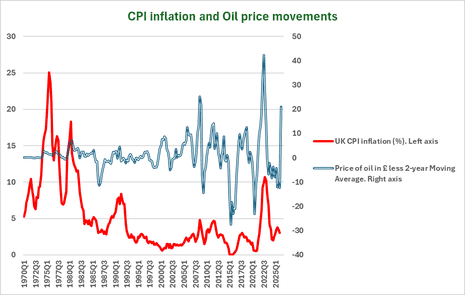
The jump in the oil price could add half a percentage point to UK inflation within the next three months, says Professor Costas Milas, of the Management School at University of Liverpool:
An oil price of $100 is more like a psychological threshold. What is more appropriate for inflation pressures is how much oil moves relative to its two-year Moving Average [see plot below].
Latest estimates, based on my LSE Business Review blog (which estimates the impact of oil price movements in addition to other drivers of inflation such as interest rate effects) suggests that the latest oil price pressures could add up to 0.52 percentage points to UK inflation within the next three months...
Stock markets 'finally wake up' to implications of Iran war
It might be a serious mistake for central banks to respond to the oil price shock by raising interest rates.
Chris Beauchamp, chief market analyst at IG, explains:
“Stock markets have finally woken up to the implications of the Iran war, as oil hits three figures for the first time in four years. Having remained remarkably complacent last week, it looks like the rush for the exits has begun in earnest. Even high-flying defence stocks are being hit hard in London today, a sign that investors are no longer concerned about potential upside, but instead are focusing on protecting their profits, opting to sell now and sit out the volatility for the time being.”
“The morning has already seen markets begin to price in rate hikes by the ECB and the Bank of England. But that seems odd given the major hit to consumer spending that is about to make itself felt – this is a supply-driven shock, not some huge surge in demand. Policymakers may well have learned the wrong lesson from 2021, and risk setting off a much deeper recession if they get too trigger-happy on rate hikes.”
European market update: losses across the board
After an hour’s trading, European markets are still firmly in the red.
-
UK’s FTSE 100: down 200 points or 1.9% at 10,087 points
-
German DAX: down 548 points or 2.3% at 23,043 points
-
French CAC: down 198 points or 2.5% at 7,795 points
Fears of a stagflationary shock last seen half a century ago are hitting markets today, reports Neil Wilson, investor strategist at Saxo UK:
A 1970s oil shock? Perhaps. The global economy is a lot less dependent on the price of a barrel than it was then – oil intensity has declined steadily since the 70s.
But clearly there are fears of a global economic slowdown and inflation crisis which is roiling global markets after a weekend of further escalation in the Middle East war. The 1970s crisis led to the 80s bull market – will it also create the roaring 20s bull market? For the moment, financial markets are concerned about a 1970s-style stagflation situation first.
The money markets are now predicting that UK interest rates will have risen to 4% by June 2027, up from 3.75% at present.
UK two-year bond yields on track for worst day since Liz Truss's mini-budget
Inflation fears mean UK short-term government bonds are on track for their worst day since former prime minister Liz Truss’s mini-budget roiled the markets in September 2022.
With prices tumbling this morning, the yield (or interest rate) on UK two-year bonds has jumped by as much as 37 basis points (0.37 percentage points) to 4.239%.
That, Reuters reports, puts two-year yields on course for the biggest one-day increase since Truss’s brief tenure, when plans for unfunded tax cuts and energy bill support sparked a surge in bond yields and sent the pound down to a record low.
Such a large move in two-year bond yields underlines how investors have ripped up hopes of cuts to UK interest rates.
Earlier this year, two cuts to interest rates in 2026 were expected – the market is now indicating that borrowing costs are more likely to rise this year (see earlier post).
Airline shares across Europe are sliding this morning.
IAG, the parent company of British Airways, has dropped by 4.3% this morning, adding to its losses last week.
Lufthansa are down 4.6% and Air France has lost 5.1%.
Budget airline easyJet is off 3.6% while Wizz Air has fallen by 8.3%.
UK government borrowing costs jump
Fears that the jump in the oil price will spark an inflationary surge are hurting government bonds.
With prices falling, the yield (or interest rate) on government debt is rising, sharply.
The benchmark 10-year UK bond yield is up 9.5 basis points (0.095 percentage points) to 4.756%, its highest level since early October last year.
This highlights how the crisis is putting pressure on the UK’s economy, and its public finances.
Kathleen Brooks, research director at XTB, says:
The UK is paying for natural gas than our European neighbors, so it is natural that our bond market sell off could be worse than Europe’s today.
Oil companies are among the few risers on the FTSE 100 index this morning, with Shell (+1.7%) and BP (+1.4%) benefitting from the surge in crude prices.
European stock markets hit lowest since December
Continental European stock markets have joined the global sell-off too, with
Germany’s DAX index dropped by 2.5% in early trading, France’s CAC 40 shed 2.4% and Spain’s IBEX lost 3.1%, amid alarm over the surge in oil prices.
This has pushed the pan-European Stoxx 600 index has dropped by 2% at the start of trading, to its lowest since December, Reuters reports.
FTSE 100 tumbles
The London stock market is open, and shares are tumbling.
The FTSE 100 index of blue-chip shares has dropped by 179 points or 1.75% at the start of trading to hit 10,106 points.
That looks to be its lowest level since mid-January, as the Iran war wipes out most of the gains recorded this year.
Mining stocks such as Anglo American (-6.2%) and Antofagasta (-5%) are among the fallers, along with Rolls-Royce (-5%) whose jet engine business will suffer from a slump in travel.