3 months ago
99
3 months ago
99
Long before the upstairs/downstairs drama of Downton Abbey, there was John Galsworthy’s dynastic shenanigans of the nouveau riche Forsyte family. Their loving and feuding was spread across nine books and set against more than four decades of British history.
Unlike Downton, the story features just the upstairs lot. They have come a long way from their Dorset farming descendants and are not the best sort of people: they hold money paramount with a need to “possess things”. Adapted by Shaun McKenna and Lin Coghlan, who previously adapted the story for radio, we see how this entitlement manifests in love, marriage and betrayal.
There is plenty of human drama and the focus is on female experience across both parts, the first involving Irene (Fiona Hampton) and her marital rape at the hands of proprietorial husband, Soames (Joseph Millson) in the Victorian era. The second is that of Fleur (Flora Spencer-Longhurst), the daughter of Soames and our sometimes narrator, taking place after the Great War. It is less reliant on familiar melodrama and is more alive for it, featuring a star-crossed romance between Fleur and Irene’s son, Jon (Andy Rush), who are on either side of a family schism. We see strong-headed Fleur regarding love as an entitlement (like father, like daughter?). “You’re mine,” she repeats, proprietorially. Jon is a more passive, pallid, character compared to Irene’s lover, Philip Bosinney (also played by Rush).
The first part is a kind of War and Peace Lite, showing how the fortunes of family members are shaped or constricted by the time in which they live, although the greater historical gyrations seem distant, with the briefest of talk about the Boers in South Africa and Queen Victoria’s funeral, but without being blended in the human drama. The post-war generation of the 1920s speak of life as a comedy and bear a hedonistic nihilism in Part 2 but this is repeatedly stated rather than felt.
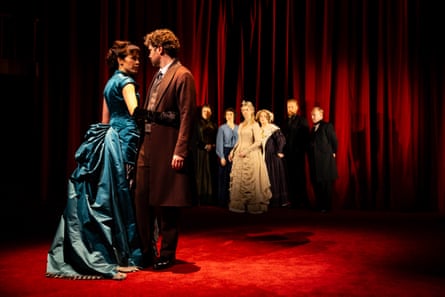
Soames, the villain of the piece in Part 1, becomes the vulnerable father who must stand and watch his daughter repeating his mistakes. Irene, whose beauty seems to be an objet d’art for younger Soames, to possess alongside his art collection, captures the contained anguish and strangled options of a woman living in an age that renders her powerless as a wife, however privileged she might look from the outside. In some respects she is a British Anna Karenina, although she proves herself a survivor.
This production’s initial run was in the intimate, fringe, space of the Park theatre, in London, where it was staged, innovatively, with an expertly spare set, consisting of little more than layers of velvet curtain. All the wealth of this family had to be imagined by the audience. It is the same in this Royal Shakespeare Company staging but it has a different effect. It seems less experimental, more a slick Merchant Ivory-style costume drama that does the job of hooking you in.
Still, it is realised with wit and pace by director Josh Roche. The minimal set design is striking in its red velvet opulence. Premium is on sound, composed and designed by Max Pappenheim, which is crisp and vivid (cooing wood pigeons, clopping horses, etc).
There is a fluidity in switching of scenes that adds a psychological undertow: characters from the last scene stand watching the next, as if eavesdropping, or they loom, like spectres in the mind. Several performances involve the adept juggling of characters. But this imaginative form of storytelling is hemmed in by a familiar story of rich scions being typically rapacious and beastly. It is essentially a posh soap opera that slips down easily enough across five hours (if you see them both) but it is not exactly penetrating in character or story.