3 hours ago
8
3 hours ago
8
For months, parts of Indonesia’s Borneo and Sumatra islands have been ablaze. The fires are sometimes lit illegally as a cheap way to clear land for plantations of oil palm, of which Indonesia is the world’s largest producer.
So prevalent is the technique that it even has a special term: slash and burn.
Many of the fires begin as small-scale blazes. But in hot, dry conditions, can easily spiral out of control, sending toxic smoke across borders and affecting the air quality of millions in Indonesia and beyond.
This year a “super” El Niño could inflame the problem.
David Gaveau, a landscape ecologist who runs Nusantara Atlas, which tracks fires and deforestation in Asia, says the worst fires occur on drained and dried out peatland.
This type of fire is extremely difficult to extinguish, and can burn for weeks underground.
“They go underground, they resurface somewhere else. And then the more water you give it, the more smoke there is,” he says, “These fires are really the legacy of 50 years of forest degradation, deforestation, and particularly on peatland.”
If there was an “apex predator” among fires, tropical peatland fires would be a top contender, says Nasa.
Fires occur annually in Indonesia, but data from this year indicates it is already looking like a bad year, with the worst hit areas in Sumatra, Kalimantan, the Indonesian part of Borneo, and Papua.
Since January at least 895,657 hectares have been burned Indonesia-wide, 34% worse than 2019, according to data from Nusantara Atlas.
“It’s trending far higher than 2019 or even 2023,” says Gaveau, “What that means is that this is a terrible year.”
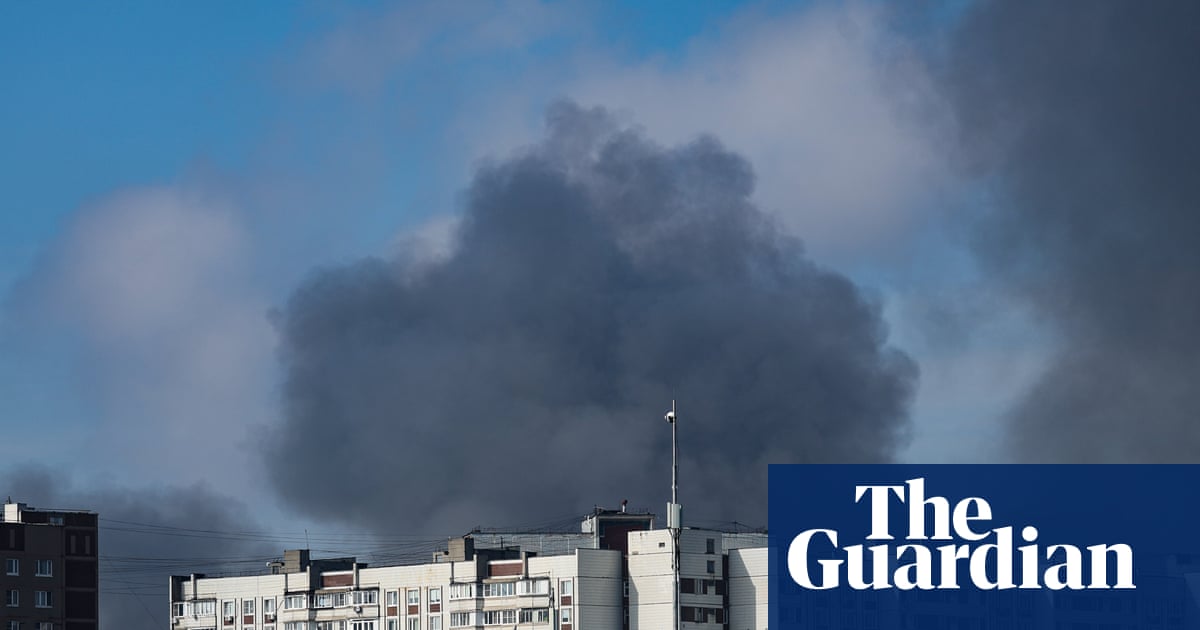
In recent weeks, photos from Kalimantan have shown a thick, sepia-toned haze shrouding streets and obscuring cities, schoolchildren wearing masks at their desks, and even rescuers giving oxygen to smoke-affected orangutans.
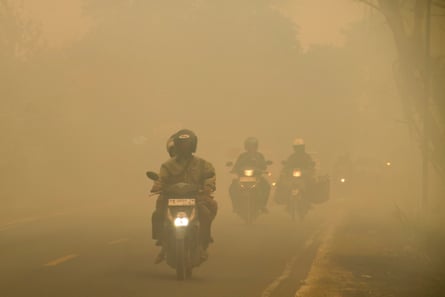
“Ever since the haze hit, we haven’t opened our doors or windows in a long time. The wind carries smoke from the fires all the way to our porch. Ash and smoke seep directly into the house, and the conditions worsen at night,” Ely Marlina, a 46-year-old schoolteacher and volunteer firefighter told the Guardian.
“While we sleep, the whole family is just breathing in the smoke,” she says. “The physical toll is visceral; eyes are left stinging and weeping daily … It feels like if we keep breathing in this smog, the dizziness will take over and our bodies will just give out.”
As the fires rage, schools have closed, and emergency rooms have been inundated with patients.
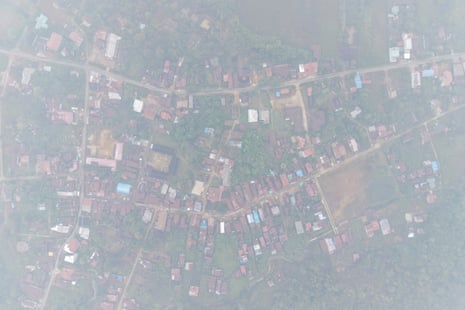
The numbers of people suffering wildfire-related respiratory illnesses in those provinces had more than doubled to 113,336 by 9 September, from 50,891 on 1 September.
Fire emissions from Indonesia in the first week of September reached 19.7m metric tons, accounting for more than a third of the global total, according to Fire Emissions Watch, a portal developed by the European Union’s Copernicus climate monitoring service.
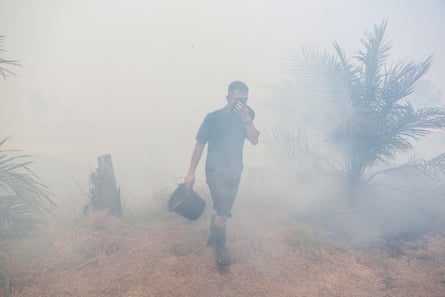
The air quality index in Indonesia and its neighbours shows just how much the fires have become a public health issue.
According to air quality index ratings, a healthy level of air, signified by green, is ranked between 0 and 50.
Anything above 300 is considered hazardous.
Every day this September, the air quality in Sampit, central Kalimantan, has been classified as hazardous, going beyond the red and into the worst rating of maroon, according to the Swiss air monitor IQAir. On 10 September, the rating hit 1142.
In Kuching, the biggest city on Malaysian Borneo, this month, AQI levels have fluctuated between unhealthy and hazardous.
One resident in Kalimantan recently told the Guardian that taking a breath feels like “smoking a cigarette”.
When the smoke from these fires crosses borders, it’s called “transboundary haze”.
This year, the haze has again plagued Indonesia’s neighbours, blanketting parts of Malaysia, Singapore, Brunei, and even the Philippines.
Carried by monsoonal winds the smoke travelled as far as Manila, with residents urged to stay indoors as much as possible, and to wear mask outdoors.
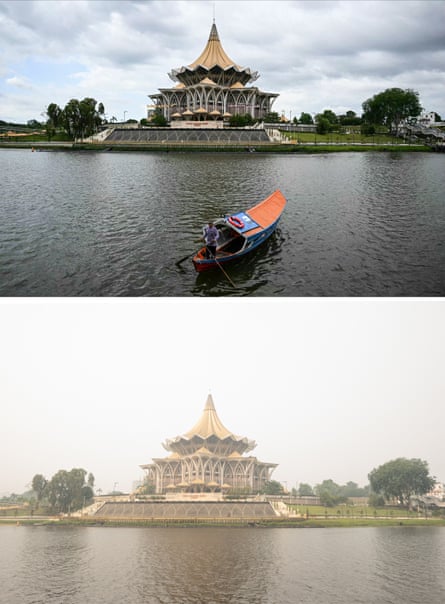
Among the countries hardest-hit, Malaysia has urged the Association of Southeast Asian Nations to review an agreement on transboundary haze from 2003.
Indonesia’s environment ministry is investigating 19 companies allegedly linked to the fires, while police have arrested 113 people on suspicion of lighting them.
But enforcement has proven a challenge for the country.
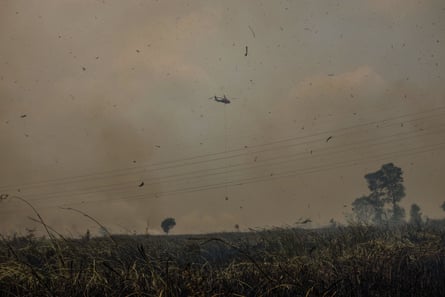
The government has vowed to crackdown on bad actors; it has also deployed planes, helicopters, drones and the military to fight the fires; and it has bolstered mitigation efforts.
Malaysia has offered three helicopters, an aircraft and 52 personnel to assist, while Japan has also sent in helicopters and a fire-fighting force.
Residents are also doing their bit. A team of female firefighters called the Power of Mama, conduct daily surveillance activities, fire monitoring and community outreach, including encouraging people not to burn and warning them of the risks.
In West Kalimantan, volunteers are going door-to-door to hand out cylinders of oxygen to residents and firefighters struggling to breathe, in a campaign called “Rumah Oksigen”, or Oxygen House.
But the next few weeks will be crucial.
With this year’s super El Niño, experts say the fires could peak this September, and continue until November, when the rainy season is expected to start, but the phenomenon is not the only factor.
“El Niño is an enabler. Of course the more powerful it is, the longer and the more intense the drought, and that’s not good news,” says Gaveau, “But you need a match. And we know what that is; it’s people.”
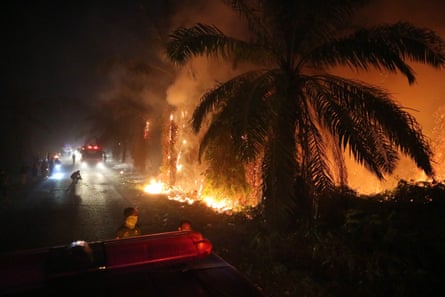
Indonesia’s forestry minister Raja Juli Antoni has also warned that the country is entering a critical phase.
“We have not yet escaped the threat of El Niño,” he said. “We are not safe from forest and land fires during this El Niño period. September is our month of struggle, our field of struggle.”
Additional reporting by Garry Lotulung