3 months ago
119
3 months ago
119
Analysis has found more than 3,000 mining operations within the most naturally precious areas of the planet, a much bigger footprint than previously thought
Weda Bay is just one example of a global trend that could see the mining industry expand into some of Earth’s last areas of wilderness in search of minerals and materials to feed the global economy.
Analysis produced for the Guardian by a group of academic researchers found more than 3,267 mining operations within key biodiversity areas (KBAs), accounting for nearly 5% of the mining sector’s global footprint. China, Brazil, Argentina and Mexico top the rankings for total surface mining area within key biodiversity areas, the most naturally precious areas of the planet.
Until recently, quantifying the industry’s exact imprint has been a difficult task, with mining companies rarely sharing accessible details about their environmental impact. But a growing number of researchers are using satellite imagery to track the sector’s activities from space.
“We have a huge gap on the global assessments of the footprint of mining. It is much bigger than we think,” says Victor Maus, a researcher at Vienna University of Economics and Business. “Most of what is published about mines is for businesses and attracting investors. There’s not much about their impacts. It has somehow escaped the eye of the international community,” he says.
With growing demand for commodities to fuel the green energy transition, the mining sector’s footprint continues to grow.
“We see an expansion of mines in biodiverse areas, particularly with materials like nickel in Indonesia. You have seen expansion into pristine forests over the past few years. The same in the Amazon in Brazil and Peru – gold mining is big there,” says Maus.
Once a mine has opened, habitat is often lost for ever. Many use huge amounts of water from the surrounding area, depleting rivers, aquifers and lakes. Despite efforts from the industry to clean up its act, mining waste is often poorly stored and has resulted in significant pollution events from acid, heavy metals and waste rock.
It is hard to put a figure on the amount of nature that may have been lost to mining activities but a recent study estimated that more than 4,500 animal species are threatened with extinction by mining. Immediate destruction of habitat, along with pollution of watercourses and deforestation for access, all threaten their survival, researchers say. Wildlife like the bent-toed gecko, which is only found on a single mountain range in Malaysia, are among those that could disappear. The Yangtze river dophin and several lemur species are other examples that have already been harmed by mining. A separate study found that up to one-third of Africa’s great ape population is facing mining-related risks.
The analysis here only covers mines that are operational. Demand for critical minerals in 2050 is projected to be 16 times higher than 2020 levels, according to one study. This is already pushing mining projects further into key biodiversity areas.
The pattern seen in Weda Bay, Indonesia, is being replicated in other parts of the world. Weda Bay’s operators did not respond to a request for comment.
Sepon copper mine in Laos
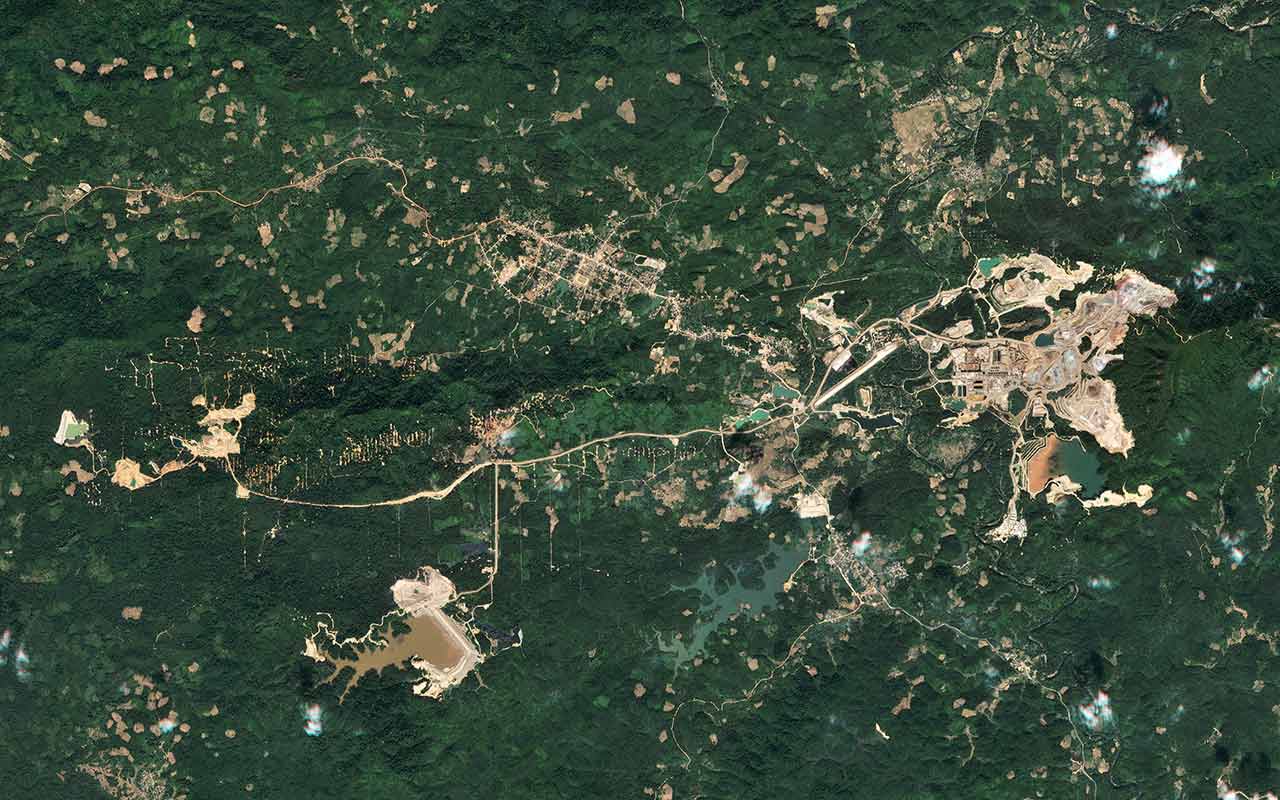
2010

2025
Around Sepon gold and copper mine in Laos, habitat has been destroyed and polluted over the lifetime of the operation. The mine’s operators did not respond to a request for comment.
In the Kayapó Indigenous territory in Brazil, one of the largest protected areas of its kind in the world, illegal goldminers are ravaging areas of the Amazon rainforest. In 2010, the forest was largely intact. But just 15 years later, large areas had been cleared.
Goldmine in Kayapó Indigenous territory, Brazil

2010

2025
“There are some places where mining should simply be off the table,” says Tim Werner, a senior lecturer at the University of Melbourne who has worked with Maus to better understand the scale of the industry.
“Areas such as Raja Ampat in Indonesia are among the most beautiful and biologically rich places on Earth, where intact rainforests sit alongside extraordinary coral reef systems. Yet they are at risk of being totally decimated by mining for critical metals. At some point, the benefits of extracting minerals are outweighed by the irreparable loss of places like these. We are indeed at a global crossroads, and we need an honest conversation about no-go zones and about prioritising extraction in landscapes we can afford to affect – even if that means higher costs,” he says.
Methodology
Satellite imagery provided by Planet Labs.
The maps of key biodiversity areas were sourced from the KBA Partnership. It defines key biodiversity areas as “the most significant sites on Earth for nature, ranging from vast deserts to the depths of the ocean. These areas are crucial for maintaining the health of our planet and ensuring various species can survive.”
The maps of mines and materials are sourced from data by Victor Maus of the Vienna University of Economics and Business, using data from the scientific article, ‘A Data-Driven Approach to Mapping Global Commodity-Specific Mining Land-Use’, and available from minethegap. This analysis is based on modelling of mining activity using a global grid of 0.5° squares sized at roughly 50 sq km.
Satellite image at the start of the piece is sourced from Planet Labs, and taken on 17 December 2010 and 14 May 2025. The first photo shows deforestation due to nickel mining in central Halmahera, Indonesia, in July 2024 (photo: Mas Agung Wilis Yudha Baskoro), the second a healthy coral reef in Halmahera, Indonesia, in April 2025 (photo: Ethan Daniels/Alamy) and the third photo shows a male standardwing bird of paradise on Halmahera Island, Indonesia, in November 2011 (photo: Minden Pictures/Alamy).
Find more age of extinction coverage here, and follow the biodiversity reporters Phoebe Weston and Patrick Greenfield in the Guardian app for more nature coverage