3 months ago
192
3 months ago
192
Practicing yoga has its benefits: the meditative calm, grounded-ness and balance. The devoted pursue transformative spiritual journeys, through poses, chants and breath work. Some followers of tantra yoga take things even further, using sensuality to channel their energy and reach beyond themselves, seeking out of body liberation and enlightenment.
But it’s that very pursuit that has also left hundreds vulnerable to alleged rape and trafficking.
Those crimes are recounted and explored in the new Apple series Twisted Yoga. Former followers of the Movement for Spiritual Integration into the Absolute (MISA) appear in the compelling (and yes, enlightening) three-part documentary series, describing their slow indoctrination into what appears to be a cult.
The followers, among them a woman named Miranda who shared her story with the Guardian last year, describe going from attending one of several yoga schools in cities like London or Paris to being whisked to secret locations, their sim cards and IDs forfeited. They were allegedly manipulated into sex cam work and orgies, groomed by an international network of yoga camps organised by Gregorian Bivolaru, a self-professed guru who was already wanted by Interpol for sexual exploitation charges in Romania dating back to 2016. Bivolaru was detained in France in 2023, and charged with organized kidnapping, organized abuse of weakness by members of a sect, human trafficking and rape. He’s currently awaiting trial.
“The question that we grappled with,” says Rowan Deacon, the Twisted Yoga director, “is how come this hasn’t come to the fore sooner? How come people haven’t spoken out sooner? Why is it happening now, when this man has been in Paris doing this for 20 years?”
As Miranda puts it in Twisted Yoga, she didn’t see herself as a victim, echoing the experience of so many who endure abuse. The words rape and trafficking were just not part of the lexicon she applied to the situation, where she found herself in a community and wholeheartedly embraced their teachings on tantric yoga. That remained the case even when, like so many women, she was inevitably lured into tantric sex with Bivolaru, as part of a transfiguration ritual reaching for the divine.
“They’re entering into that situation as a sort of spiritual exercise and thinking about it linguistically in those terms,” says Suzanne Lavery, Twisted Yoga executive producer. “But if you take away that terminology, and then you’re looking at it from a legal perspective, or as a therapist, or in the cold light of day … it’s challenging the belief system that they had built up during their time with the school, and then realizing the different language that fit was much, much more uncomfortable.”
“I found that so fascinating,” adds Deacon, speaking to Miranda’s reckoning, “that the indoctrination would have actually changed the perspective of what had happened to her … It takes a long time to disentangle the narratives that you’ve told yourself or that you’ve been told. In many women’s cases, it took other women speaking to them about their experiences that kind of unlocked something for them.”
Deacon begins our conversation speaking to her hesitation approaching the subject matter. She was wary that the explosive case against Bivolaru, a figure who used the remnants of Romania’s communist regime to paint himself as an unfairly prosecuted political refugee, could result in true crime sensationalism. Twisted Yoga does have its fair share of investigative reporters and French detectives unravelling the sordid international web of collusion, deceit and abuse not yet tested in court. But Deacon and Lavery steer it towards a psychological story exploring consent and power, where financial power (as in the case of office abuses) or age (when children are victimized in Catholic Churches) don’t factor into what made these victims vulnerable.
“I wanted this to be an empathetic piece that explained these women’s stories to people from their point of view, not from the police or an investigator … It allowed us to explore the way in which the psychological power, ideologies and dogma can really get under the skin and really start to change the way that these women saw themselves, and saw their own boundaries. It was interesting to me in the discovery of this story that the power of belief is no less effective than other forms of more structural power.”
Ashleigh Freckleton is chief among Twisted Yoga’s subjects. Before she became a Bachelor Australia contestant, Freckleton was living in London, England. She joined the Tara Yoga Centre there in 2018, seeking self-improvement. In the series, Freckleton describes the calm and healing she felt through exercises channelling telluric energy, Deacon uses projection mapping to visualize in seductive yoga scenes, as light flowing from the ground through the body.
Freckleton recounts getting so deep into the school that she too was ushered through cloak-and-dagger practices to a secret house in Paris, groomed for the transfiguration ritual with Bivolaru, only breaking free in that face-to-face moment.
Deacon points out that unlike some of the other survivors, who may have come from broken homes or endured similar traumas, factors that compelled them to seek healing and community, Freckleton describes a happy childhood, and largely sought out yoga to find some direction after a romantic breakup.
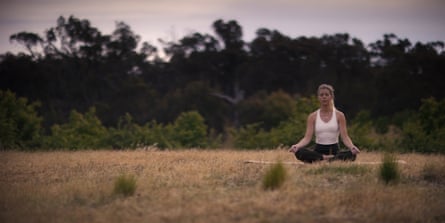
“It was important to make sure that not everybody was pigeonholed into a ‘oh, that’s why they …’” says Deacon. She adds that the victims in this case could come across to the average audience as a friend or colleague attending these classes like they do Pilates, just anyone who could have been “there but for the grace of God go I”.
“What we really didn’t ever want,” say Lavery, “was for people to say, ‘Oh well, that would never happen to me. I would never join an organization like that.’
“The process that they went through, as they became deeper on their spiritual journeys within the various schools that they were attending, broke down barriers, just took them step by step by step until they find themselves somewhere that they really didn’t expect to be.”
Part of the allure, and the false sense of safety, Deacon adds, comes from the real ancient yoga practices that the schools in question appropriate. There are genuinely liberating benefits to yoga that she’s careful not to denigrate, but in this case, they were abused, or twisted, as the show’s title succinctly puts it.
“At the heart of the teachings was the sense that you should surrender, and particularly surrender your ego. So much of our modern preoccupation with wellness and self-improvement is often about surrendering to the process.
“What’s being folded in to this positive, empowering (practice) is something that is also very disempowering at the same time.”
-
Twisted Yoga starts on Apple TV+ on 13 March