3 months ago
155
3 months ago
155
Nations are right to consider diplomatic relations when deciding whether to “call out” potential breaches of international law, the attorney general has said, after the UK government faced criticism over its reluctance to condemn the US attack on Venezuela.
In an interview with the Guardian, Richard Hermer, the government’s most senior law officer and a close ally of Keir Starmer, said that in a “complicated and dangerous” world, leaders should be able to use “statecraft” to consider other factors when establishing whether to hold allies to account.
In his first public comments since Britain’s reaction to the US attack on Venezuela and threats toward Greenland, Hermer refrained from singling out the Trump administration, insisting that his comments were theoretical rather than aimed at any individual country. But his intervention comes amid domestic questions over the UK’s ability to influence the White House.
MPs on the left of the Labour party, as well as senior Labour figures including the Welsh leader, Eluned Morgan, and chair of the foreign affairs committee, Emily Thornberry, have called for a more robust approach to Trump’s actions. On Monday, Thornberry said: “We need to be clearer that this has been a breach of international law and we do not agree that they should have done it.”
Starmer and the foreign secretary, Yvette Cooper, have refrained from saying that the Venezuela attack was a breach of international law. But the prime minister has said that only Greenland and Denmark should decide the territory’s future.
Hermer emphasised Britain’s own commitment to the international rules-based order, despite challenges from countries such as Russia, adding that “throwing our muscle around or just kind of flouting rules” would not be in the national interest.
The attorney general also argued Labour was protecting fundamental rights at home which Reform UK would erode, and launched a staunch defence of Keir Starmer, suggesting he had been misunderstood.
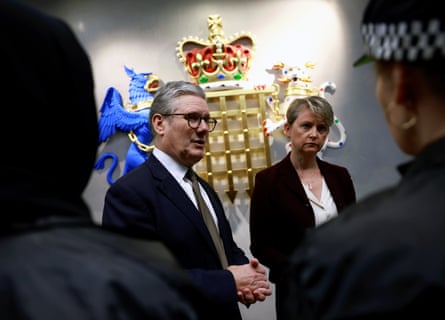
The prime minister’s attempts to start the new year with a focus on the cost of living have been overshadowed by situations overseas – in Venezuela, Greenland and Ukraine – which Hermer acknowledged were challenging.
He said: “What’s the response of a country like the UK that has always been a leader on international law? Is it to say, you know what, others might be trying to flout it, so let’s consider all bets are off, and let’s just see what we can get away with, throwing our muscle around or just kind of flouting rules?
“I don’t think it is. I think the correct approach is to actually double down on this country’s commitment. Our national interest is served by the international rules-based order. It gives that degree of certainty and led to greater prosperity.”
He argued that there was a distinction to be drawn between the UK’s commitment to complying with international law itself, and its deployment of “statecraft” – in this case diplomacy – on what other countries chose to do.
“There will be a range of factors for any leader with any ally, about choosing when, if at all, to call out breaches of international law … There will be obvious pros and obvious cons. But in a complicated and dangerous world, it is right that statecraft plays a role in that.”
In the interview, Hermer drew a firm dividing line between the government securing the rights of people at home – including for workers, renters and those affected by the Hillsborough law – and the threat posed by the prospect of a Reform government.
“I have no doubt that Reform would take away rights from working people. They’d undermine the rule of law,” he said. “I do have very real concerns about what type of prime minister Nigel Farage would be, the extent to which he would respect the democratic norms.”
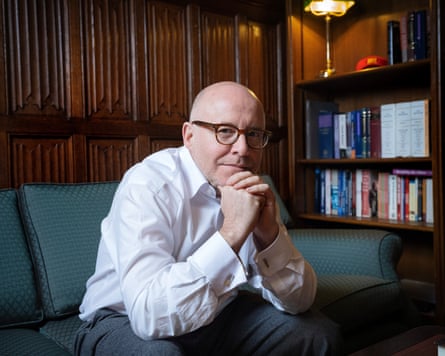
Both Reform and the Conservatives have said they would withdraw from the European Convention of Human Rights (ECHR) to enable them to reduce illegal migration, a important issue for voters. Starmer is working with other European leaders to modernise its interpretation, so they can take tougher action to protect borders.
Hermer defended the ECHR, saying that pulling out would leave the UK in “splendid isolation”. That would be “completely counterproductive” to tackling illegal migration, which required international cooperation.
While most British people did not have a problem with legal immigration or people fleeing persecution, he acknowledged concerns about illegal arrivals. “We’re not a country that wants to be taken for a ride,” he added.
Since he was appointed to the role last summer, Hermer has faced criticism for representing controversial clients such as Gerry Adams during his career as a human rights barrister, even though he was following the legal “cab rank” rule.
He explained: “There is a system of justice here that requires you to go and defend an individual, whether you like them or don’t, whether you think they’re repugnant or you think they’re an angel.
“You get into that mindset. So it doesn’t matter whether your client is the worst of the worst, the best of the best, you get on in accordance with your professional duty. That’s the job. I had 30 years of the bar, I represented thousands of people.”
However, he criticised his Tory shadow, Lord Wolfson, for practising law full-time, including representing the Russian oligarch Roman Abramovich – who is under sanctions – alongside his role, raising potential conflicts of interest.

Hermer, one of Starmer’s closest friends in politics, said he understood why after a decade of austerity, Boris Johnson’s rule-breaking and Liz Truss’s handling of the economy so many people felt deeply sceptical about politics.
On the table in his parliamentary office was a copy of the speeches of Edward H Levi, appointed US attorney general by Gerald Ford after the Watergate scandal and given the onerous task of restoring legitimacy to his discredited department.
“I really understand why it is that people mistrust politicians … I completely accept it is reasonable for people not to just rely on what we’re saying, that things are going to get better, and to have a degree of scepticism about that,” he said.
“But I am convinced that as we go into this year, we’re going to be able to demonstrate to people that we are different, because we are going to be able to start showing that we are matching our promises with action.”
He added: “None of this is to suggest that life is not still incredibly hard for people 18 months into this government.”
With Starmer’s approval ratings at record lows, and regular speculation over his leadership, Hermer admitted frustration over how he was seen by the public – but insisted he could still turn it around. He had “absolutely no doubt” Starmer would be in office by the next election.
“I’m conscious as someone who’s known him for 30 years, that for many people, his public image doesn’t reflect the real person. From the off, I recognised this was someone who was – and remains – an incredibly decent person.
“I’m convinced he can turn it around. We need to show people more of the real Keir, because it is so genuine … We need to put him in situations where people can see that fundamental decency and kindness.”