3 months ago
114
3 months ago
114
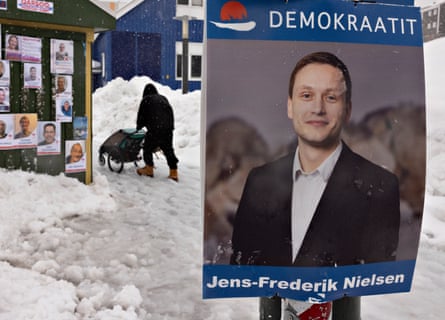
This time last year, Greenland’s prime minister, Jens-Frederik Nielsen, was better known on the global stage for his sporting achievements than international politics. For years he dominated the territory’s badminton scene, winning the singles and doubles championships almost every year. He won several medals at the Island Games, earning himself a reputation for “very competitive” play on the court.
As it turned out, that was useful preparation for his time in office.
The 34-year-old was sworn in last April after winning a surprise election victory fought against the backdrop of Donald Trump’s threats to acquire his homeland. Those threats morphed into a full-blown crisis this year when, fresh from his seizure of Nicolás Maduro from Caracas, the US president reiterated his desire for Greenland and initially refused to rule out taking it by force.
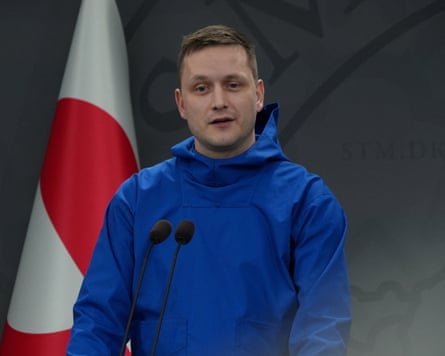
Europe’s biggest crisis since the second world war saw Nielsen, who often sports a blue anorak in keeping with Greenlandic formal attire, thrust into the geopolitical spotlight. He seems to have weathered the storm: Greenlanders say that, after Trump pulled back from threats of military intervention at the World Economic Forum in Davos, the young leader has more of a voice on the world stage.
A key moment in Nielsen’s handling of the rapidly escalating crisis came in January, on the eve of a tense meeting in Washington DC with the US vice-president, JD Vance. “If we have to choose between the US and Denmark here and now,” he said, “we choose Denmark, Nato and the EU”.
Aqqaluk Lynge, a veteran of Greenlandic politics who co-founded the party Inuit Ataqatigiit (IA), said shortly afterwards it was the moment Greenlanders had been waiting for. “I don’t know if I could have done that when I was his age,” he told the Guardian.
Nielsen grew up in Nuuk, capital of the semi-autonomous Danish territory, with a Greenlandic mother and Danish father. He speaks both languages, which some say helps him to see both sides of the relationship between Greenland and its former colonial ruler, Denmark.
He has previously said he was bullied in school for looking Danish. On the badminton court, however, he flourished.
In 2020, aged 28, having helped shape its direction as a consultant while studying social sciences at the University of Greenland in Nuuk, he became chair of his party, the centre-right Democrats. “Even I probably wouldn’t have seen it coming so soon. But the opportunity presented itself and I jumped at the chance because I want this,” he told the newspaper Sermitsiaq the same year.
For a short period he had a government position as minister of industry and mineral resources but lost it when he withdrew his party from the government. Then, last March, the Democrats more than tripled their seats to become the biggest party in the Inatsisartut, the Greenlandic parliament.
Weeks later, just hours before Vance arrived in Greenland at the US’s Pituffik space base, Nielsen and the leaders of three other parties announced a broad four-party coalition government in a show of national unity. In a clear rebuke to Trump’s threats, the first page of the coalition agreement stated: “Greenland belongs to us.”
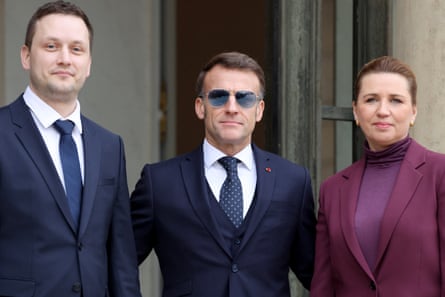
Nielsen’s straightforward style and clear messaging seem to be impressing leaders in the rest of Europe. This week he was received by the German chancellor, Friedrich Merz, and the French president, Emmanuel Macron, side by side with Mette Frederiksen, the Danish prime minister.
“We have some red lines we cannot cross but, from a Greenlandic perspective, we will try to sort out some sort of agreement,” he said in Paris. “We have been working with the US for many years now.”
Alongside the pragmatism Nielsen painted a vivid picture of the fear and stress of the unprecedented situation. “We are under pressure, serious pressure,” he said, adding that many in Greenland were “afraid and scared”.
Government figures in Denmark appreciate his style.
A source close to the Foreign Office said his comments about choosing Copenhagen over the US were appreciated. “In the Danish public he is a very well-liked figure and people are very impressed that he has been able to handle it under pressure and young.”
His good rapport with Frederiksen also helps. “He is a great guy and he has a great chemistry with the Danish prime minister and Danish government in general, so we are pleased it is him in office,” said the source.
Aaja Chemnitz Larsen, a Greenlandic member of the Danish parliament and representative of IA, who has known Nielsen since he was a child, said she thought he was doing “an amazing job” on the global stage.
It takes courage to do what he has done, she said: “He is a young leader and a leader gaining experience as we speak, so of course it is a big task.”