3 months ago
163
3 months ago
163
A tantalising spread of food arrives at the table, including a sizzling mixed grill platter, blistered naans and punchy curries. The smell of spice and smoke fills the air amid a cacophony of sounds, from the clink of pint glasses to the beats of Punjabi bhangra music.
This is a scene that you might not associate with the traditional British pub, but for many communities in the Midlands it is commonplace in the growing number of Desi pubs.
It is a phenomenon that has transformed struggling pubs into communal hubs by south Asian landlords who have fused the warmth of the British pub with the heart of south Asian hospitality, food and culture.
“We’re proud of what we’ve achieved – creating jobs in the community. We’re breaking down barriers, we’re creating social cohesion,” Satnam Purewal, the landlord at the Red Lion in West Bromwich, said.
Purewal’s father, Jeet, took over the Red Lion pub in 1997, when the brewery was looking for new owners. It is one of several taken over by south Asian people in the Midlands in the second half of the 20th century, when a growing number of people from India, Pakistan and Bangladesh arrived in the UK.
Such communities were often met with hostility and prejudice, including at pubs where a bar operated that disallowed people of colour from entering. Although it was made illegal in 1965, it still continued to operate years after.
The racial discrimination endured by Black and Asian communities prompted the American civil rights activist Malcolm X to meet Avtar Singh Jouhl from the Indian Worker’s Association (IWA) in Smethwick in 1965. On the day of his visit, Malcolm X was refused service at the nearby Blue Gates pub – this meeting is now depicted in stained glass art on display at the Red Lion.
Over the decades, Desi pubs have continued to grow in number and popularity in the region. “We were one of the early ones,” Purewal said. “And then it started to get really, really popular and more and more people embraced it.”
The continued popularity, however, has coincided with growing fears the UK is witnessing a return to the racism and discrimination seen decades before. The Midlands, believed to be the birthplace of the campaign that has led to Saint George’s and union jack flags erected across the UK, has been a particular focal point.
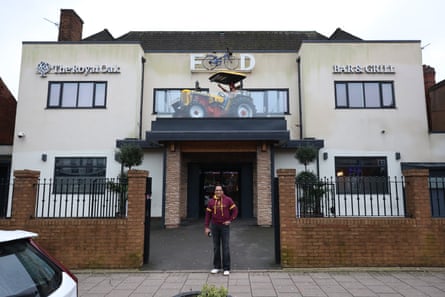
For Purewal, he said pubs like his are a symbol and celebration of diversity in the UK. “Our customers are very aware that we’re a melting pot of loads of different cultures, all mixing together and being able to sit down together,” he said. “We don’t just get Indian clientele. We get loads of English people, the Black community, the Muslim community.”
“When you start sitting down with people you realise actually there’s very little difference between us – we all do the same thing; we all go to work, we come back and we all worry about the kids,” he said. “By having pubs like ours, it breaks down those barriers that might exist.”
Amrik Singh Saini, the landlord of the Royal Oak, also described positive relations between different communities in the area.
His pub is located in Handsworth, an inner-city area of Birmingham that recently made headlines after the former Conservative MP Robert Jenrick described it as “one of the worst integrated places I’ve ever been to. In fact, in the hour and a half I was filming news there I didn’t see another white face”.
When asked about these comments, Saini said he “always” sees white faces at his pubs and people from a variety of backgrounds frequent his establishments. His pub regularly serves home and away fans at West Bromwich Albion.
In many ways, the decor of the Royal Oak is a physical manifestation of the fusion of cultures. The pub, which is dedicated to the late Punjabi musician Sidhu Moose Wala, has several paintings of him while two large statues of the Queen’s Guards sit in front of the kitchen.
“Different communities mix together,” Saini said.
Saini, who bought the pub in 2011, said it was “hard work” to establish and renovate it. “It’s not like you buy a building, buy a pub, and just put a mixed grill in. It doesn’t work like that.” Good quality food and atmosphere is a focus for Saini, who said businesses like his are booming.
“All Desi pubs [are] busy.”