1 month ago
96
1 month ago
96
Teesside’s Transporter Bridge, a disinfecting station in Hackney and a former working men’s club in Barrow-in-Furness have been included on a list ringing alarm bells for Victorian and Edwardian heritage.
The Victorian Society has published its annual top 10 endangered buildings list, intended as a way of drawing national attention to at-risk places in England and Wales.
Also on the list is a secluded mausoleum in north Wales and an Essex house containing remarkable, little-known painted interiors by the artist Elizabeth Arkwright.
Griff Rhys Jones, the president of the Victorian Society, said it was a “desolation” that all 10 were Grade II-listed, with two at Grade II*, meaning they already have protection. They were all “under threat from decay or neglect”, he said.
“We have had great results in the past. But unless we look to them, deserted or abandoned, fine and beautiful structures can be subject to arson attacks or continued decay. We need to shout out about these ones. They have a future for all of us. They can be reused.”
The Tees Bransporter Bridge dates from 1911 and has been closed since 2019 because of structural concerns.
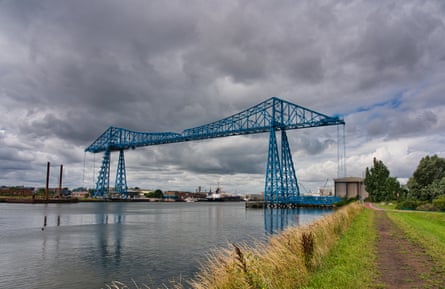
It is, the society said, “one of the most recognisable engineering landmarks in the UK” but “its future now hangs in the balance”.
Responsibility for the bridge is shared between Middlesbrough and Stockton councils but the estimated £60m repair and restoration bill is beyond their means, the society said.
It is calling for a coordinated national response to either reopen the bridge as a crossing or conserve it as a monument.
James Hughes, director of the society, said: “The Tees Transporter Bridge is one of Britain’s most remarkable feats of engineering and a defining landmark of the north-east.
“Its future cannot be left to uncertainty. A clear strategy, supported at national level, is urgently needed to secure both its structure and its continued role in the life of the region.”
Others on the top 10 are:
Hackney borough disinfecting station in Clapton, London, described as a “rare and powerful reminder of the Victorian response to infectious disease”. It has been unused for decades.
Former Strand Railway Station & Railway Men’s Club in Barrow, Cumbria. Used as a station, a drill hall and a working men’s club “it now stands neglected, with no clear plan for its future”.
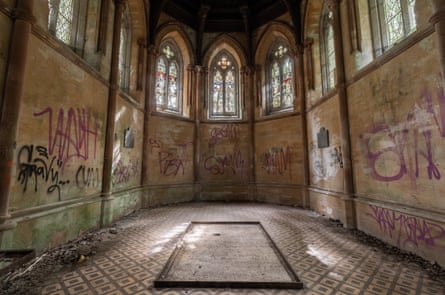
Faenol (Vaynol) mausoleum, Pentir, near Bangor. Years of neglect have taken a toll on this secluded mausoleum, the society said, with graffiti and damage to its stained glass.
Parndon Hall, Harlow. Once a Victorian “family home of distinction” it stands “neglected” in the grounds of a modern hospital. The wow factor is the series of paintings by Elizabeth Arkwright throughout the house on ceilings, doors and wall panels. The building is now being used for storage with no plans for its future, the society says.
The list is completed by: New Market buildings, Bridgnorth; Oakes school, Huddersfield; St Michael’s RC cemetery chapel, Sheffield; Derby school of art, Derby; and a former library and mechanics institute in Devonport.
Hughes said: “This year’s list demonstrates both the richness of our Victorian and Edwardian heritage and the scale of the ongoing challenge in securing its future. These buildings were created with foresight, ambition and a strong sense of civic purpose. Too often today they are left without clear ownership, investment or direction.
“With the right commitment, every one of them could have a viable future. What is needed now is the will to act.”