3 months ago
178
3 months ago
178
Viva la revolution and don’t forget your password, your pronouns, your plaid gown and your gun. One Battle After Another, from writer-director Paul Thomas Anderson, is the brawling rebel insider of this year’s Oscar race; a state-of-the-nation Hollywood spectacular that feels as disunited and unstable as the country it depicts. The film hates America and it loves it, too. It’s on the side of the angels even when it’s not quite sure who they are. It lights a candle to curse the darkness, and prays to God it hasn’t picked up a stick of dynamite by mistake.
“We have to stay out of politics,” Wim Wenders advised his fellow directors at last month’s Berlin film festival, and yet One Battle After Another is political to its fingertips, hard-wired to the here and now and perfectly anticipating the tenor of Donald Trump’s second term. Leonardo DiCaprio plays Bob, the one-time firebrand turned burnt-out stoner, who belatedly hauls himself off the couch when his daughter Willa (Chase Infiniti) is captured. Freely adapted from Thomas Pynchon’s 1990 novel Vineland, the film updates the book’s jaundiced post-60s hangover for the ICE-age 2020s as the plot careens from the migrant detention camp to the sanctuary city to uncover a Christian Nationalist cell within the US federal government. The self-styled “Christmas Adventurers” are on a heaven-sent mission to make America great again. They say, “If you want to save the planet, you always start with immigration.”
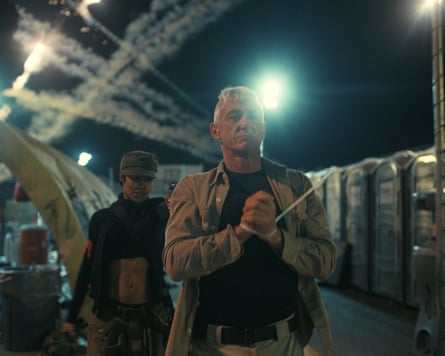
Anderson’s story feels volatile. Jonny Greenwood’s jittery score sets the pace. One Battle After Another plays like a melody made from atonal notes, or a set of clashing component parts. According to the Golden Globes, it’s a comedy, which is true to a point, inasmuch as it’s rambunctious, profane and full of mischief. But it is also always deadly serious. Colonel Lockjaw, Sean Penn’s bumptious baddy, is cartoonish, almost clownish, but he’s cartoonish in the style of someone like Gregory Bovino, the true-life Border Patrol commander who led his goons into Minneapolis. Probably most fascists are clowns that are easy to laugh at; probably that works in their favour. They use the laughter as cover when they order your daughter to be shot dead in the street.
If One Battle After Another isn’t a straightforward comedy, it’s not a party political picture either, at least not in the way that Wenders would understand it. Yes, its natural sympathies are with the underdogs, the guerilla fighters for social justice, but it knows that the struggle is exhausting, sisyphean, and that the battle lines have long since blurred. The vexed question of Willa’s true parentage, for instance, echoes the plot of Mark Twain’s 19th-century novel Pudd’nhead Wilson, in which a supposedly black child is switched for one who is supposedly white. Twain’s tale exposed the racist lie behind slavery; Anderson’s film explodes the red and blue state divide. The real America is marbled, messed-up; everyone’s stirred together. Try as they might, the left or the right – the French 75 or the Christmas Adventurers – can’t unmelt the pot, or put the genie back in its bottle. The future is mixed and it looks like Willa.
Oscar winners don’t have to be timely, but sometimes it helps, especially this year when the stakes are so high: when too many people are scared of speaking up and rocking the boat; when Warner Bros – the film’s backer – is poised to be swallowed by Trump-friendly Paramount Skydance. One Battle After Another isn’t my favourite Anderson picture (that would be The Master). It’s not even my runaway favourite best picture nominee (that’s a three-way-tie with Sinners and The Secret Agent). But it’s the right film for the moment, a rollicking old-school stars-and-bars epic; lawless and splashy and swinging off in all directions. Hollywood used to crank out sprawling, ambitious productions like this on a semi-regular basis. Today One Battle After Another looks all but unique. It might be the last great American whale.
It’s no wonder that shambling Bob has lost his appetite for the fight. The arc of history bends slowly. Sometimes it bends back. And yet Anderson’s movie insists that the effort is worth it and that every small victory is worth 100 defeats. The ending is corny in the way that Lockjaw is cartoonish, which is to say that it’s rousing and moving and ringing with hope. Revolutionaries like Bob, it suggests, can only take us so far. They struggle and fail and then hand the flame on to the next generation. Maybe their kids will do just that little bit better. Maybe they’ll take the torch and run with it.