3 months ago
124
3 months ago
124
Anyone trying to understand why Yvette Cooper studiously avoided saying whether the UK viewed the kidnapping of Nicolás Maduro as a breach of international law only needs to look to what was planned in Paris a day later.
After the foreign secretary’s 90-minute humiliation in the House of Commons on Monday night, a joint statement was expected in the French capital by the coalition of the willing – and a draft included the US promising binding security guarantees to protect Ukraine in the event of a further Russian attack.
From the Foreign Office’s perspective, there was no good reason to be critical of Donald Trump if it risked provoking him to withdraw the painstakingly negotiated and fragile US agreement to participate in the Ukraine security guarantees. Those guarantees, the subject of military level talks for months, required US sign-up if they were to be seen as a credible, viable alternative to Ukraine’s Nato membership – an aspiration Ukraine is being forced to abandon. The guarantees are also the precondition for a negotiated settlement between Russia and Ukraine that Europe and Kyiv can swallow.
For British officials, the US agreement to be a guarantor, symbolised by the presence of Jared Kushner and Steve Witkoff in Paris, was one of the great diplomatic rescue jobs, given Europe had been left flat footed and horrified when Witkoff’s 28-point abandonment of Ukraine leaked on 19 November.
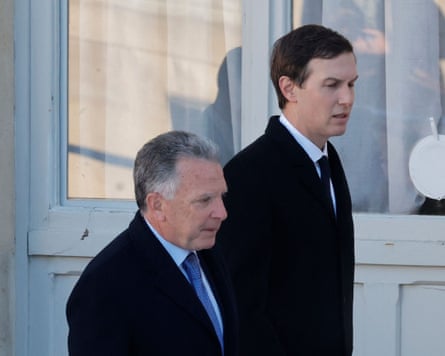
The US administration official that probably did most to coax Trump back to offering future protection to Ukraine, and therefore Europe, was the US secretary of state and national security adviser, Marco Rubio.
Europe as a result is deeply in Rubio’s debt, but since the US capture of Maduro was very much a Rubio-masterminded operation – JD Vance, the vice president has been conspicuous by his absence – British diplomats regarded it as vital not to query the legal basis of what Rubio regards as a great personal, political, military and economic coup.
One British official said it was “a no-brainer’ in weighing the value of public criticism of Rubio over the removal of a head of state that the UK had not recognised anyway, and whose toppling was a fait accompli by the time the UK had been informed. The UK had long stopped supplying intelligence to the US over the attacks on Venezuelan drug boats.
Cooper sent as many coded hints to MPs on Monday night as she could that, in discussing Venezuela with Rubio over the weekend, she did not just tell him international law in abstract should be a guiding principle, but should have applied in the case of Venezuela.
Moreover, Cooper is obviously trying to insert the UK into Washington’s sketchy planning about Venezuela’s future.
The UK’s commitment to Venezuela goes back a long way – to the birth of the republic in the early 19th century, when the UK provided more material and diplomatic support than any other foreign power to the Great Liberator, Simón Bolívar. Now, the Foreign Office is arguing that Venezuela must move to a democratic transition, and it is unrealistic to expect a government stuffed with the acolytes of Hugo Chávez to act as US puppets.
“Stability will not be maintained unless there is a transition that has the will of the people,” Cooper told MPs. She has been touting the UK chargé d’affaires in Caracas, Colin Dick, as a man that understands the Venezuelan opposition, including the apparently shunned María Corina Machado.
But Rubio, a Latin American specialist in his own right, has clearly made the brutal decision that the Venezuelan opposition are not up to the task of running the country and will, if installed, only provoke a civil war of the kind seen in Libya and Iraq – where the destruction of the military left a vacuum. From the US perspective, this is less about regime change than enforced changes to how the regime operates.
The worry for the Foreign Office is that there is little sign so far that Trump or Rubio are much interested in the UK’s Latin American expertise.
Indeed it seems any journalist in Washington can grab two minutes on the phone with Donald Trump, yet Keir Starmer was not consulted about the capture of Maduro at all.
That raises deep questions about whether the Foreign Office can operate on the old assumption that this asymmetric relationship built on defence intelligence and security is still based on shared values, or is still that important to the US.
Many MPs of different politics believe the Foreign Office needs to reassess Trump in the second term and how he is best influenced. Trump of course remains hard to read. He is not isolationist, nor a liberal internationalist. He harbours little ambition for wars, preferring to strike and quickly retreat. He enjoys the propaganda of force, and the power of threats. Boards of peace are announced for him to chair and then they never meet. He shuns alliances, prefers the company of autocratic great powers, and has just set out a national security strategy with which Cooper admits the UK does not agree.
The US seizure of Greenland by force is, after Caracas, a serious prospect. “We live in a world in which you can talk all you want about international niceties and everything else,” deputy chief of staff Stephen Miller told CNN on Monday night. “But we live in a world, in the real world … that is governed by strength, that is governed by force, that is governed by power.”
In this Hobbesian world, the UK can cherish its often temporary wins on Ukraine, and nurse its capital in Washington for ever more selective use. But if America First requires the destruction of the niceties of a rules-based order, the UK at some point is going to have swallow hard, stop being risk-averse, and seek influence in a way that is entirely different to the past 80 years.