3 months ago
154
3 months ago
154
When anti-immigration riots spread across the UK in the summer of 2024, one of Liverpool’s oldest churches found itself in the crosshairs.
The 180-year-old St Anne’s in Toxteth was one of dozens of properties across the country on a far-right “hitlist” shared online. One menacing post showed its historic redbrick tower burning behind flame emojis.
The church itself was not the target. Violent agitators were calling for an attack on one of its tenants: Asylum Link Merseyside (ALM), a charity that for 25 years has supported people fleeing war and persecution.
The threat, said Ewan Roberts, then the centre manager for ALM, felt scarily real: “People had been scoping us out, driving past filming, kids on bikes filming. You think: ‘Oh God, is this how it happens?’”
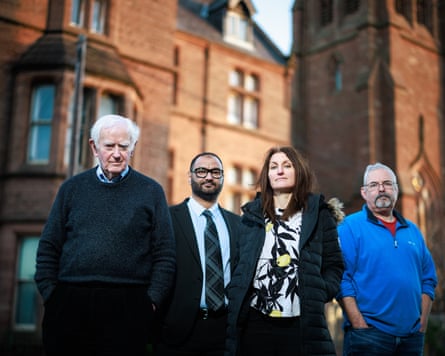
Barely a mile away, al-Rahma mosque was also being watched. “You would see people monitoring the area, people on bikes hiding their faces. At one point we had someone with a machete outside,” said Dr Badr Abdullah, the chair of Liverpool Muslim Society.
“It did feel like civil war … The feeling in the community was: someone is going to be killed, the mosque is going to be burned down,” he added.
Across England and in Belfast, rioters had torched buildings, attacked mosques, battled police and brought terror to minority communities after the horrific murder of three young girls at a Taylor Swift holiday club in Southport on 29 July 2024.
They singled out Britain’s immigrant and Muslim populations amid debunked claims that the killer, the Cardiff-born teenager Axel Rudakubana, was an Islamist terrorist who had arrived by small boat.
In Merseyside, the unrest was shocking and widespread. The next flare-up, planned for 7 August 2024, threatened to be even worse and triggered the biggest mobilisation of riot police across England in at least 13 years.
But something else was happening too. Against what felt like a death spiral of racist attacks, solidarity was blossoming.
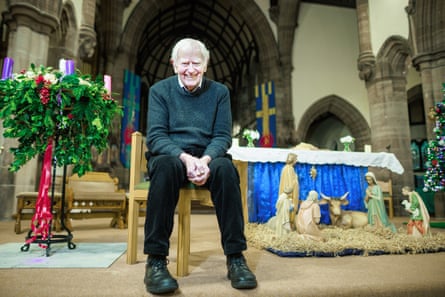
Roberts, 60, describes “an army of carpenters” turning up to barricade the Grade II-listed windows of St Anne’s church. Hundreds more offered to protect the place of worship that survived Luftwaffe bombs in the second world war.
As 7pm approached, mounted police patrolled the streets, riot vans were on virtually every street corner and Toxteth, with boarded-up pubs and shops, looked like a town bracing for war.
Father Peter Morgan, the energetic 87-year-old parish priest of St Anne’s church, who arrived in Toxteth after the 1981 riots, had urged community members to stay away on the advice of police – though he stood defiantly outside.
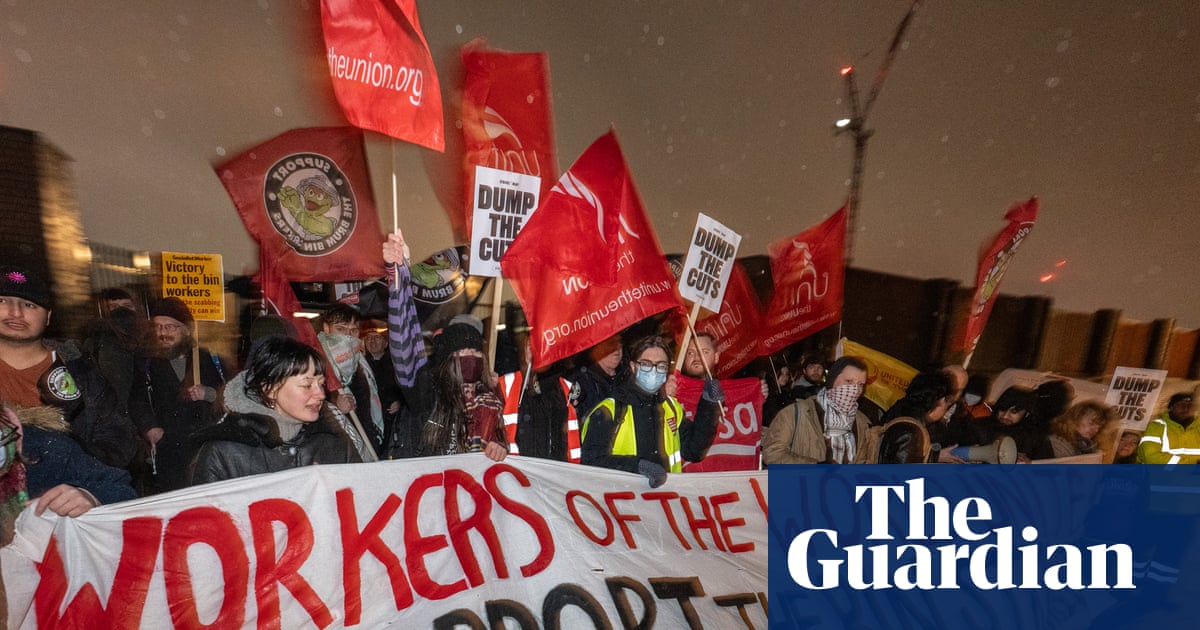
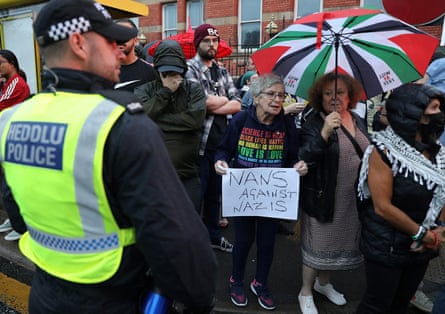
They came at first in their dozens. Then their hundreds. By dark, the mood had shifted as a crowd of about 2,000 people had amassed outside the glowering old church – not to raze it to the ground, but to defend it.
They faced down the threat of petrol bombs and bricks with steel drums, dancing and homemade placards, one emblazoned “Nans against Nazis”. The scene was replicated across England: hope, not fear, had won.
“That night was a turning point,” said Abdullah. “There was a sense of relief, solidarity, hope. We had seen a big rise of hate, but [then] we saw a big rise of love.”
After more than a week of violence across England and in Belfast, the shift was immediate and palpable, Roberts, now the fundraising manager for ALM, said: “If it had gone the other way, you might have seen even more of an escalation. It took the whole sting out of it.”
All three groups – St Anne’s church, al-Rahma mosque and ALM – are members of the Liverpool chapter of Citizens UK, one of five charities supported by this year’s Guardian charity appeal, which is raising money for grassroots voluntary organisations fighting division, hate and despair.
Morgan said the solidarity shown that summer helped foster stronger links between the city’s many faith and community groups. “It was a gathering that couldn’t have come about through any other means.”
Catherine McCarron, a community organiser for Citizens UK in Liverpool, said it had made her organisation more determined to fight division – particularly, she said, when it felt like politicians were not “showing leadership”.
Although the immediate threat of violence has gone, anti-immigration rhetoric has become widespread. Across England, union jacks are hoisted from lamp-posts and a new form of Christian nationalism is on the march, championed by the far-right activist Stephen Yaxley-Lennon, also known as Tommy Robinson.
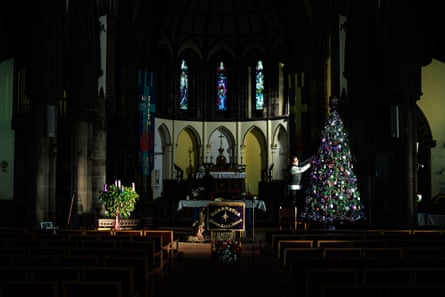
Morgan is bemused about what he sees as the weaponisation of Christianity. “It’s absolute and utter nonsense – and utter hypocrisy,” he said. “They’re using Christian symbols, not really Christianism. If anything expresses unity for us, the cross does.”
Abdullah, whose Liverpool Muslim Society represents more than 40,000 worshippers, said the “hijacking” of Christianity trod the same path as extremists in Islam. What worries him now is not this newfound zealotry – but that the anti-immigration message is now mainstream: “The momentum is back on their side.”
Community leaders across England fear it is a matter of when – not if – disorder breaks out again. But when that day comes, the far right will be facing a more unified and determined voice.
“It’s in all our self-interest to work together. We are community. We’re not separate strands – we belong,” said Morgan, whose church has revived its links with Abdullah’s mosque.
“It’s that belonging that people want to have – and the trouble is some people feel that someone is taking away their belonging. But we’re tremendously enriched by what we share together.”