3 months ago
161
3 months ago
161
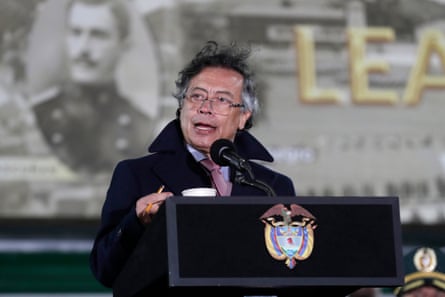
Colombia has mobilised its armed forces in the aftermath of US strikes on neighbouring Venezuela. President Gustavo Petro said Colombia was concerned about refugees fleeing in the aftermath of the attacks.
Petro posted on X that his government had held a national security meeting in which it was decided that forces should be sent to the border amid a potential “massive influx” of people leaving Venezuela.
He also called for an emergency session of the UN security council.
Petro said: “The government of Colombia rejects the aggression against the sovereignty of Venezuela and of Latin America.”
Donald Trump claimed the US had “captured” the Venezuelan dictator, Nicolás Maduro, and his wife, Cilia Flores, and had flown them out of the country after overnight airstrikes.
Explosions rocked the capital, Caracas, before dawn on Saturday, with the Venezuelan government claiming the US had launched a series of attacks on civilian and military targets.
Maduro’s vice-president, Delcy Rodriguez, told state-run television that the whereabouts of the president and his wife were unknown and asked Trump for proof they were alive.
The Cuban president called the attacks on Venezuela “criminal” and called for a tough response from the international community.
Cuba has long had a fractious relationship with the US stretching back to the cold war. It is now subject to an economic embargo by the US. President Miguel Díaz-Canel said the US was responsible for “state terrorism against the Venezuelan people”.
Russia and Iran also voiced their objections. The Russian foreign ministry said it was an “unacceptable violation of the sovereignty of an independent state”.
The neighbouring Guyanese government said it was monitoring the situation which was of “grave concern” to the wider region.
The president of Argentina, Javier Milei, an ally of Donald Trump, said: “Liberty advances! Long live liberty!”
Spain’s government has offered to mediate between the US and Venezuela as its foreign ministry urged de-escalation and a respect for international law. In a statement, a spokesperson said: “Spain calls for de-escalation and moderation, and for action to be conducted in accordance with international law and the principles of the UN charter.
“In this regard, Spain is prepared to offer its good offices to achieve a peaceful and negotiated solution to the current crisis.”
The Italian foreign minister, Antonio Tajani, said Italy was watching developments as about 160,000 Italians live in Venezuela. Tajani said Italy’s prime minister, Giorgia Meloni, was being kept informed.
Meanwhile, the German foreign ministry said a crisis team was due to meet later on Saturday. A written communication seen by Reuters said Germany was in close contact with the embassy in Caracas.
The vice-president of the European Commission, Kaja Kallas, joined calls for restraint and respect for international law.
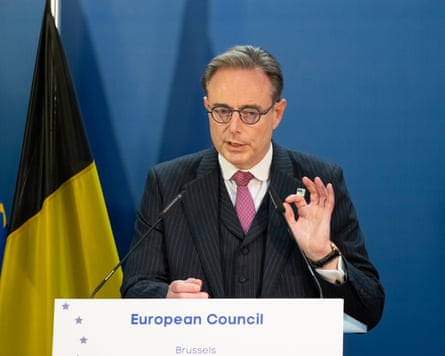
Kallas said she had spoken to the US secretary of state, Marco Rubio, and the EU’s ambassador to Venezuela. “The EU has repeatedly stated that Maduro lacks legitimacy and has defended a peaceful transition. Under all circumstances, the principles of international law and the UN Charter must be respected. We call for restraint,” she said.
Dr Christopher Sabatini, a senior fellow for Latin America at the Chatham House thinktank, said the attacks were not a surprise and were “almost inevitable” after the last six months had failed to lead to Maduro’s removal.
He said: “It looks for now that the US focused on key military infrastructure: Tiuna Fort, an unoccupied military barracks, several airfields and bases. Will this be enough to provoke a regime change alone? Or will it need to continue? Frankly, while some US special operations forces could land in Venezuela to support targeted strikes, a full military invasion is unlikely. Can these strikes go on indefinitely?
“According to surveys, US citizens are opposed to the use of its military in Venezuela. And any strikes inside Venezuela now will probably force a vote in Congress under the War Powers Act.
“But assuming even if there is regime change – and it’s by no means clear even if it does happen that it will be democratic – the US’s military action will likely require sustained US engagement of some sort. Will the Trump White House have the stomach for that?”