2 months ago
53
2 months ago
53
As an Australian, even one lacking in cricket parochialism, it’s flat to sit around the Perth CBD city centre on what should have been the third day of the opening Ashes Test but isn’t. In the same way that this city of heatwaves is now being combed by chilly winds and rain, the whole thing just feels wrong. Through years of buildup, the current England team has raised the possibility of being different to those that came before. For anyone who believed it, even a little, it seems as if we all got hoodwinked.
In my cricket watching lifetime, English visits have been a procession of the abject. This is not to claim any personal influence, merely to give a temporal window. But the length to which this lifetime has now grown does take the observation beyond the trivial. In 1986-87, when Mike Gatting’s team won the series by the fourth Test, I was too much of an infant to notice. No one then could have predicted the disproportionate brutality of the decades to come.
By 1991, there were a couple of draws, but three Australian beltings. By the end of each series in 1995 and 1999, England won a consolation match but lost three. In January 2003 the consolation win came after four defeats. Then the zip era began: a couple went 5-0, a couple went 4-0, either side of that single anomaly of a grand old England team whacking Australia 3-1 in 2010-11.
One series win out of nine, six Test wins out of 45. All of which is to say, there were very firm grounds for a historically sourced lack of confidence that England would compete this time around. But we kind of, sort of, just a little bit, bought it. Some of us, anyway, following the game across the world, we couldn’t help but hear that this English setup was full of boisterous confidence. They were too vocal about that to miss it. And while that was partly annoying, and certainly irritated plenty of Australians in the lead-up, it was also heartening in its difference. This was not an England team arriving here with tails already lodged between legs, trying to avoid criticism for seeming cocky while instead strangling themselves with deference. This lot said they would bring combative fire and said it for long enough to persuade that perhaps they could.
But doing that would have needed the right preparation, the right attention to detail. England got the first part right with their squad selection of fast-bowling options, knowing they needed to launch their campaign in Perth with a bang. They got it right with their bowling in Australia’s first innings, making up for the failure of their first turn with the bat. A Test match gives the possibility of getting away with failure once, if you fix it the second time around.
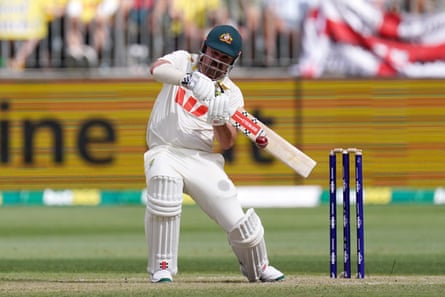
Instead, from an Australian perspective, England’s second innings procession was a source of bewilderment. We saw a visiting team so insufferably full of self-regard that they thought they could show up, not practise, not adjust, not think, not change, and play in exactly the way that has failed on Perth pitches since fast bowling was invented. Now, having lost in two days, with 11 days to spare before a pink-ball match of the sort few of them have played, they still vacillate over whether it’s worthwhile for their batters to stoop to an acclimatising hit in a tour match.
There is no reason on paper that England cannot turn the series around. The Australian batting offers ways in. Jake Weatherald is new, Usman Khawaja is sore, Steve Smith is erratic, Marnus Labuschagne is coming back, Travis Head can’t do it every time. That’s not formidable. But then, in the past few decades, formidable hasn’t been necessary. English teams have been beaten, even flattened, by Australian sides whose runs came from the mid-range talents of Brad Haddin, Shaun Marsh, Greg Blewett, Khawaja, Greg Matthews and Mitchell Marsh. It is counterintuitive that the one team England did manage to beat, even flatten, was the comparatively A-list side with Simon Katich, Ricky Ponting, Mike Hussey and Michael Clarke.
after newsletter promotion
History suggests another belting is on the way, while England’s squad try to keep up their bullishness. When there’s a trend, we want to identify the moment it changes. There’s always the temptation to be the cleverest person; to say, like Ben Stokes and his charges, that whatever has happened in the past has nothing to do with them, whatever lessons the past may offer are irrelevant to them, because they are here now to author their own brilliant future singlehandedly. To the self-appointed heroes of the present, the past is the country of losers. As of right now though, the losers are watching from the mirror.