3 months ago
128
3 months ago
128
Why do we have so few public toilets in UK cities? It’s hard to think of two more fundamental social needs than a) not being forced to relieve yourself on the street and b) not having other people relieve themselves on the street – yet the public toilet is an ignored and vanishing public amenity. The British Toilet Association reports that 40% of public toilets have closed since 2000 – Victorian facilities in particular attract developers, not least because their dignified buildings endure: solidly built, centrally located and still embedded in the daily flow of the city. When maintenance costs are high and councils are struggling, it is easy to convert a sturdy urinal into a fancy bar or flower shop that brings in rent.
Against this backdrop, a new wave of architects has begun to emerge who are reframing the problem and bringing new expression to the building type. They are supported by innovative councils and, sometimes, government grants. This may mark the start of a trend, driven by a convergence of conditions: growing public attention to access, the clear scarcity of toilet provision and a renewed sense of purpose within local authorities. These architects are emphasising not only public toilets’ necessity, but also the potential for public luxury.
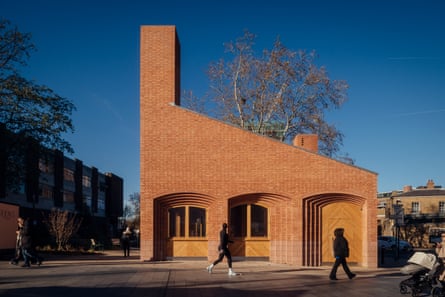
Some remarkable examples are in London. As director of Studio Weave, I’ve overseen two new public toilet buildings in the past year – one in Woolwich and one in Maida Hill – funded by the boroughs of Greenwich and Westminster respectively. Both projects were championed by forward-thinking council officers and local politicians who recognise the importance of such facilities and their role in civic life. Greenwich was successful in securing backing from the Department for Levelling Up’s Future High Streets Fund and, crucially, it was strongly supported during the public consultation. This meant that the council could ringfence spending on the public toilets, protecting them from overbearing cost-cutting measures.
As an architect who designs public buildings, I can tell you that quality materials and vision are key. In cities, you are often dealing with a complicated underground spaghetti of gas pipes, sewers and cables. You may have to negotiate with local authorities that have no obligation to cooperate. And you’re working with Victorian infrastructure that almost never matches the drawings.
We have to build toilets that are safe – perhaps with passive surveillance from nearby businesses – but that respect users’ dignity. We think about the way the doors open and who can see in and out, and we make sure there are no places to hide drugs or a knife. Our Woolwich toilets have high-quality traditional encaustic-tile flooring and oversized chimneys to enable passive ventilation – old technologies to suit a modern world. We like to incorporate shelter from the rain and sun, as well as drinking water and a place to sit down – those small public amenities that a council isn’t obliged to provide but will find hard to take away once they are incorporated into a solid building. Sometimes, we are lucky enough to work with a council that has money and a longer vision: for our project at Finsbury Circus, the City of London set a 100-year design life, demanding much higher-quality materials than most contemporary public buildings make do with.
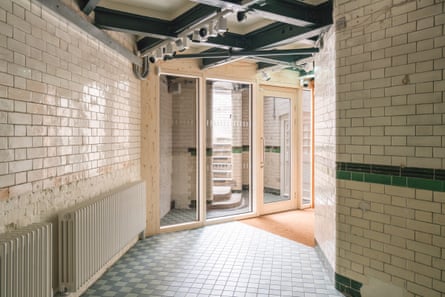
Colleagues in contemporary architecture have produced similarly strong work: DK-CM’s elegant refurbishment in Bruce Grove (for Haringey borough) and Hugh Broughton’s civic design in Westminster are distinguished by their architectural quality and thoughtful integration into the city. The Bruce Grove project has added a new community room and cafe to what was a dilapidated old public toilet building. The Westminster architects commissioned an artist to evoke the character of the local area.
Delivering such projects means managing tight local authority budgets. It often requires cross-programming, such as adding cafes or storage facilities to offset maintenance costs through rent. These measures boost footfall, enhancing passive surveillance and therefore reducing antisocial behaviour. The result is a virtuous cycle: more users, less crime, less fear and ultimately even greater use.
Local politicians know that visible public provision wins votes, yet in most UK councils, funding remains scarce. The projects above relied on the Mayor’s Fund, the Levelling Up Fund and small portions of local budgets – streams that have largely dried up. A bright civic future is therefore hard to imagine, even though investment in public toilets would probably pay for itself by revitalising public spaces and stimulating commercial activity.
However, change may be coming – the government is offering positive news in its Pride in Place strategy, which will offer funding specifically for public toilets to local authorities. Earlier this year, the London Assembly called on the government to make public toilets a statutory duty for local authorities. Perhaps the UK will follow the best practice of the Tokyo Toilet project, which brought talented architects to design safe, beautiful, accessible public restrooms – but also, importantly, has a well-funded maintenance programme. The project boasts that “toilets are a symbol of Japan’s world-renowned hospitality culture” – not a space that should be regarded as an afterthought or an embarrassment.
Good architects should embrace the complex challenges of designing public architecture, whether that be libraries, museums or public toilets. It is possible to approach all these typologies with the same rigour and belief that good architecture will improve people’s lives. But this also requires political will. Ultimately, nothing is too good for the public. These buildings succeed not by hiding their function, but by dignifying it. They understand that good design doesn’t just manage waste, it redeems it. A public toilet can express democracy – evidence that a city still believes in itself enough to provide for its most basic, universal needs.
It’s public toilets or barbarism.
-
Eddie Blake is a director of the architecture practice Studio Weave