3 months ago
110
3 months ago
110
A former head of the British military is calling for the government to ease restrictions on the party drug MDMA so that it can be tested more cheaply as a treatment for veterans with post-traumatic stress disorder (PTSD).
Sir Nick Carter, who was chief of the defence staff until 2021, said existing regulations meant a single gram of “medical grade” MDMA cost about £10,000 compared with a street price of about £40, inflating the cost of trials.
The Sandhurst-trained former general wants Britain to press ahead with further trials after a study in Nature Medicine showed that PTSD symptoms were eliminated in 71% of the 52 cases where MDMA-assisted therapy was tested.
Carter said the initial results showed that MDMA therapy had the potential to be more effective than existing treatments for PTSD, which affects about 9% of military veterans who served at the time of deployments in Iraq and Afghanistan.
“What we want is for the government to make the cost of trials much cheaper. We’re not asking for MDMA to be declassified, but there should be some sort of reduction in its classification when it comes to medical treatment,” Carter said.
Potential benefits could reach beyond the military, Carter added. “This could help not just veterans, but others such as police and workers in other emergency services and the NHS as well,” he said.
MDMA, or ecstasy, is a class A drug in the UK, and its sale or possession is illegal, though it can still be bought from black market dealers. But to be used in a clinical environment, it has to be bought in from abroad and expensively transported in a special convoy to researchers.
A group at the University of Cambridge is seeking to raise £2m to fund a further trial of MDMA-assisted therapy for about 40 people, in a partnership with the charity Supporting Wounded Veterans, of which Carter is the patron.
So far, £700,000 has been raised, according to Gilly Norton, the chief executive of the charity, for tests that aim to cover a group of veterans, first responders and war correspondents all suffering from PTSD in the UK.
When used recreationally, in small doses, MDMA produces feelings of euphoria and acts as an empathogen, increasing feelings of wellbeing, empathy and compassion. It is these qualities mental health researchers want to take advantage of.
A course of MDMA-assisted therapy consists of two or three eight-hour sessions with a therapist to explore underlying problems a PTSD sufferer would ordinarily be resistant to exploring.
“Essentially it affects the plasticity of the brain,” Carter said. “So when the psychiatrist asks questions, the patient is much more responsive. The process needs to be closely supervised; it’s not about creating a trip, but having the right effect.”
One of those hoping to benefit is Martin Wade, 53, a former lawyer with the British army, who developed complex PTSD several years after being deployed in Helmand province, Afghanistan with the Royal Marines in 2006-07.
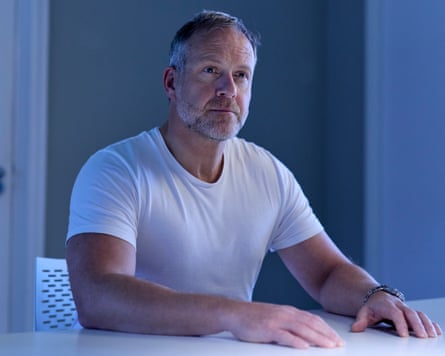
One of Wade’s responsibilities included deciding whether a proposed operation was in line with UK and international law, as the only lawyer on the deployment.
“What I found particularly difficult was that as time went on, I felt more and more responsible for what was happening on the ground,” Wade said.
Wade also conducted initial inquiries into incidents in which civilians were killed, to determine if a murder investigation by military police was required.
In one case he had to decide if a war crime had been committed after a soldier fired a warning shot into the ground in front of a car that had been driving towards a military convoy. The bullet ricocheted up, went through the engine bay, killing the driver, a woman and her three-year-old child that she was holding, Wade said.
“One round, three dead civilians, no bombs onboard, and you’ve got this young 18- or 19-year-old and the rest of the convoy really quite traumatised by it. I’m flying out to deal with this, and all of a sudden … I can feel my body now. Where do you start?” He concluded it was “a terrible, terrible mistake”.
In the years that followed Wade struggled with drink and his mental health, before being diagnosed with PTSD and ultimately being abruptly discharged from the military. Further psychiatric treatment in hospitals followed and gradually Wade’s condition has improved, helped partly by him becoming an artist.
Wade said he wanted to be able to try MDMA assisted therapy, because he believed that the trials “really offer some hope to veterans”.
He said it was his understanding that “it gives you a sense of self-love when you’re talking about difficult and ingrained experiences that have become part of a chronic condition”.
Despite many years of conventional therapies “and all my ardent and best efforts to sort of melt the symptoms away”, Wade said he had never been able to successfully eliminate “hyper-vigilance, hyper-arousal and flashbacks and nightmares.”
Wade called for more help for those struggling with PTSD. “What really irritates me is that when you are in somewhere like Afghanistan, you realise how far missiles are being used at £80,000 per warhead.
“And you think, just if the government would give each veteran that’s really struggling £80,000 worth of therapy.”