3 months ago
136
3 months ago
136
In the murky first chapters of the human story is an unknown ancestor that made the profound transition from walking on all fours to standing up tall, an act that came to define us.
The odds of stumbling on the fossilised evidence of such an evolutionary prize are slim, but in new research, scientists argue that an ape-like animal that lived in Africa 7m years ago is the best contender yet.
After a fresh analysis of bones belonging to a species called Sahelanthropus tchadensis, the researchers concluded that while it resembled an ape, its bones were adapted to walking upright, rather than moving around on all fours. It is considered the oldest known hominin, or member of the human lineage since the evolutionary split with chimpanzees.
“Based on the features we’ve found, this would have looked like a bipedal ape, most similar to a chimpanzee or bonobo,” said Dr Scott Williams, an associate professor at New York University and the lead author on the study. While chimps and bonobos can walk upright for short stretches, they are mostly knuckle-walkers.
The work is the latest in a debate that has raged since 2001, when a handful of Sahelanthropus fossils were recovered from the Djurab desert in Chad. When the finding was made public, the lead researcher on the team, Prof Michel Brunet at the University of Poitiers in France, suggested Sahelanthropus walked upright because of how it carried its head. He declared the species “the ancestor of all humankind”.
Other scientists were less convinced that Sahelanthropus belonged to the human lineage. And without more bones, particularly from the lower body, it was hard to nail down how it got around. A partial thigh bone and forearm bones from Sahelanthropus later emerged, but failed to resolve the debate: researchers still disagreed over whether or not it belonged to an upright walker.
In this latest research, Williams and his colleagues decided to re-examine the thigh and forearm bone with new techniques, comparing their size, proportion and 3D contours with bones from known hominins and apes. One feature in particular caught their eye: a bump on the Sahelanthropus thigh bone called the femoral tubercle.
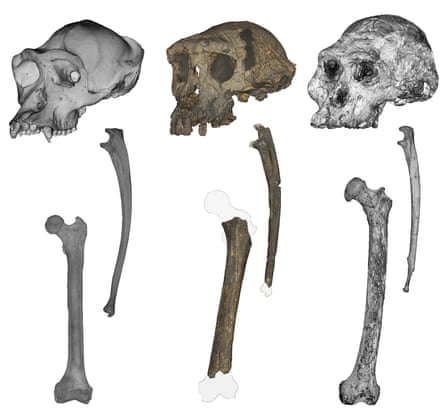
“It’s the attachment point for the largest and most powerful ligament in our bodies,” Williams said. “When we’re seated, that ligament is loose and when we stand it tightens up. It prevents your torso from falling backward or from side to side as you walk around, so it’s a really important adaptation for bipedal walking. As far as I know, this has only been identified in bipedal hominins.”
The analysis revealed further hallmarks of upright walking that other teams have spotted, such as the natural twist in the thigh bone that helps the leg point forward, and buttock muscles that keep the hips stable and aid in standing, walking and running. Details are published in Science Advances.
For Williams, the evidence points to an ape-like animal that lived around the time of the evolutionary split between humans and chimpanzees, and walked upright on the ground, if not all the time. “We think the earliest hominins were adapting to terrestrial bipedalism,” he said, “but were still relying on trees for foraging and seeking safety.”
But the case is far from closed. Dr Marine Cazenave at the Max Planck Institute for Evolutionary Anthropology in Germany, said most of the results pointed to similarities with African great apes or extinct apes, and called the evidence for upright walking “weak”. She found the femoral tubercle unconvincing too, adding that it is not directly related to upright walking and was “very faint” in a “highly damaged” region of the thigh bone.
Dr Rhianna Drummond-Clarke, at the same institute, found some of the evidence convincing, but still had questions. “More work is needed to clarify whether walking on two feet was used to walk in the trees, or to move on the ground, the latter of which is a defining feature of the human lineage,” she said. The results could equally suggest Sahelanthropus was an early chimpanzee that became less upright, and a knuckle-walker, as it evolved, she said.
Dr Guillaume Daver and Dr Franck Guy at the University of Poitiers, who have long argued that Sahelanthropus was bipedal, welcomed the new evidence, but said the debate would not be settled without more fossils, which they hope to find when the Chadian-French team return to the site this year. That appears to be something everyone agrees on. “I think it’s a case of too few fossils and too many researchers,” said Williams.