3 months ago
171
3 months ago
171
Thirty-two years ago, a small group of archaeologists gathered for a weekend in Somerset to make a TV programme about a field in Athelney, the site where once, 1,200 years ago, King Alfred the Great rallied resistance to the invading Viking army.
There weren’t many concessions to showbiz glitz. Instead, a group of blokes with unruly hair and a couple of women walked across a field, talked things over in the pub and, at one point, gathered around a dot matrix printer to watch it slowly disgorging some results. The most exciting artefact they found was a lump of iron slag. No soil was overturned.
From those unpromising beginnings, however, a TV juggernaut was born. That first episode of Time Team, screened on Channel 4 on 16 January 1994, kicked off a remarkable 20-year run of more than 200 episodes, before falling audiences and an unhappy revamp led to its eventual cancellation in 2013.
But as any archaeologist will tell you, just because something is in the past doesn’t mean it will stay buried. In 2021, at the urging of a group of devoted fans, some of the original Time Team experts gathered again to film a dig, this time to be broadcast on their own channel on YouTube.
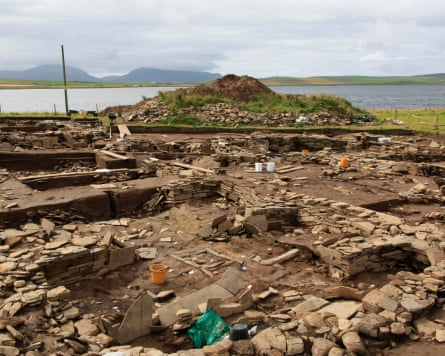
Four years on, Time Team has 350,000 subscribers on the platform, where its films regularly attract audiences of up to 2 million. More importantly for the bottom line, 16,000 people pay each month to support it on Patreon. That financial leverage means Time Team is again making archaeological waves: next summer, it will fund a new dig at the Ness of Brodgar in Orkney, after a chance discovery by the programme’s resident geophysicist John Gater suggesting “something quite extraordinary” at the Neolithic world heritage site.
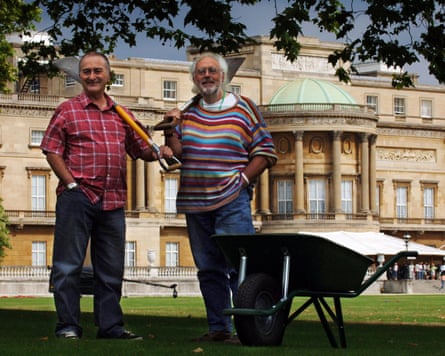
Even the original presenter, Tony Robinson, has returned for some of the films, after initially, he has admitted, being unsure how the format would work on YouTube. The programme’s renaissance has been “like one of those bulbs that you plant in the garden and forget about, and then five years later it flourishes again,” he says.
A comedy favourite by the early 90s for his work as the gormless sidekick Baldrick on Blackadder, Robinson says that he was initially offered the presenting job “because [Channel 4] were thinking, ‘This is such an arcane subject. Who should we have to present it? Clearly we should get the person who epitomises stupidity on television.’” In fact, the actor already had a keen interest in archaeology, and was a friend of Professor Mick Aston, who served as the programme’s lead archaeologist.
Carenza Lewis – a veteran of that first episode – was a twentysomething postdoc student when she was approached to take part, agreeing because “I thought it would be something I would regret if I didn’t.
“I remember turning up at the very first one we did, and Mick had decided it would be a good idea to get everyone relaxed by bringing a couple of bottles of wine. It worked – but it meant it took us forever to do the first scene.”
Lewis, now a professor at the University of Lincoln, was let go from the programme in 2005 after 12 series – “I never really got a straight explanation” – but in the long gap before she rejoined the YouTube revival, Time Team never left her. She recalls giving a paper at a conference in Moscow more than a decade after she left the programme, when she was introduced with a reference to Time Team. “And there was a murmur of appreciative recognition, in a room full of Russian archaeologists. I really didn’t expect Time Team to have even reached Russia.” About 40% of its YouTube and Patreon audience is now from outside the UK.
For Gater, also part of the original team, YouTube gives a flexibility that its previous incarnation didn’t allow. “The three-day format was brilliant, it created tension and so on,” he says. “But it became more and more expensive, and Channel 4 found it difficult to justify funding all the post-excavation work.
“The beauty of crowdfunding is our supporters recognise that it’s not just the TV programme, it’s the archaeology – and they’re supporting that. We’re going to the Ness of Brodgar for a month – we wouldn’t have been able to do that with Channel 4.” Time Team will mark New Year’s Day with a three-hour broadcast on Sutton Hoo – equally inconceivable on linear TV.
YouTube brings new challenges, too, says Emily Boulting, Time Team’s senior producer-director, who first joined the programme in 2003: persuading careful archaeologists to adopt “acceptable hyperbole” to make their videos stand out online is one. But the audience doesn’t necessarily demand flashiness – one popular new approach is a fixed camera showing uninterrupted footage from a trench excavation. “People have loved the idea of sitting with moving wallpaper – it’s a bit like watching a test match,” she says.
The programme is keen to expand – growing its supporter base, of course, but also investing in community digs and potentially a children’s strand. Brand partnerships would be very welcome, but they don’t see much advantage in teaming up with another broadcaster, says Boulting. “It’s difficult to imagine the right one at this point, because we are loving our freedom.”
That Time Team is still flourishing three decades on is “extraordinary”, says Robinson – so how does he account for its enduring appeal? “I think archaeology is like magic. This is the ground that we walk on all day, every day. And yet if you weave the right spell, you can go down into it and find something extraordinary from another time. That is stunning, isn’t it? What better thing to be reminded of than the fact that there are wonders underneath our feet?”