3 hours ago
11
3 hours ago
11
Early in a career that reaches 92 plays with The Trial of Romeo Oscar at his Scarborough home base next month, Alan Ayckbourn often spins titles from expressions: Absurd Person Singular, Relatively Speaking, Joking Apart and How the Other Half Loves, his ninth play.
In How the Other Half Loves (1969), the pun is doubled. Two couples – the Phillipses and Featherstones – envy how the well-to-do Fosters, boss Frank and wife Fiona, live. But structurally, the Phillipses and Fosters occupy half the set each, actors blanking out characters in the other house even while making phone calls to each other side by side. In the second scene, when the Featherstones – unwittingly used as adultery alibis by Mr Phillips and Mrs Foster – simultaneously attend dinner parties on consecutive nights with the other couples, the two actors in both scenes swivel their heads at tables laid across each other.
Tying with the middle act of Michael Frayn’s Noises Off as the most ingeniously crafted and reliably hilarious half hour in English farce, it started Ayckbourn’s experiments in theatrical time and space, leading to audiences seeing a cross-section of three apartments in The Things We Do for Love (1997), and House & Garden (1999) occupying two theatres simultaneously.
While the geometric cleverness in How the Other Half Loves remains fresh, other aspects date: men can’t make their own breakfast, have their clothes laid out for them by (further wordplay) “the other half” and offices were completely male. The domestic honorific “dear” has been cut. However, Ayckbourn’s policy of allowing every actor a big moment gives the wives more agency than much 1970s comedy. Even Mrs Featherstone, nicknamed “Mouse”, finally roars.
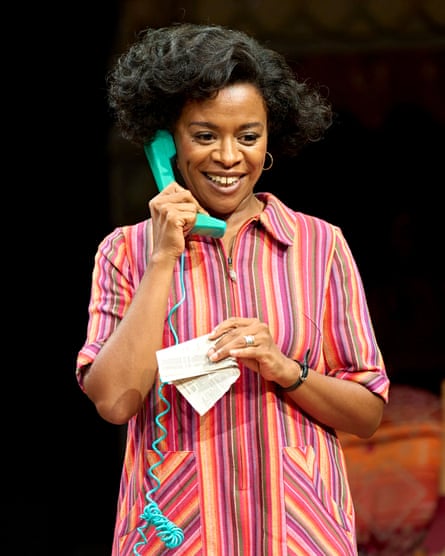
Director Philip Breen sensibly treats it as a period drama, with 1969 hits including The Boxer and Where Do You Go to My Lovely? covering scene changes. Rob Howell’s sets and costumes delight in an era where transistor radios, Trimphones and egg nog were exotic novelties, as time again has made them.
The cast of six, though, is more than half the joy, their verbal and physical humour stopping the show as surely as big numbers in musicals. Roger Allam’s Frank, managerial pomposity concealing kindness, has a magnificent scene as a hapless marital Poirot, wildly mis-summarising who was in which room with whom when. Laura Elsworthy’s Mary wins a big laugh via a feat of backstage athleticism. Ayesha Antoine’s Teresa shows how spirited acting can update an older play’s social attitudes. Ayckbourn followed this with (so far) 83 more plays but his early work can still deliver two great halves and, this London summer, a tempting sex farce double bill with Florian Zeller’s The Truth.